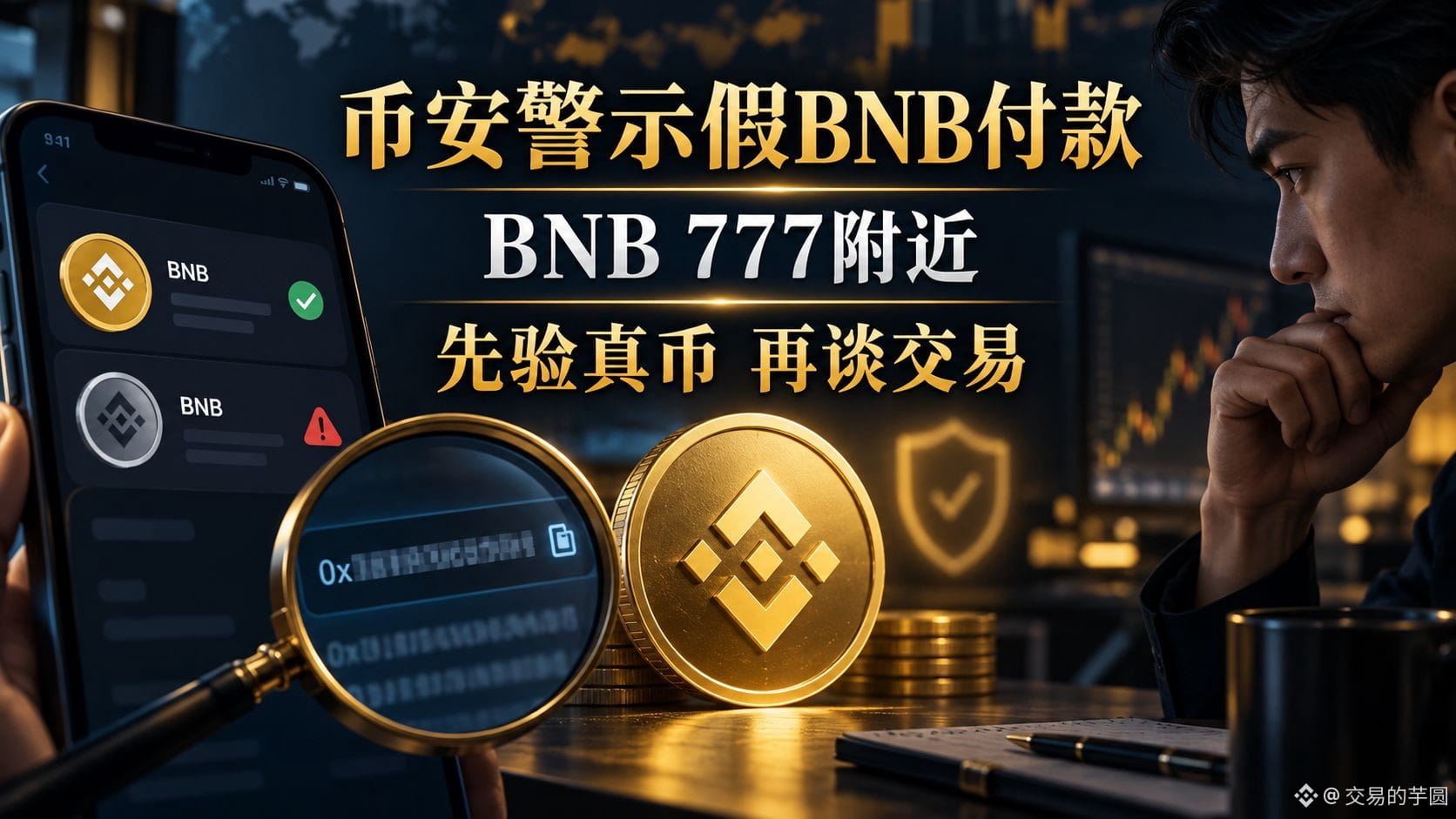
Binance Warning on Fake BNB Payments|Wallet Credits Don’t Equal Real Coins|Around 777, I will re-check first
My attitude is to protect assets first, then talk about direction. On September 24, Binance’s security blog disclosed a “fake payment” scam: the骗子 sends a token with a name, icon, and displayed price that look like a mainstream coin’s custom-built token, tricking the recipient into believing the payment has been completed. The article’s real case involved a seller handing over a TikTok account, agreed to receive 0.9 BNB, and later discovered the wallet credited a counterfeit token that cannot be properly exchanged or withdrawn. Binance’s official News account also reposted this reminder. What’s being discussed here is the risk of verifying personal incoming payments, not that the BNB mainnet was compromised, nor that Binance exchange’s BNB balances were falsified; turning this case into a “systemic security incident” would mislead trading decisions.
The mechanism is worth every on-chain payee taking seriously. Wallet UI symbols and USD valuations can be manufactured by a fake token plus a very shallow liquidity pool. If the attacker controls most of the supply, then sells into the thin pool, the quoted price can collapse quickly in appearance. Binance’s verification points include checking the network, the full contract address, the agreed amount, and whether it can truly be exchanged and withdrawn as expected. If you encounter a suspicious token, don’t click “approve,” don’t deliver goods or services first, keep the transaction hash, and verify through official support channels. In particular, distinguish native BNB from other tokens whose names merely contain “BNB”—even if they appear in your wallet, they don’t automatically carry the credibility of native coins.
This news affects BNB price indirectly: if users repeatedly fall victim to fake-coin payment, on-chain payment trust is damaged; better security education and address verification help with long-term usage. But a single case is not enough to infer the day’s selling pressure. When writing, KuCoin spot BNB/USDT is around $777.58; over the past 24 hours, the high is $785.89 and the low is $763.00, about +1.12% versus 24 hours ago. The market does not show one-sided downside attributable to this article. I won’t force news into the cause of price movement. For trading, first watch whether it can hold above the 786 area; downside to watch is 770 and 763. If a larger, verifiable event related to security emerges, or if it breaks below 763 and fails to rebound, then the current neutral view must be overturned.
If this were my own trade: I’m not participating. Directionally, I only keep a conditional plan for a small-position spot long, and I won’t touch high leverage. Only if two complete 15-minute K-lines close above $786, and the pullback holds the 780–786 range, would I try a long position with 0.3% of total capital. If $795 is hit, cut the position in half; close the rest near $806. After entry, if the 15-minute close falls back below $775, cut in half first; if it touches 770, set a full stop and close the position. If before that it breaks below 763, the entire plan is canceled immediately. In real payment scenarios, I would set up a separate process: “pre-verify it’s a real coin, then confirm on-chain settlement, and only last deliver”—that is more valuable than arguing about a $1 move on the price chart.
#BNB
The above is only personal market observation and does not constitute investment advice.
My attitude is to protect assets first, then talk about direction. On September 24, Binance’s security blog disclosed a “fake payment” scam: the骗子 sends a token with a name, icon, and displayed price that look like a mainstream coin’s custom-built token, tricking the recipient into believing the payment has been completed. The article’s real case involved a seller handing over a TikTok account, agreed to receive 0.9 BNB, and later discovered the wallet credited a counterfeit token that cannot be properly exchanged or withdrawn. Binance’s official News account also reposted this reminder. What’s being discussed here is the risk of verifying personal incoming payments, not that the BNB mainnet was compromised, nor that Binance exchange’s BNB balances were falsified; turning this case into a “systemic security incident” would mislead trading decisions.
The mechanism is worth every on-chain payee taking seriously. Wallet UI symbols and USD valuations can be manufactured by a fake token plus a very shallow liquidity pool. If the attacker controls most of the supply, then sells into the thin pool, the quoted price can collapse quickly in appearance. Binance’s verification points include checking the network, the full contract address, the agreed amount, and whether it can truly be exchanged and withdrawn as expected. If you encounter a suspicious token, don’t click “approve,” don’t deliver goods or services first, keep the transaction hash, and verify through official support channels. In particular, distinguish native BNB from other tokens whose names merely contain “BNB”—even if they appear in your wallet, they don’t automatically carry the credibility of native coins.
This news affects BNB price indirectly: if users repeatedly fall victim to fake-coin payment, on-chain payment trust is damaged; better security education and address verification help with long-term usage. But a single case is not enough to infer the day’s selling pressure. When writing, KuCoin spot BNB/USDT is around $777.58; over the past 24 hours, the high is $785.89 and the low is $763.00, about +1.12% versus 24 hours ago. The market does not show one-sided downside attributable to this article. I won’t force news into the cause of price movement. For trading, first watch whether it can hold above the 786 area; downside to watch is 770 and 763. If a larger, verifiable event related to security emerges, or if it breaks below 763 and fails to rebound, then the current neutral view must be overturned.
If this were my own trade: I’m not participating. Directionally, I only keep a conditional plan for a small-position spot long, and I won’t touch high leverage. Only if two complete 15-minute K-lines close above $786, and the pullback holds the 780–786 range, would I try a long position with 0.3% of total capital. If $795 is hit, cut the position in half; close the rest near $806. After entry, if the 15-minute close falls back below $775, cut in half first; if it touches 770, set a full stop and close the position. If before that it breaks below 763, the entire plan is canceled immediately. In real payment scenarios, I would set up a separate process: “pre-verify it’s a real coin, then confirm on-chain settlement, and only last deliver”—that is more valuable than arguing about a $1 move on the price chart.
#BNB
The above is only personal market observation and does not constitute investment advice.