


While investors were waiting for a massive and evenly distributed altseason, the market was quietly reallocating capital. The biggest attention went not to familiar giants like Ethereum, Solana, or XRP, but to assets that had only recently been in their shadow. Let’s break down which coins have moved ahead, why the market has bet on them, and whether it’s worth hopping on the train that’s already gathered speed.
Who leads the rankings?
After the rise in Bitcoin and sharp jumps of some coins on the market, people started talking about altseason again. While Bitcoin still holds dominance and the CoinMarketCap index shows only 50 points out of the 75 needed for a full-fledged rally, the recovery has already gone beyond one-off projects. Glassnode analysts note that the September surge covered far more assets than the August one, and Darkfost estimates that around 70% of altcoins on Binance are trading above their 200-day averages.
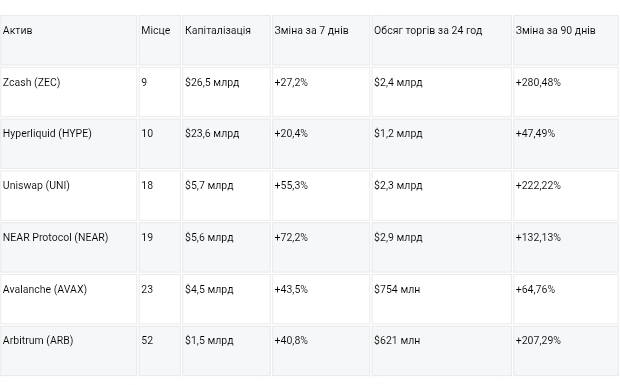
At the same time, Ethereum, Solana, XRP, and BNB have long been holding their spots among the largest cryptocurrencies and constant attention, even though lately they’ve shown only moderate momentum. On the other hand, at the top of the 90-day ranking there is PONS, launched just this summer, with gains of over 6,700%. We focused on other major coins that rose noticeably over the past months and became newsmakers thanks to events in their respective projects. Their 90-day results and the last week are shown in the table:
Zcash is back in the top 10 on the wave of interest in privacy
In early July, ZEC was about $417, and by September 23 its price exceeded $1,500. Nearly a fourfold rise in under three months returned a coin from the 2016 issue to the top ten most valuable cryptocurrencies in the world. Such a jump is hard to explain solely by the general market revival, since Zcash outpaced most competitors in the pace of recovery.
The main background for this rally was another intensification of oversight of cryptocurrency transactions by major global regulators. Against this backdrop, investors once again turned their attention to Zcash’s key technology, which enables fully anonymous transfers. According to ZecStats, protected pools on the network hold about 29% of all issued coins, indicating real usage of this feature by the market.
The coin received an additional boost thanks to public statements from leading institutional players. Bitwise’s investment director, Matt Hougan, singled out ZEC as the primary bet on privacy, and Paradigm fund co-founder Matt Huang confirmed the coin’s presence in the firm’s portfolio. At the same time, access to the asset for investors expanded through exchange-traded products. In September, an additional European exchange-traded instrument appeared from 21Shares, following the U.S. ETF ZCSH, which attracted capital starting at the end of August.
Hyperliquid combined trading growth with demand for HYPE
Although in terms of gains over 90 days, HYPE is behind Cardano and Litecoin, over a longer period the coin has shown a relatively stable upward trend. Since the end of 2024, its price has risen from a few dollars to more than $93, and HYPE itself has entered the top ten cryptocurrencies. One explanation is growth in trading on Hyperliquid. According to DefiLlama, over the past 30 days trading volume in perpetual futures on the platform reached around $225 billion, and fees totaled $77.6 million. A significant portion of this money is directed toward buying back HYPE, so traders’ activity creates demand for the token.
The platform is already moving beyond crypto trading. Thanks to HIP-3, external teams are launching futures markets on stocks, indices, and commodities, staking 500,000 HYPE for this. In September, Kraken’s parent company announced it plans to use this infrastructure for perpetual futures markets in the U.S. Launching it still requires regulatory approval, but the news added attention to the platform’s prospects.
For HYPE, there’s also the flip side of this story. The bought-back tokens don’t necessarily get burned, and new coins will enter circulation. Tokenomist lists October 6 as the date of the next unlock for team participants. So after a strong rally, investors will assess not only trading returns, but also whether demand for HYPE will be sufficient as its supply increases.
Avalanche and Arbitrum are back in focus amid the news
Avalanche and Arbitrum are well-known to many investors from previous growth waves. AVAX reached $146 in 2021, while ARB climbed to $2.40 in early 2024. Today, both tokens are worth more than 90% less than at their peak. But September brought attention back to them.
For Avalanche, the loudest reason was a statement by Ava Labs president Charlie Cooper. According to him, the New York Stock Exchange had been testing the network technology for a future platform of tokenized securities for about a year. The NYSE hasn’t yet chosen a blockchain for this project, but the collaboration itself increased interest in AVAX.
There are already deployed examples of use in Arbitrum. Robinhood built its own network using its technology, and in Arbitrum One the value of tokenized assets posted exceeded $1 billion. This helps explain the return of attention to the project, though the link to the ARB price is less direct. The token gives voting rights in the governance of Arbitrum, not a share of network fees.
Why did capital go to these particular coins
September’s leaders are united not by one technology, but by a clear reason for reassessing. In Zcash, it’s privacy, which has again become an important topic, plus access through an exchange-traded fund. In Hyperliquid, it’s a large trading volume, fees, and the buyback of HYPE. In UNI and NEAR, it’s renewed interest in sectors that had been lagging before.
However, these reasons have different strengths. When ZEC or HYPE get more expensive, you can check data on the fund, trading, fees, or token issuance. For a meme coin it’s much harder to determine what will remain after the hype dies down. That’s why the same weekly percentage increase doesn’t mean the same quality of growth.
The overall market mood also plays a role. After the unsuccessful push of the CLARITY Act and the Fed rate hike, cryptocurrencies initially came under pressure. The subsequent recovery of Bitcoin made it easier to return to riskier assets. But Bitcoin’s high dominance shows the limit of this process. As long as its share doesn’t start to fall steadily, it’s too early to talk about capital shifting to most altcoins.
What will decide the fate of the September leaders
A strong project story or a short-term surge of attention alone doesn’t guarantee further growth. During the last rally, the market has already priced in a lot of expectations: from upcoming updates and new partnerships to anticipated profits from decentralized platforms. If the next news only confirms these plans, the coin might simply not have drivers for a new surge. Any deviation from forecasts after a rapid spike can trigger a quick pullback.
The situation is complicated by the potential selling pressure from market participants who managed to get into the current leaders before the rally began. According to Glassnode, in the median altcoin, less than 25% of the supply is in profit. That means many holders of other coins are waiting for any local upswing just to get back to even and close positions. Already today, September 24, most of the assets in our selection are in the red alongside Bitcoin and other major coins. At the moment, this looks like a moderate market correction after a rise rather than a loss of interest in specific projects. But it’s during these pullbacks that it becomes clear whether buyers are willing to return at current prices.
That said, even if capital continues to grow, it doesn’t necessarily mean it will stay among the mysterious favorites. Alongside them in the 90-day ranking, Raydium grew by 248%, PUMP by 236%, and ENA by 160%. If the next strong news appears in other segments, traders’ attention could shift there. Then today’s leaders will have to compete for new buyers even without any worsening in their own results.
Beyond the crypto market’s internal mechanics, the decisive factor remains the macroeconomic backdrop. Tighter signals from central banks on interest rates, fluctuations in global liquidity, and a strengthening dollar can quickly reduce appetite for risky assets. In such a scenario, even the strongest local narratives give way to investors’ broader caution.
Therefore, the main test for the new leaders isn’t whether they can show a few more standout days on the chart. More important is whether real demand will remain in the market after the first wave of profit-taking, and whether their fundamental indicators can withstand the challenge of the overall macroeconomic environment.