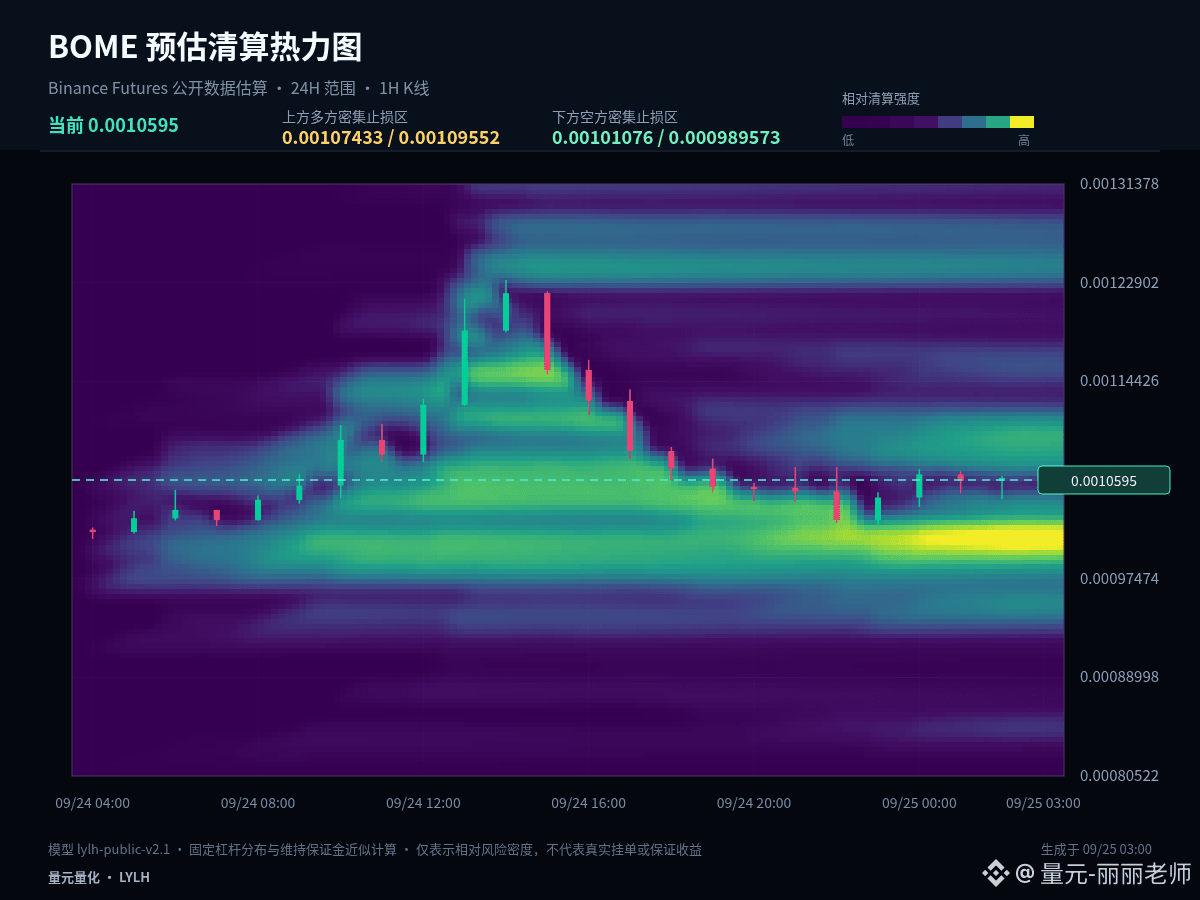
$BOME #BOME Do a structural review. Current price 0.0010609, 1 hour -0.11%, 24 hours +5.00%, and the amplitude over the last 24 hours is about 22.7%.
Currently, the 1-hour is -0.11% and the 24-hour is +5.00%. The two cycles have not formed clear alignment in the same direction. In a range-bound market, the tolerance for chasing or killing longs is low. It’s more suitable to confirm direction with the upper boundary and confirm support with the lower boundary, while the midline is only used as the line between strength and weakness.
Key levels from the review: 0.0011298 determines short-term initiative; 0.00125 is used to confirm upside room; 0.0010096 is used to observe downside defense. Going forward, there’s no need to guess each step—just check whether the original thesis still holds when price passes through these levels.
If the market matches expectations, manage profit in stages and continue raising/strengthening protection; if it doesn’t, acknowledge the change in conditions promptly. Professional trading isn’t always about being right—it’s about maintaining consistent execution after new information updates.
Position sizing needs to distinguish between spot and futures. Existing spot positions can be managed in segments around key levels without frequently flipping direction due to a single 1-hour candlestick. If you’re in cash, waiting for confirmation and then scaling in can be more comfortable. Futures place more emphasis on the entry position and invalidation conditions. When volatility amplifies, actively reduce position size to prevent short-term judgment from turning into passive holding.
Risk control is still placed before the conclusion: only execute when conditions appear; when price invalidates the setup, reassess immediately. The greater the volatility, the more you must restrain each single position. The above is a scenario projection based on the current 1-hour and 24-hour data; it does not constitute a promise of returns.
#US10YTreasuryYieldHits19YearHigh
Currently, the 1-hour is -0.11% and the 24-hour is +5.00%. The two cycles have not formed clear alignment in the same direction. In a range-bound market, the tolerance for chasing or killing longs is low. It’s more suitable to confirm direction with the upper boundary and confirm support with the lower boundary, while the midline is only used as the line between strength and weakness.
Key levels from the review: 0.0011298 determines short-term initiative; 0.00125 is used to confirm upside room; 0.0010096 is used to observe downside defense. Going forward, there’s no need to guess each step—just check whether the original thesis still holds when price passes through these levels.
If the market matches expectations, manage profit in stages and continue raising/strengthening protection; if it doesn’t, acknowledge the change in conditions promptly. Professional trading isn’t always about being right—it’s about maintaining consistent execution after new information updates.
Position sizing needs to distinguish between spot and futures. Existing spot positions can be managed in segments around key levels without frequently flipping direction due to a single 1-hour candlestick. If you’re in cash, waiting for confirmation and then scaling in can be more comfortable. Futures place more emphasis on the entry position and invalidation conditions. When volatility amplifies, actively reduce position size to prevent short-term judgment from turning into passive holding.
Risk control is still placed before the conclusion: only execute when conditions appear; when price invalidates the setup, reassess immediately. The greater the volatility, the more you must restrain each single position. The above is a scenario projection based on the current 1-hour and 24-hour data; it does not constitute a promise of returns.
#US10YTreasuryYieldHits19YearHigh