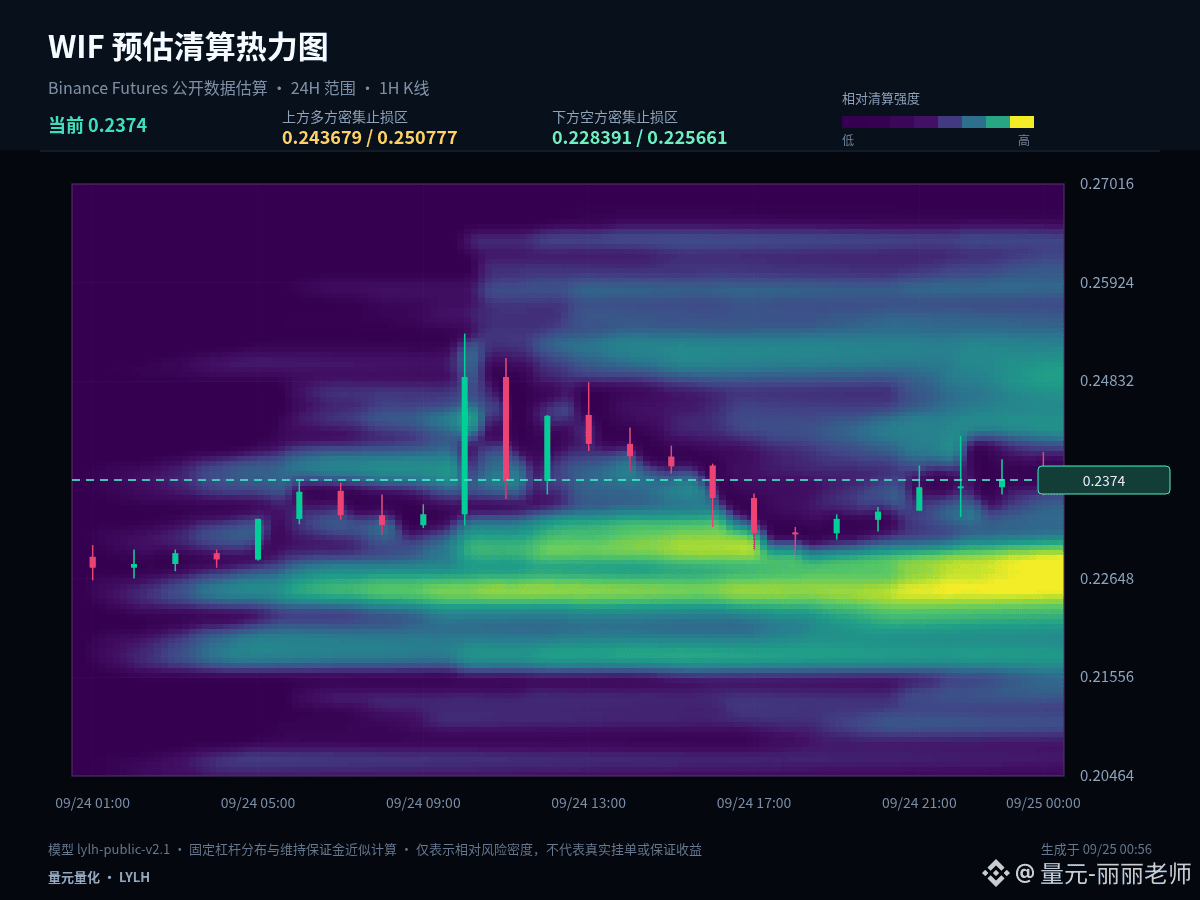
$WIF #WIF Order book record: Current price 0.2376, -0.08% in the past 1 hour, +3.94% in the past 24 hours, with an approximate 11.3% amplitude over the last 24 hours. First write down the current data and judgments; later verify with the price trend.
$WIF #WIF has not formed a clear one-directional move yet; the 1-hour and 24-hour rhythms are still tug-of-war. At this stage, focus on the boundaries of the trading range rather than the color of each individual candlestick.
For the short term, first watch whether 0.2267 can form continuous support, then see whether 0.2401 can be reclaimed again. The former determines whether the sell-off can slow down; the latter determines whether the rebound can strengthen. Until both are confirmed, it’s not advisable to judge opportunity based on drawdown alone.
For the next path, handle it in three ways: if price effectively holds and moves upward above 0.2535, wait for a pullback that does not break and then reassess for continuation; if price breaks downward below 0.2267, prioritize risk control and wait for new support; if price continues to oscillate around 0.2401, treat it as range turnover—don’t repeatedly chase the direction in the middle of the range.
When reviewing after the fact, I will check three things: how price reacts when it first approaches the key level, whether the 1-hour close completes the confirmation, and whether adjustments are made according to the plan after the judgment is invalidated. Compared with only recording outcomes, these three points reveal execution problems more effectively.
A trading plan must include invalidation conditions. When the judgment is correct, you can realize it in stages; when the judgment is wrong, you must allow yourself to exit. Don’t use averaging-in to cover up the fact that the original logic has already changed. The market will update, and your viewpoint should also adjust based on price evidence.
#USWeighsPromotingDollarStablecoinsAbroad
$WIF #WIF has not formed a clear one-directional move yet; the 1-hour and 24-hour rhythms are still tug-of-war. At this stage, focus on the boundaries of the trading range rather than the color of each individual candlestick.
For the short term, first watch whether 0.2267 can form continuous support, then see whether 0.2401 can be reclaimed again. The former determines whether the sell-off can slow down; the latter determines whether the rebound can strengthen. Until both are confirmed, it’s not advisable to judge opportunity based on drawdown alone.
For the next path, handle it in three ways: if price effectively holds and moves upward above 0.2535, wait for a pullback that does not break and then reassess for continuation; if price breaks downward below 0.2267, prioritize risk control and wait for new support; if price continues to oscillate around 0.2401, treat it as range turnover—don’t repeatedly chase the direction in the middle of the range.
When reviewing after the fact, I will check three things: how price reacts when it first approaches the key level, whether the 1-hour close completes the confirmation, and whether adjustments are made according to the plan after the judgment is invalidated. Compared with only recording outcomes, these three points reveal execution problems more effectively.
A trading plan must include invalidation conditions. When the judgment is correct, you can realize it in stages; when the judgment is wrong, you must allow yourself to exit. Don’t use averaging-in to cover up the fact that the original logic has already changed. The market will update, and your viewpoint should also adjust based on price evidence.
#USWeighsPromotingDollarStablecoinsAbroad