The Hidden Secret That’s Separating Those Who Work From Those Who Simply Accumulate Wealth in Today’s World! 🚨
Have you ever stopped to think about why, even working hard every single day, it feels like the financial peak keeps getting farther away—while others seem to just watch money grow on its own in their accounts? The answer isn’t a lack of effort, but rather an invisible mechanism that has been governing the global economy for centuries.
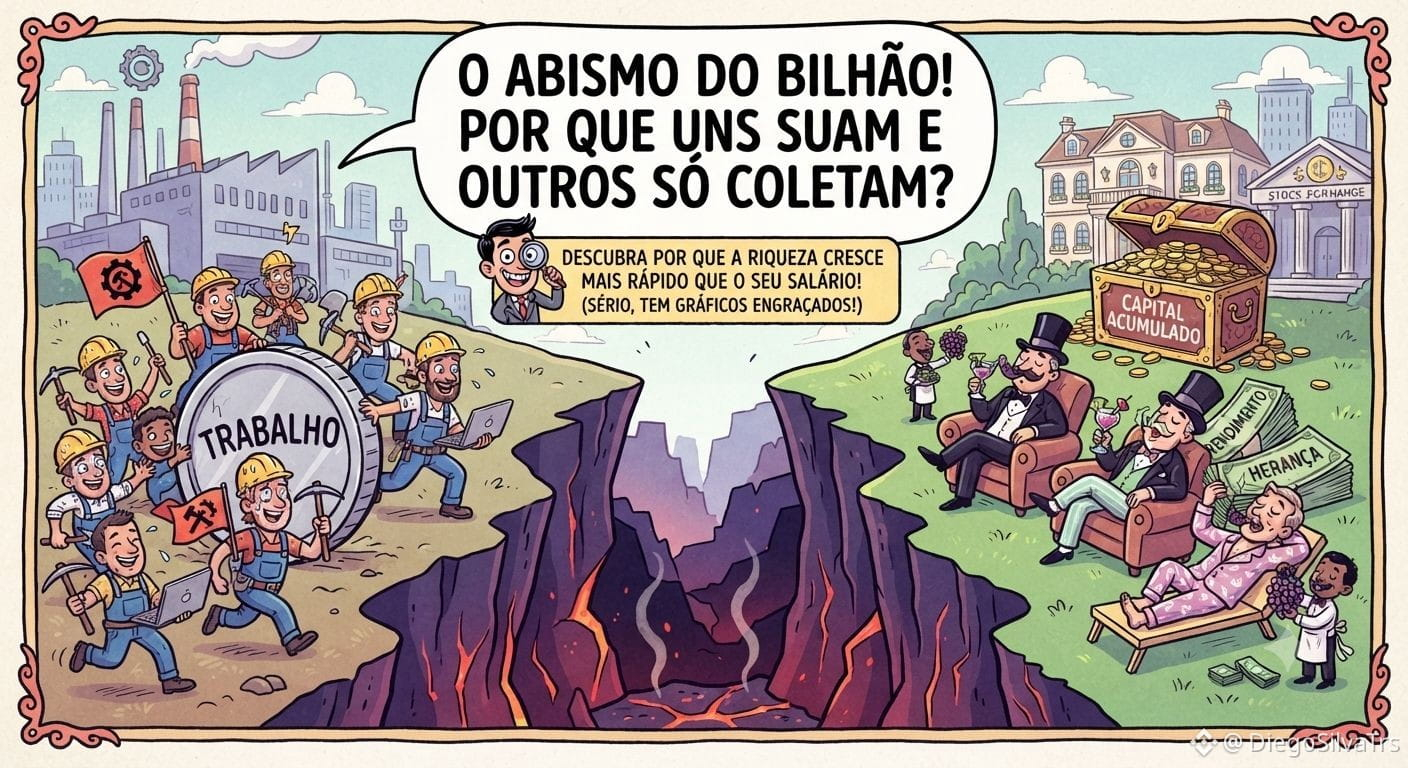
To understand this, imagine that the world runs under two different growth rules: on one side, we have the real economy—wages and the result of the daily toil of those who produce; on the other, we have the returns generated by investments, inheritances, properties, and large accumulated assets. Historically, the major revelation that shocked specialists is that the return on accumulated capital grows at a structurally faster pace than the expansion of the economy and wages. In practical terms, those who already hold large sums can make their money work and multiply far more quickly than any ordinary worker can accumulate by saving part of their monthly salary.
This dynamic creates an ruthless snowball effect: without intelligent interventions—such as fair tax policies focused on great fortunes or excessive inheritances—wealth concentration tends to become even more entrenched in the hands of a few. The system, on its own, does not distribute opportunities equally; instead, it rewards disproportionately those who already start ahead, creating a deep social divide that affects economic stability and the future of the next generations.
Understanding this cold logic of numbers is the first step to look beyond the illusions of the financial market and grasp where the global chessboard is moving. All these deep reflections, supported by centuries of historical data, were compiled and analyzed by Thomas Piketty in "Capital in the Twenty-First Century".
$BTC $PAXG $ETH
Have you ever stopped to think about why, even working hard every single day, it feels like the financial peak keeps getting farther away—while others seem to just watch money grow on its own in their accounts? The answer isn’t a lack of effort, but rather an invisible mechanism that has been governing the global economy for centuries.
To understand this, imagine that the world runs under two different growth rules: on one side, we have the real economy—wages and the result of the daily toil of those who produce; on the other, we have the returns generated by investments, inheritances, properties, and large accumulated assets. Historically, the major revelation that shocked specialists is that the return on accumulated capital grows at a structurally faster pace than the expansion of the economy and wages. In practical terms, those who already hold large sums can make their money work and multiply far more quickly than any ordinary worker can accumulate by saving part of their monthly salary.
This dynamic creates an ruthless snowball effect: without intelligent interventions—such as fair tax policies focused on great fortunes or excessive inheritances—wealth concentration tends to become even more entrenched in the hands of a few. The system, on its own, does not distribute opportunities equally; instead, it rewards disproportionately those who already start ahead, creating a deep social divide that affects economic stability and the future of the next generations.
Understanding this cold logic of numbers is the first step to look beyond the illusions of the financial market and grasp where the global chessboard is moving. All these deep reflections, supported by centuries of historical data, were compiled and analyzed by Thomas Piketty in "Capital in the Twenty-First Century".
$BTC $PAXG $ETH