Most payment standard integrations do not actually bring real settlement volume to a blockchain, yet markets treat every headline like guaranteed adoption.
Too many traders buy into protocol news with $ADA only to realize later that technical compatibility rarely translates into active liquidity. Getting trapped at local tops because of misunderstanding infrastructure announcements is one of the easiest ways to bleed capital during high-sentiment phases.
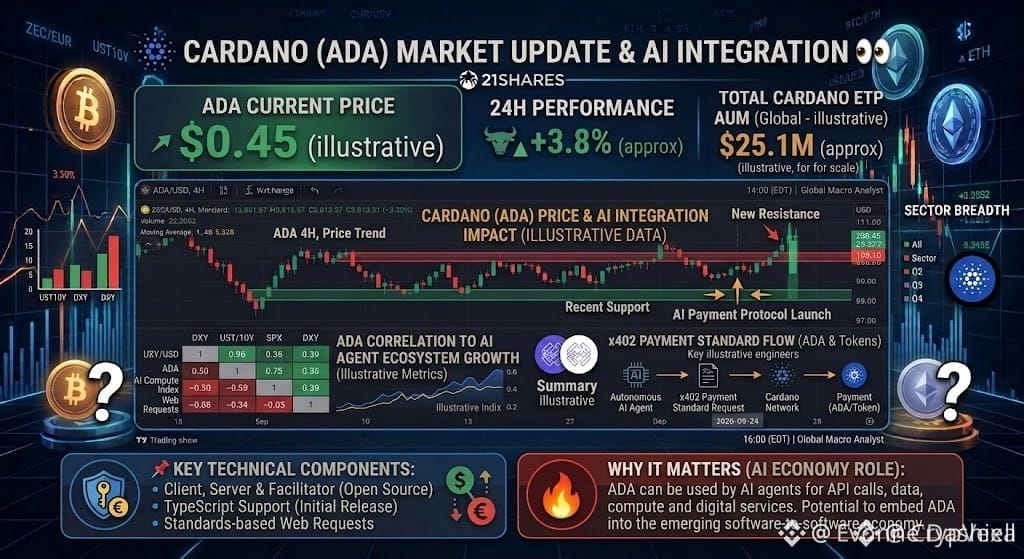
The X402 payment protocol basically creates an automated HTTP payment standard for web services, allowing direct programmatic settlement. While connecting Cardano to this standard sounds neat on paper, people forget how hard it is to incentivize real-world web APIs to route automated micropayments over a layer 1 instead of established rails using $USDT. In practice, protocols adopt standards all the time, but if developer tooling and low-friction merchant settlement are missing, the rail stays empty.
There is also the execution risk of transaction latency and state congestion when automated machine-to-machine calls scale up. When looking at how payment rails evolve across ecosystems like $NEAR , developer subsidies often dry up before everyday users even touch the feature. If volume fails to follow the technical milestone, liquidity providers end up bearing the cost of idle infrastructure.
Do you think machine-to-machine payment standards will actually drive organic on-chain volume, or is this just another speculative narrative?
#CardanoJoinsX402PaymentStandard #USWeighsPromotingDollarStablecoinsAbroad
Too many traders buy into protocol news with $ADA only to realize later that technical compatibility rarely translates into active liquidity. Getting trapped at local tops because of misunderstanding infrastructure announcements is one of the easiest ways to bleed capital during high-sentiment phases.
The X402 payment protocol basically creates an automated HTTP payment standard for web services, allowing direct programmatic settlement. While connecting Cardano to this standard sounds neat on paper, people forget how hard it is to incentivize real-world web APIs to route automated micropayments over a layer 1 instead of established rails using $USDT. In practice, protocols adopt standards all the time, but if developer tooling and low-friction merchant settlement are missing, the rail stays empty.
There is also the execution risk of transaction latency and state congestion when automated machine-to-machine calls scale up. When looking at how payment rails evolve across ecosystems like $NEAR , developer subsidies often dry up before everyday users even touch the feature. If volume fails to follow the technical milestone, liquidity providers end up bearing the cost of idle infrastructure.
Do you think machine-to-machine payment standards will actually drive organic on-chain volume, or is this just another speculative narrative?
#CardanoJoinsX402PaymentStandard #USWeighsPromotingDollarStablecoinsAbroad