ETH trading logic:
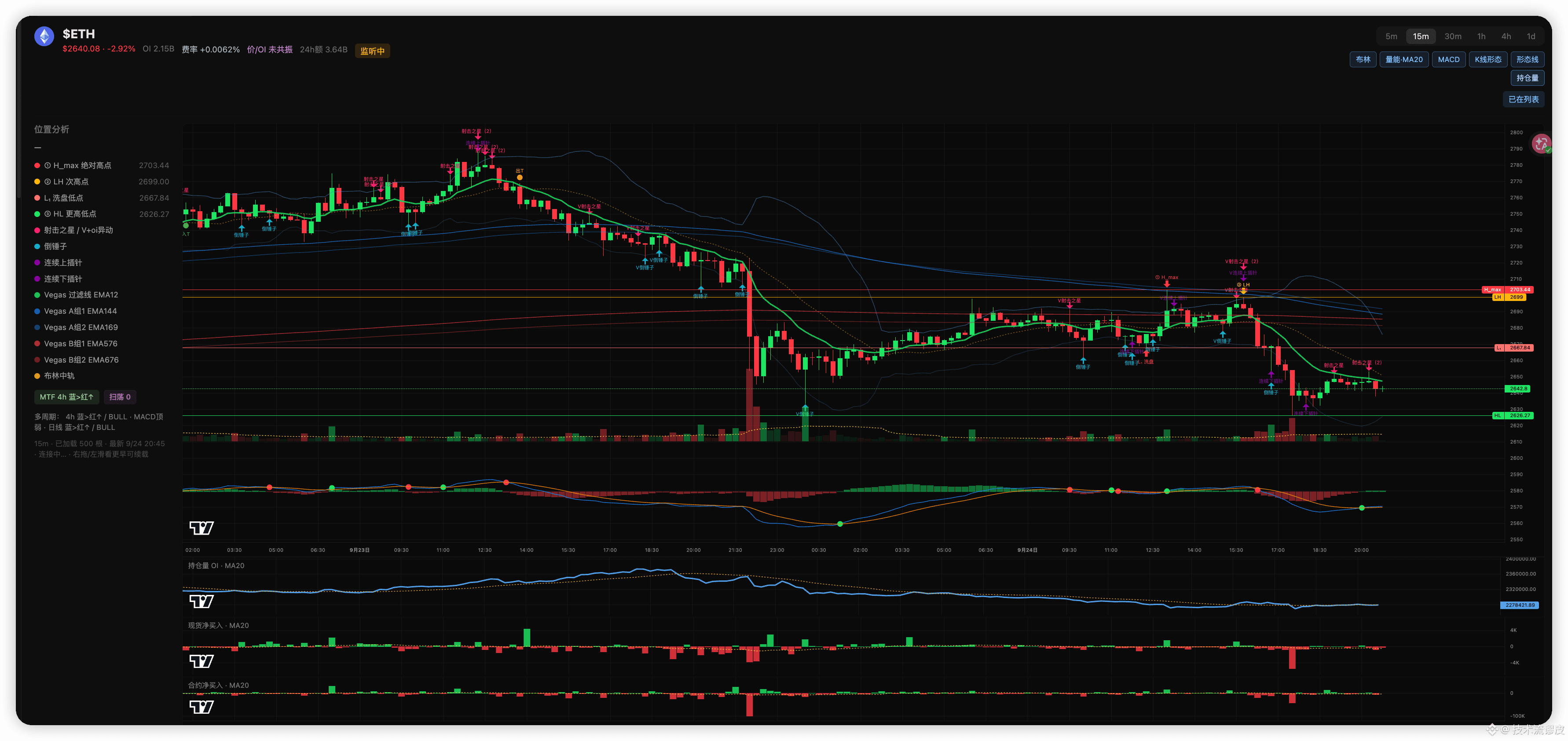
Using the current 15m chart as an example: Don’t buy at 2640.
Wait: If price drops to 2626 and prints a reversal K → go long. Stop loss 2618. Targets 2668 / 2699.
Or: If price goes up to 2668 and fails → stand aside. Stop loss 2678. Targets 2640 / 2626.
If 2626 breaks, don’t catch the falling knife—wait for a pullback. Don’t chase if it breaks above 2703; wait for a retest. Why not now?
Where is the current price? It’s at 2640 in the middle. Below it is the HL at 2626. Above it is the washout low at 2668. Even higher is 2699–2703.
You’re neither at a support area where a reversal is confirmed, nor at a resistance area where failure is confirmed—you’re in between two segments of the path.
Why does going long here have a worse stop-loss? If your stop is below 2626 (2618), the room is about 22 points.
First target 2668—about 28 points. The risk-reward ratio is barely 1:1.3; fees and slippage eat up the difference.
There’s also overhead: moving averages, the old low at 2668, and the pressure left by the large bearish candle from last night. The first leg could be capped.
After that big bearish candle in the night session, the move is a repair, not a new trend. OI is still trending downward, which doesn’t look like someone is urgently opening longs at 2640.
Why does shorting here also have poor reward? It just bounced up from the low; you’re shorting halfway up. Then your stop-loss can only be awkwardly placed (2668 or 2703). Either it’s too close and you get swept, or it’s too far and you lose a chunk.
The target at 2626 is only around ten-odd points—doesn’t justify it.
There’s no sustained increase in net selling for spot/futures, so the short setup isn’t aligning both “position + momentum” at the same time.
The reason to wait for 2626 / 2668 is that those two lines are already validated structures:
2626 is a higher low; only when price falls to here does the long thesis hold. The stop is short and the target only becomes long enough when aiming for 2668.
2668 is prior-low resistance. Only if price goes up and fails there does the short thesis hold. The stop is short, and below it you have two layers of meat at 2640 and 2626.
Same direction—but if you choose a different location, risk is smaller and room is larger. Entering now means you’re paying with a worse price for an idea the market hasn’t fully confirmed yet.
Using the current 15m chart as an example: Don’t buy at 2640.
Wait: If price drops to 2626 and prints a reversal K → go long. Stop loss 2618. Targets 2668 / 2699.
Or: If price goes up to 2668 and fails → stand aside. Stop loss 2678. Targets 2640 / 2626.
If 2626 breaks, don’t catch the falling knife—wait for a pullback. Don’t chase if it breaks above 2703; wait for a retest. Why not now?
Where is the current price? It’s at 2640 in the middle. Below it is the HL at 2626. Above it is the washout low at 2668. Even higher is 2699–2703.
You’re neither at a support area where a reversal is confirmed, nor at a resistance area where failure is confirmed—you’re in between two segments of the path.
Why does going long here have a worse stop-loss? If your stop is below 2626 (2618), the room is about 22 points.
First target 2668—about 28 points. The risk-reward ratio is barely 1:1.3; fees and slippage eat up the difference.
There’s also overhead: moving averages, the old low at 2668, and the pressure left by the large bearish candle from last night. The first leg could be capped.
After that big bearish candle in the night session, the move is a repair, not a new trend. OI is still trending downward, which doesn’t look like someone is urgently opening longs at 2640.
Why does shorting here also have poor reward? It just bounced up from the low; you’re shorting halfway up. Then your stop-loss can only be awkwardly placed (2668 or 2703). Either it’s too close and you get swept, or it’s too far and you lose a chunk.
The target at 2626 is only around ten-odd points—doesn’t justify it.
There’s no sustained increase in net selling for spot/futures, so the short setup isn’t aligning both “position + momentum” at the same time.
The reason to wait for 2626 / 2668 is that those two lines are already validated structures:
2626 is a higher low; only when price falls to here does the long thesis hold. The stop is short and the target only becomes long enough when aiming for 2668.
2668 is prior-low resistance. Only if price goes up and fails there does the short thesis hold. The stop is short, and below it you have two layers of meat at 2640 and 2626.
Same direction—but if you choose a different location, risk is smaller and room is larger. Entering now means you’re paying with a worse price for an idea the market hasn’t fully confirmed yet.