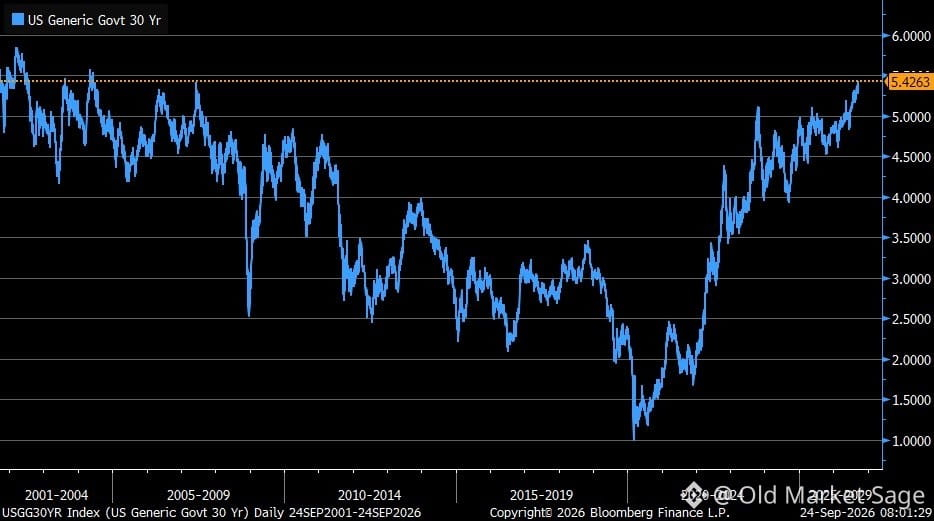
30-year Treasury yield just hit its highest level since 2004.
That's two decades of context washing away in real time. We spent years in a world where free money felt normal, where yields near zero seemed permanent, where "there is no alternative" justified every valuation stretch.
Now the cost of long-term capital is back to pre-crisis levels. That changes everything—how we value growth stocks, how we think about housing affordability, how governments finance deficits, how pension funds meet obligations.
Markets got comfortable in a low-rate regime. Muscle memory formed around cheap money. But rates don't care about comfort. They reflect reality: inflation expectations, fiscal concerns, supply and demand for credit.
This isn't just a data point. It's a regime shift playing out in slow motion. And most people won't adjust their mental models until it's already too late.
That's two decades of context washing away in real time. We spent years in a world where free money felt normal, where yields near zero seemed permanent, where "there is no alternative" justified every valuation stretch.
Now the cost of long-term capital is back to pre-crisis levels. That changes everything—how we value growth stocks, how we think about housing affordability, how governments finance deficits, how pension funds meet obligations.
Markets got comfortable in a low-rate regime. Muscle memory formed around cheap money. But rates don't care about comfort. They reflect reality: inflation expectations, fiscal concerns, supply and demand for credit.
This isn't just a data point. It's a regime shift playing out in slow motion. And most people won't adjust their mental models until it's already too late.