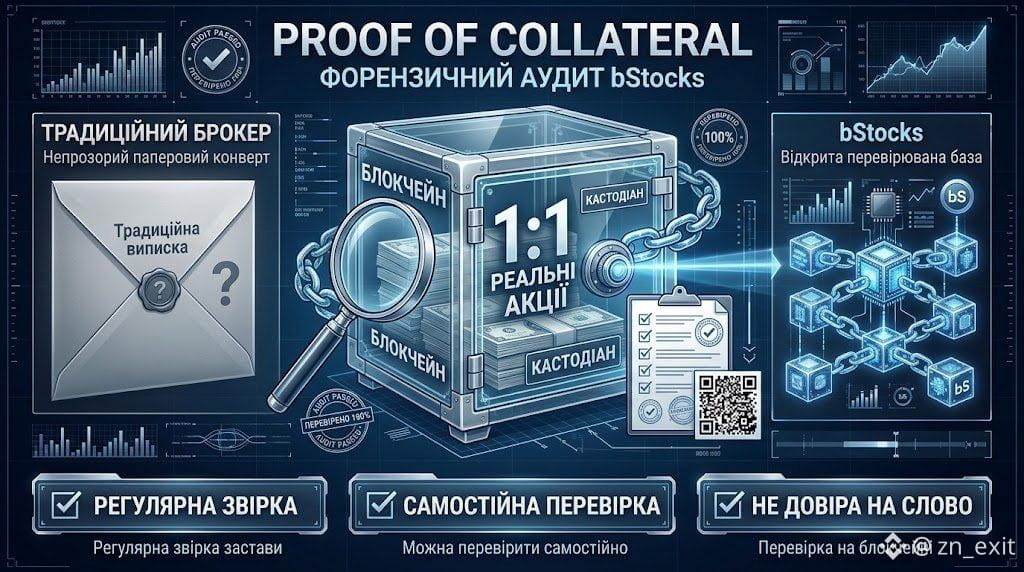
#binancesquare Questions worth asking yourself in advance, not after you’ve already invested: what really guarantees that the amount of bStocks in circulation matches the actual shares held in custody? 🔍
The answer isn’t just “trust me”—it’s a specific proof-of-collateral mechanism: a regularly published reconciliation that, in theory, anyone can verify on their own, not only the company behind closed doors. This is fundamentally different from a typical broker statement, where the user effectively trusts the number on the screen with no independent way to verify it themselves. 🛡️
This doesn’t mean the risk is, in principle, zero—the issuer’s risk, the custodian’s risk, and regulatory risks remain very real separate categories that you should always keep in mind. But the assurance/verification mechanism here is set up differently than in the traditional model, and you should understand it as a distinct technical product characteristic—not just a nice marketing line from a presentation. 📄
Verifying everything yourself is a completely useful practice: open the data, find the source, and figure out exactly what’s being reconciled.
Have you ever verified the proof-of-collateral data yourself?
@Binance_Ukraine
The answer isn’t just “trust me”—it’s a specific proof-of-collateral mechanism: a regularly published reconciliation that, in theory, anyone can verify on their own, not only the company behind closed doors. This is fundamentally different from a typical broker statement, where the user effectively trusts the number on the screen with no independent way to verify it themselves. 🛡️
This doesn’t mean the risk is, in principle, zero—the issuer’s risk, the custodian’s risk, and regulatory risks remain very real separate categories that you should always keep in mind. But the assurance/verification mechanism here is set up differently than in the traditional model, and you should understand it as a distinct technical product characteristic—not just a nice marketing line from a presentation. 📄
Verifying everything yourself is a completely useful practice: open the data, find the source, and figure out exactly what’s being reconciled.
Have you ever verified the proof-of-collateral data yourself?
@Binance_Ukraine