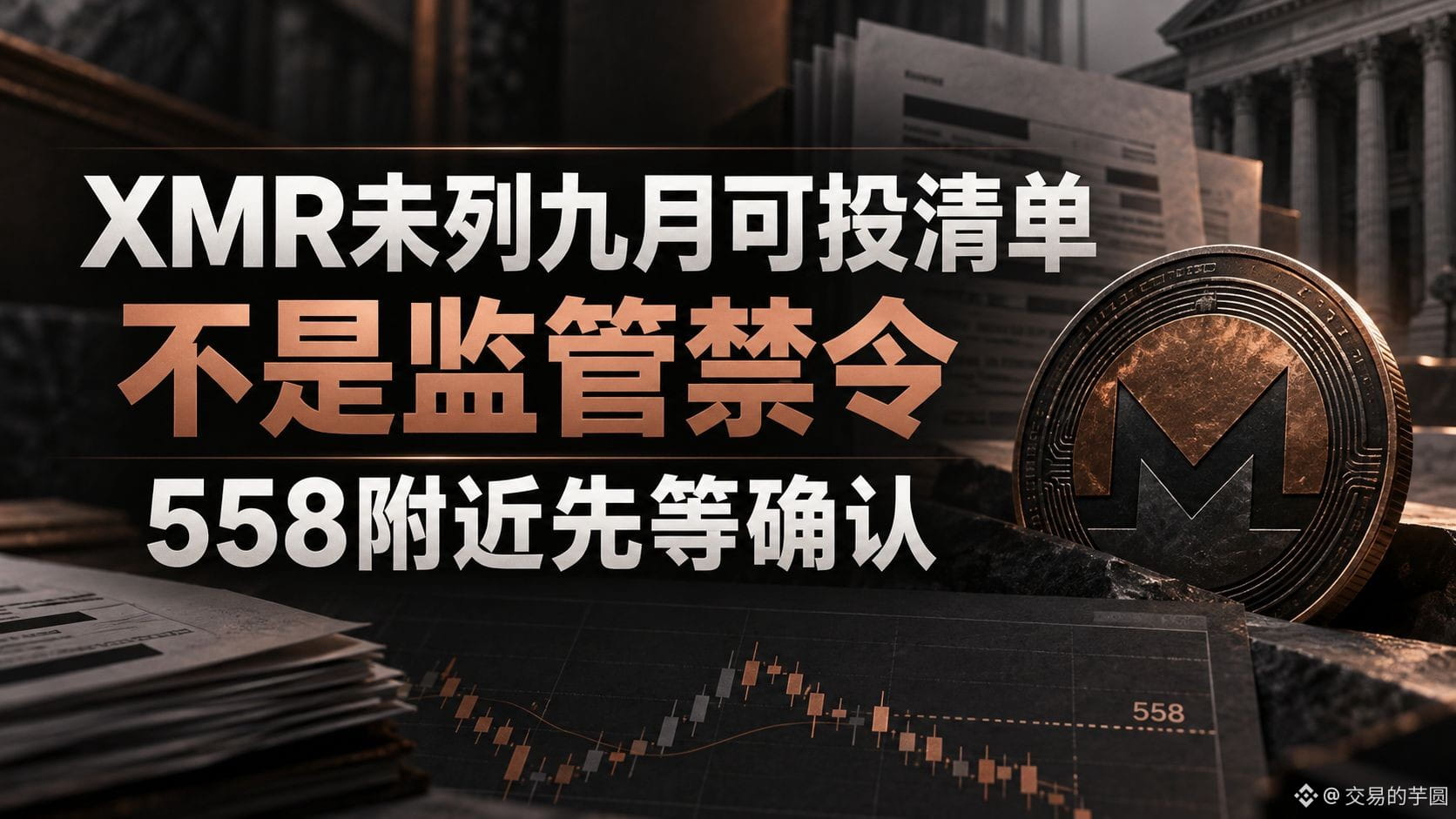
XMR not on the September fund list | Not the same as a regulatory ban | Around 558, I’ll wait
My attitude is cautious, not turning a single fund document into a comprehensive negative for XMR. Binance Square Trending Topics are still about BNB, ETH, and so on. The Most Searched “Rapid Riser” is ZEC, with no directly pointing-to-XMR new hot list. I also checked Binance News, Research, and official OTC accounts, as well as the central bank macro materials, SEC regulations, ETF and institutional fund flows, Strategy holdings, exchange safety, the Monero project, and exchange announcements. I found no first-hand report today of any new regulatory ban or mainnet incident affecting XMR, so I’m not hopping on unrelated trending tags.
But an already published institutional document is worth using to calibrate expectations. The SEC filing for T. Rowe Price Active Crypto ETF—an amendment to the prospectus submitted on September 9—lists the tradable coins that the manager at the time deemed eligible. It includes ZEC, BNB, and others, but not XMR. That’s the list from September 9, not a new rule issued just today. The document also states that the fund may add other eligible assets not listed, and it will inform shareholders on the fund’s website. Therefore, “not appearing on this list” only indicates that at that time the fund disclosed an eligible set that did not include XMR; it cannot be used to conclude that the U.S. prohibits institutions from holding XMR, and it certainly cannot be used to conclude that all funds can never allocate to it. Also, the list isn’t actual portfolio positions—you can’t treat “ZEC being on the list” as “already bought.”
For trading, this distinction matters. For institutional money to flow into a coin, it typically has to clear several gates at least: product eligibility, custody, trading execution, and internal risk controls. Qualification at the document level is only one gate—it’s not the same as spot net inflow. My inference on XMR is: without a new verifiable fund document or an issuer’s holdings disclosure, relying on “privacy-sector rotation” to claim institutional buying still lacks evidence. Monero’s privacy attributes may increase the complexity of some products’ operational and compliance assessments, but that’s a mechanism-based inference—not the official reason why the fund didn’t list XMR. You can’t automatically infer that XMR will receive allocations just because ZEC’s search heat is rising.
The market also hasn’t provided a one-sided confirmation. Around 16:30 Beijing time, I checked KuCoin’s public XMR/USDT spot price—about $558.34. Over the past 24 hours: high $572.4, low $542.88, change about -1.44%. The price is in the middle of the intraday range: neither breaking below the low nor reclaiming the high. I can’t attribute this volatility to the document from two weeks ago. For the short term, I’m watching whether 552—558 can form support and continuation. Resistance at 565 and 572.4 are levels that need to be reclaimed step by step. If it breaks below 542.88 and the rebound cannot return to 552, then my cautious bullish bias observation would be invalidated. If it regains 565 and holds, then only afterward would I consider that it’s just range consolidation turning stronger.
If I were trading it myself: I wouldn’t enter now. I’d only pre-set a small-position spot long, at most 0.3% of total capital, no leverage. Entry requires two complete 15-minute candlesticks closing above 565, and then on the pullback 560—565 must hold without breaking and the price must turn back up; if those conditions aren’t triggered, I keep 0 position. After triggering, the first target is around 572: cut the position in half there. The second target is 578—582 to close the remaining position. If, after entry, a 15-minute close returns below 558, then cut the position in half first. An effective break below 552 means a full stop-loss. If it breaks below 543 first, the original plan is immediately canceled; I won’t change the message to “add at lower prices.” Keeping the position small is to preserve optionality when both document and price signals aren’t strong, not to predict the next candlestick.
#XMR #ZEC
The above is for personal market observation only and does not constitute investment advice.
My attitude is cautious, not turning a single fund document into a comprehensive negative for XMR. Binance Square Trending Topics are still about BNB, ETH, and so on. The Most Searched “Rapid Riser” is ZEC, with no directly pointing-to-XMR new hot list. I also checked Binance News, Research, and official OTC accounts, as well as the central bank macro materials, SEC regulations, ETF and institutional fund flows, Strategy holdings, exchange safety, the Monero project, and exchange announcements. I found no first-hand report today of any new regulatory ban or mainnet incident affecting XMR, so I’m not hopping on unrelated trending tags.
But an already published institutional document is worth using to calibrate expectations. The SEC filing for T. Rowe Price Active Crypto ETF—an amendment to the prospectus submitted on September 9—lists the tradable coins that the manager at the time deemed eligible. It includes ZEC, BNB, and others, but not XMR. That’s the list from September 9, not a new rule issued just today. The document also states that the fund may add other eligible assets not listed, and it will inform shareholders on the fund’s website. Therefore, “not appearing on this list” only indicates that at that time the fund disclosed an eligible set that did not include XMR; it cannot be used to conclude that the U.S. prohibits institutions from holding XMR, and it certainly cannot be used to conclude that all funds can never allocate to it. Also, the list isn’t actual portfolio positions—you can’t treat “ZEC being on the list” as “already bought.”
For trading, this distinction matters. For institutional money to flow into a coin, it typically has to clear several gates at least: product eligibility, custody, trading execution, and internal risk controls. Qualification at the document level is only one gate—it’s not the same as spot net inflow. My inference on XMR is: without a new verifiable fund document or an issuer’s holdings disclosure, relying on “privacy-sector rotation” to claim institutional buying still lacks evidence. Monero’s privacy attributes may increase the complexity of some products’ operational and compliance assessments, but that’s a mechanism-based inference—not the official reason why the fund didn’t list XMR. You can’t automatically infer that XMR will receive allocations just because ZEC’s search heat is rising.
The market also hasn’t provided a one-sided confirmation. Around 16:30 Beijing time, I checked KuCoin’s public XMR/USDT spot price—about $558.34. Over the past 24 hours: high $572.4, low $542.88, change about -1.44%. The price is in the middle of the intraday range: neither breaking below the low nor reclaiming the high. I can’t attribute this volatility to the document from two weeks ago. For the short term, I’m watching whether 552—558 can form support and continuation. Resistance at 565 and 572.4 are levels that need to be reclaimed step by step. If it breaks below 542.88 and the rebound cannot return to 552, then my cautious bullish bias observation would be invalidated. If it regains 565 and holds, then only afterward would I consider that it’s just range consolidation turning stronger.
If I were trading it myself: I wouldn’t enter now. I’d only pre-set a small-position spot long, at most 0.3% of total capital, no leverage. Entry requires two complete 15-minute candlesticks closing above 565, and then on the pullback 560—565 must hold without breaking and the price must turn back up; if those conditions aren’t triggered, I keep 0 position. After triggering, the first target is around 572: cut the position in half there. The second target is 578—582 to close the remaining position. If, after entry, a 15-minute close returns below 558, then cut the position in half first. An effective break below 552 means a full stop-loss. If it breaks below 543 first, the original plan is immediately canceled; I won’t change the message to “add at lower prices.” Keeping the position small is to preserve optionality when both document and price signals aren’t strong, not to predict the next candlestick.
#XMR #ZEC
The above is for personal market observation only and does not constitute investment advice.