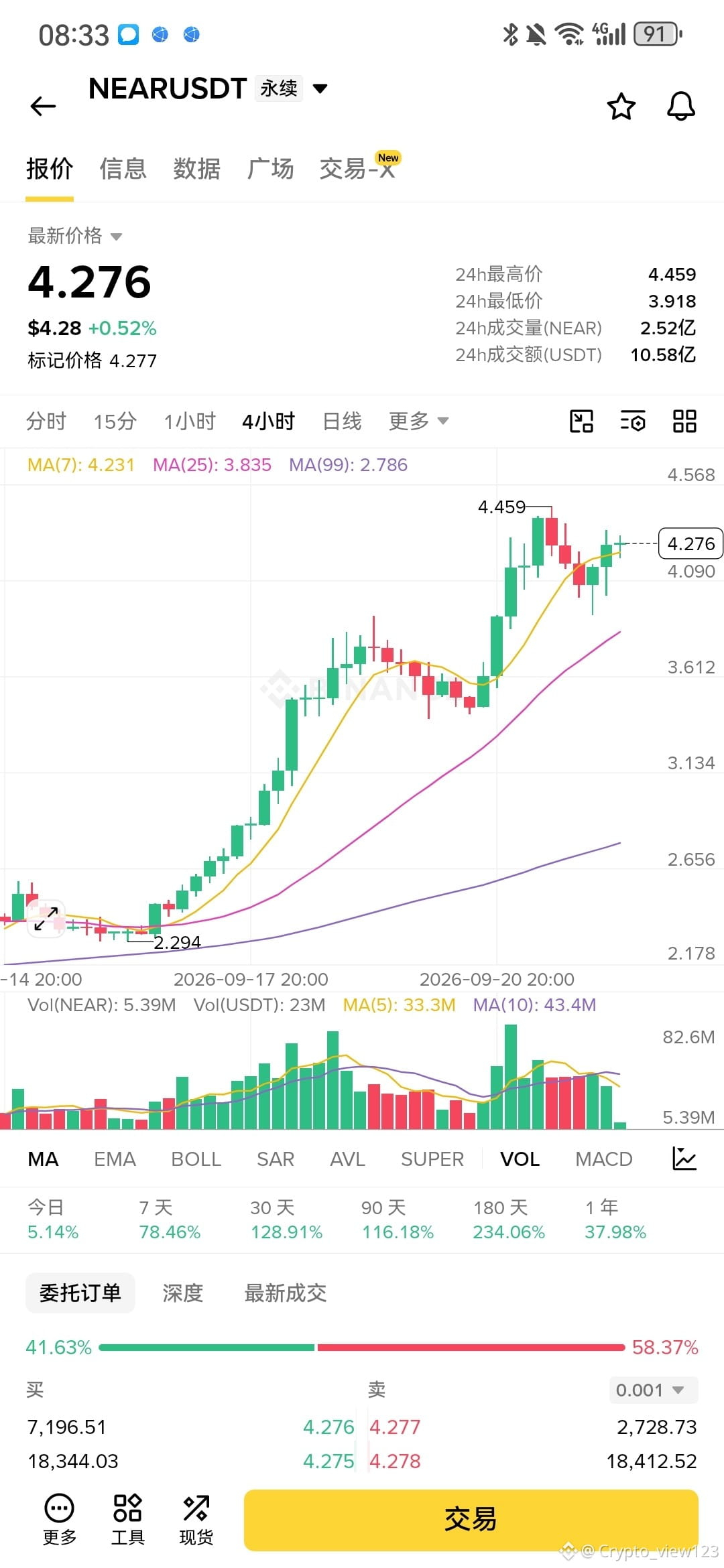
#NEAR up nearly 80% in a week
NEAR is up nearly 80% over the past week. Most people only look at that number and miss the even tougher one next to it: the intended transaction volume is already approaching $30 billion.📊
In public-chain markets, usually the price moves first and volume fills in gradually. This time the order is reversed.
What “intended transaction volume” means is that users specify the desired outcome—cross-chain routing, swapping, finding the cheapest path—while the system handles the steps in between. Users don’t have to watch every step themselves. This kind of volume is the hardest to fake because it has to be produced repeatedly through real usage scenarios.
A move like “up 80% in a week” inherently carries expectations of a pullback. People who chase in usually think it can still run for a bit longer.
If the volume can reach the $30 billion scale, it means someone is genuinely using it—not just buying and holding while waiting for it to go up.
Price is only the result; volume is the cause. Conversely, if this volume was manufactured by subsidy burn, it would ebb alongside the price. After price makes its circuit, it turns around. Volume is what remains on-chain—once it drops, you have to slowly rebuild it again.
So what really matters in this move is whether this volume can hold. In the coming week, you only need to watch one number: whether the intended transaction volume has fallen back to its original level.🔗
NEAR is up nearly 80% over the past week. Most people only look at that number and miss the even tougher one next to it: the intended transaction volume is already approaching $30 billion.📊
In public-chain markets, usually the price moves first and volume fills in gradually. This time the order is reversed.
What “intended transaction volume” means is that users specify the desired outcome—cross-chain routing, swapping, finding the cheapest path—while the system handles the steps in between. Users don’t have to watch every step themselves. This kind of volume is the hardest to fake because it has to be produced repeatedly through real usage scenarios.
A move like “up 80% in a week” inherently carries expectations of a pullback. People who chase in usually think it can still run for a bit longer.
If the volume can reach the $30 billion scale, it means someone is genuinely using it—not just buying and holding while waiting for it to go up.
Price is only the result; volume is the cause. Conversely, if this volume was manufactured by subsidy burn, it would ebb alongside the price. After price makes its circuit, it turns around. Volume is what remains on-chain—once it drops, you have to slowly rebuild it again.
So what really matters in this move is whether this volume can hold. In the coming week, you only need to watch one number: whether the intended transaction volume has fallen back to its original level.🔗