

The ice-breaking moment in regulatory history
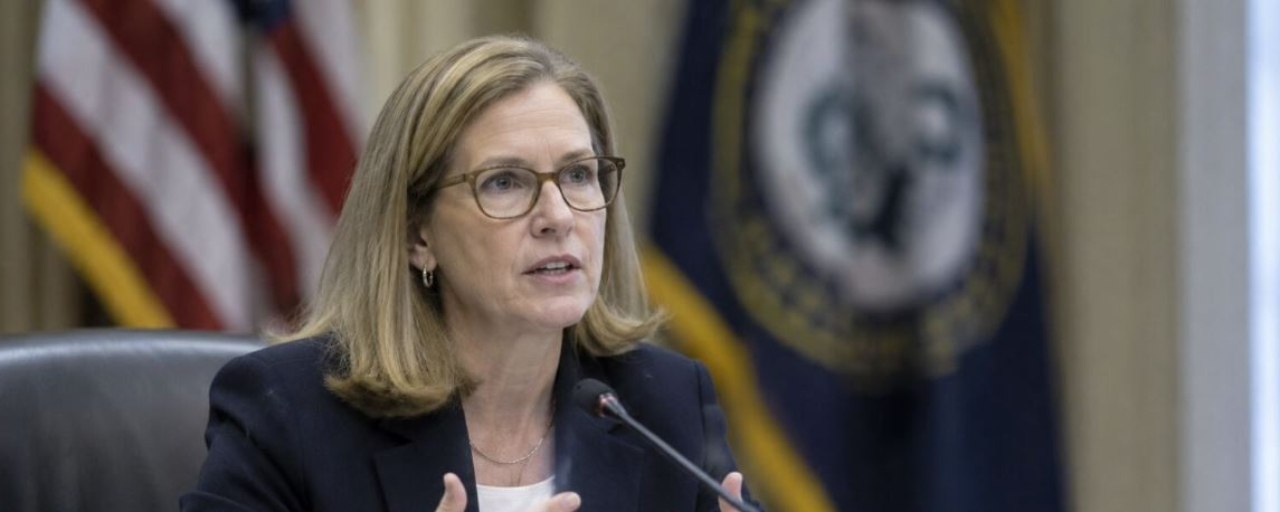
For the first time, the U.S. Commodity Futures Trading Commission (CFTC) has greenlit crypto perpetual contracts. This historic reform has completely broken the long-standing regulatory deadlock faced by cryptocurrencies.
The CFTC’s approval signifies that the crypto derivatives market has been officially brought under the U.S. federal legal framework. It not only paves the way for institutional capital, but also fully aligns traditional finance with Web3.
Regulation moves from ambiguity to clarity
In the eyes of U.S. regulators, perpetual contracts were long considered swap products with unclear boundaries, which led local exchanges such as Coinbase and Kraken to hesitate to enter due to compliance risks.
Moreover, the futures-proof innovation regulatory plan recently rolled out by the CFTC clearly defines perpetual contracts that meet certain conditions as futures contracts under the Commodity Exchange Act, providing a legal and clear development path for U.S. domestic institutions.
Is geopolitics really the driving force?
At the beginning of 2026, when the Iran war broke out, global financial markets were thrown into turmoil. Stocks, precious metals, and other commodities often surged and plunged wildly during weekends and non-trading hours, leaving investors worldwide in distress.
This kind of extreme market volatility highlights the lag of traditional finance. A large number of traders seeking to hedge are forced to flood into the Web3 world to use perpetual contracts for hedging, which has also made regulators recognize the urgent need for 24/7 trading mechanisms.
A strategic battle over pricing power
The U.S. regulators’ conservative stance toward perpetual contracts has caused massive trading volumes and liquidity to concentrate mainly in non-U.S. exchanges and decentralized exchanges. As a result, the U.S. government has not been able to capture any advantage in this space.
With the CFTC’s action at this time, there is no doubt that it is telling the whole world: the massive derivatives trading capital must return to the U.S. domestic market, and the U.S. must have a say in the perpetual contracts space.
What compliance incentives exactly has the CFTC released?
The policy “combo” issued by the CFTC has released unprecedented institutional regulatory dividends for the crypto derivatives market, fully opening up a two-track system of compliance running in parallel between the domestic and offshore sides.
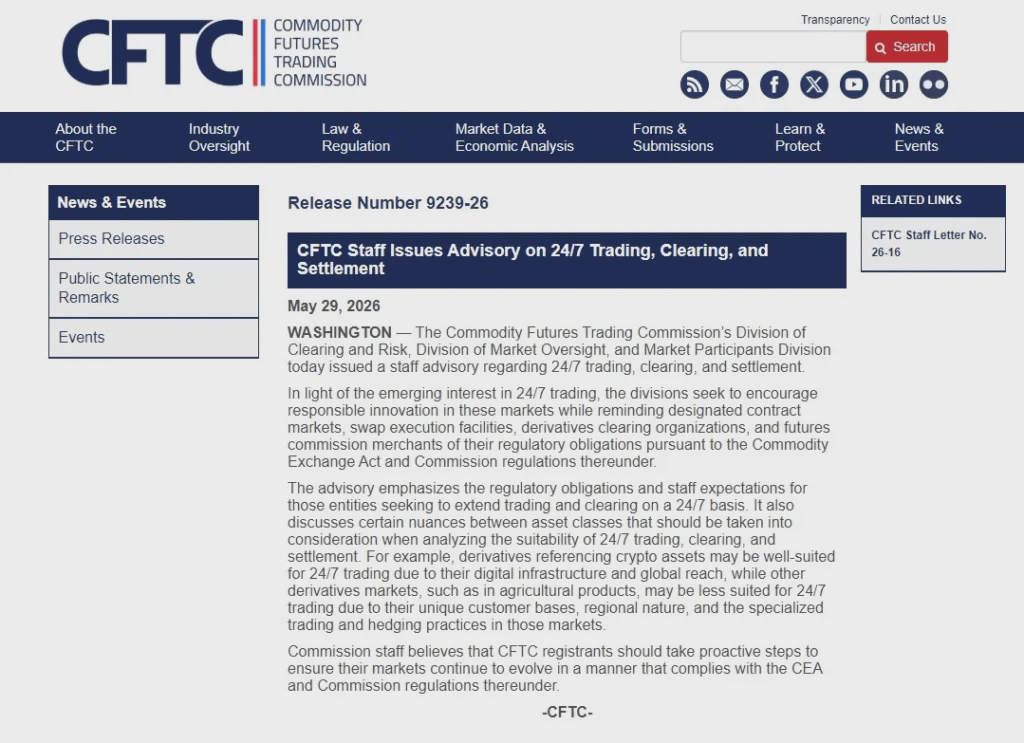
Through specific employee guidance, regulators have greenlit an innovative homegrown product—laying the groundwork for 24/7 financial operations in advance. In the first wave, exchanges are set to experience explosive growth, provided there is a clear trail of the early benefits.
The world’s first-ever 24/7 clearing
In response to the feature of crypto currency perpetual contracts never closing, multiple departments under the CFTC jointly released guidance on 7*24-hour trading and clearing employees.
The above guidance is mainly aimed at providing direction on real-time market monitoring, system security defenses, and margin requirements for weekends and public holidays, offering very specific—yet practical and easy for exchanges to implement—standards for everyday compliance responsibilities.
Prediction market transition exchange
The prediction market platform Kalshi is set to become one of the first direct beneficiaries of this policy. The cash-settled bitcoin perpetual contracts launched on its platform have officially received official approval and been listed for trading.
This regulatory dividend breaks the previous monopoly in which only CME could issue crypto derivatives, creating a precedent in which a new digital asset platform directly transforms into a compliant derivatives exchange.
High-quality liquidity flows legally into the United States
After the CFTC issued the No-Action Letter, Coinbase, as the largest homegrown compliant exchange, is undoubtedly one of the biggest beneficiaries—second only to Kalshi.
This approval allows Coinbase to, through its acquisition of the Dubai derivatives exchange Derbit, legally enable U.S.-based customers to directly open and trade overseas crypto perpetual contracts, successfully and safely connecting mature, deep liquidity with funds from within the United States.
Who are the losers? How will the money flow?
With a clearer path to compliance, it is foreseeable that the global crypto derivatives market will undergo a reorganization of capital.
This liquidity battle led by U.S. regulation will not only affect existing exchanges, but may also completely disrupt regulatory attitudes in countries around the world in the future.
Offshore exchanges have a chance to be hit
The exchanges that have long monopolized global perpetual contracts, as well as PerpDEX—which has become a market focus in 2026—could both be harmed in this wave of turmoil.
As U.S. domestic capital gains a legal and direct trading channel, the capital that previously flowed overseas through various grey channels to evade regulation may very well withdraw on a large scale—thereby continuously harming exchange volumes and liquidity.
Arbitrage opportunities are slim
In terms of capital flow, once perpetual contracts are legalized within the United States, it can be confirmed that a large amount of capital will flow into this area. As for what the incoming funds will be used for, it could include trading, hedging, arbitrage, and so on.
And among the focus points: funding rates may well be what these whales see as the juicy target—after all, as long as there is an error in the mechanism’s anchor, there is an opportunity to exploit arbitrage operations using funding.
This report is for information sharing purposes only. The content does not constitute any form of investment advice or decision-making basis. The data, analyses, and viewpoints cited in the text are all based on the author’s research and public sources, and may involve uncertainty or changes at any time. Readers should make investment judgments prudently based on their own circumstances and risk tolerance. If further guidance is needed, it is recommended to seek professional advisory opinions.