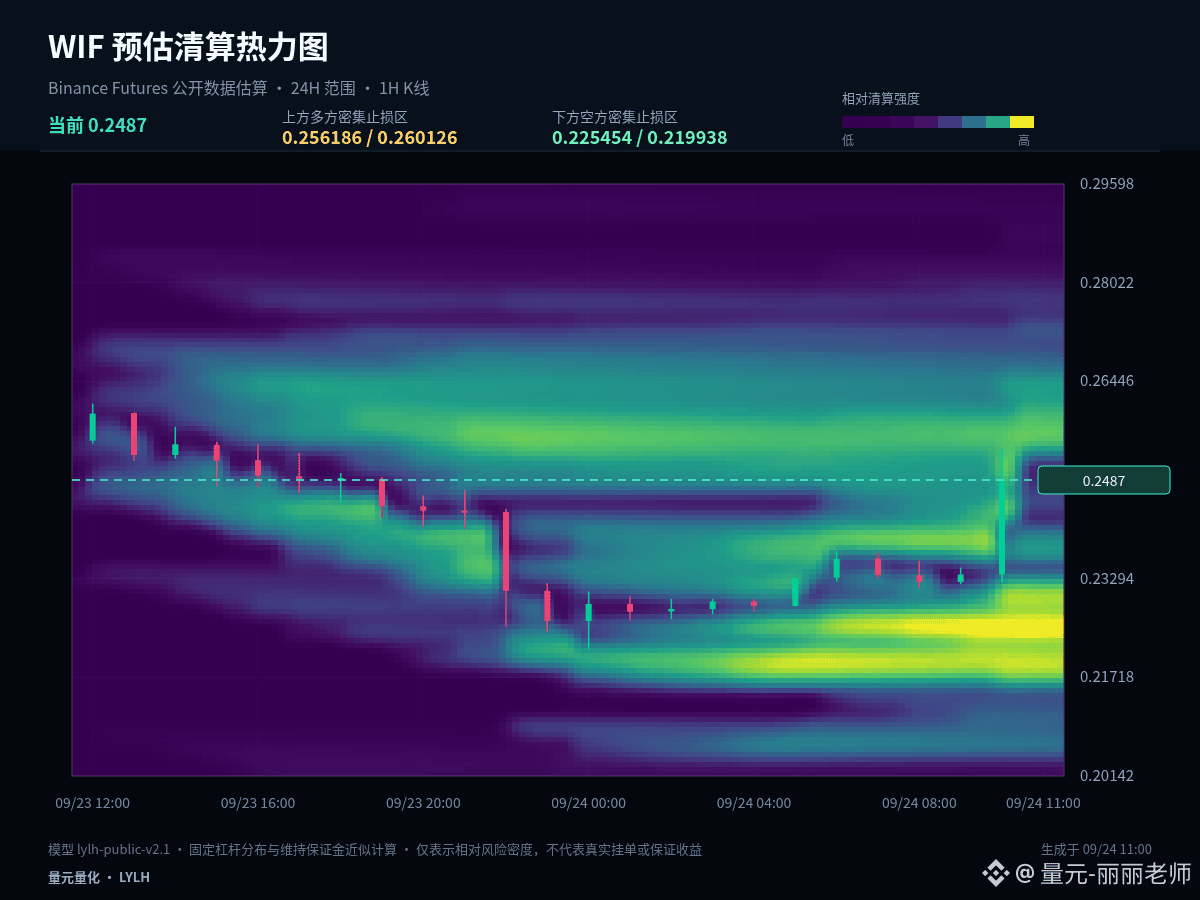
$WIF #WIF If we only keep one observation price for this round, I would choose 0.2414. Current price is 0.2488: 1 hour -0.08%, 24 hours -1.54%. The gains/losses around the mid-axis can help filter out a lot of intraday noise.
The price has not yet recovered 0.2414. For now, treat the current rebound as a weak repair; genuine strength will rely on a stable close as proof. If it turns weaker again, 0.2217 is the next level to watch to see whether the sell pressure is fading.
Current 1 hour -0.08%, 24 hours -1.54%. Across these two cycles, there hasn’t been sufficiently clear alignment in the same direction. In a range-bound market, the tolerance for chasing or killing positions is lower. It’s better to confirm the direction with the upper boundary and confirm support/absorption with the lower boundary. The mid-axis should only be used as the line separating strength from weakness.
The next path can be handled in three ways: if price effectively holds and stands above 0.2611, wait for a pullback that doesn’t break and then reassess whether the move can continue; if price breaks down below 0.2217, prioritize risk control and wait for new support; if it keeps oscillating around 0.2414, treat it as range rotation and don’t repeatedly chase direction from the middle.
On positioning, you need to differentiate spot holdings from futures/contracts. If you already have spot, manage it in segments around key levels, and don’t switch direction frequently based on a single 1-hour candle. Staying flat and waiting for confirmation, then scaling in more calmly, is also an option. Contracts care more about the entry location and invalidation conditions. When volatility increases, proactively reduce position size to avoid turning short-term judgment into passive holding.
The market will ultimately validate your thesis with price. Do you think the most critical right now is a breakout above 0.2611, or the defense of 0.2217? Let’s track the results together.
#US10YTreasuryYieldHits19YearHigh
The price has not yet recovered 0.2414. For now, treat the current rebound as a weak repair; genuine strength will rely on a stable close as proof. If it turns weaker again, 0.2217 is the next level to watch to see whether the sell pressure is fading.
Current 1 hour -0.08%, 24 hours -1.54%. Across these two cycles, there hasn’t been sufficiently clear alignment in the same direction. In a range-bound market, the tolerance for chasing or killing positions is lower. It’s better to confirm the direction with the upper boundary and confirm support/absorption with the lower boundary. The mid-axis should only be used as the line separating strength from weakness.
The next path can be handled in three ways: if price effectively holds and stands above 0.2611, wait for a pullback that doesn’t break and then reassess whether the move can continue; if price breaks down below 0.2217, prioritize risk control and wait for new support; if it keeps oscillating around 0.2414, treat it as range rotation and don’t repeatedly chase direction from the middle.
On positioning, you need to differentiate spot holdings from futures/contracts. If you already have spot, manage it in segments around key levels, and don’t switch direction frequently based on a single 1-hour candle. Staying flat and waiting for confirmation, then scaling in more calmly, is also an option. Contracts care more about the entry location and invalidation conditions. When volatility increases, proactively reduce position size to avoid turning short-term judgment into passive holding.
The market will ultimately validate your thesis with price. Do you think the most critical right now is a breakout above 0.2611, or the defense of 0.2217? Let’s track the results together.
#US10YTreasuryYieldHits19YearHigh