


Today I was communicating with a client who needs to build a DeFi project, and I encountered a common misconception that almost every Web3 startup team falls into.
At the time, we had already finalized the DApp development timeline, the customization plan, and the overall quote. When we discussed the launch and maintenance process, we mentioned the monthly server costs. The client immediately raised a question: “Since it’s a decentralized DApp, why do we still have to rent a server every month? Isn’t that effectively centralized? Is decentralization just a marketing gimmick?”
I fully understand this question. Most project teams’ understanding of decentralization stays at “completely getting rid of servers, zero maintenance, and no ongoing operating costs.” But after delivering and executing hundreds of overseas projects in practice, I can be blunt: a decentralized DApp that’s suitable for commercial use and can run stably over the long term can’t—nor should it—be completely detached from servers. Conversely, any development service provider that promises “pure decentralization, no servers required, and zero ongoing costs” is basically using concept packaging to mislead customers. What they deliver is essentially an incomplete demo that can’t be audited and is difficult to maintain—something that simply can’t support a real production launch and ongoing operations.
Many projects fall into pitfalls. The root cause isn’t technical difficulty—it’s that the project team from the very beginning confuses on-chain decentralization business logic with off-chain deployment infrastructure. Based on first-line deployment experience today, we’ll make this blind spot clear: help teams preparing to build DeFi, staking, and chain-game DApps avoid hidden traps and stay away from various kinds of invisible fees.
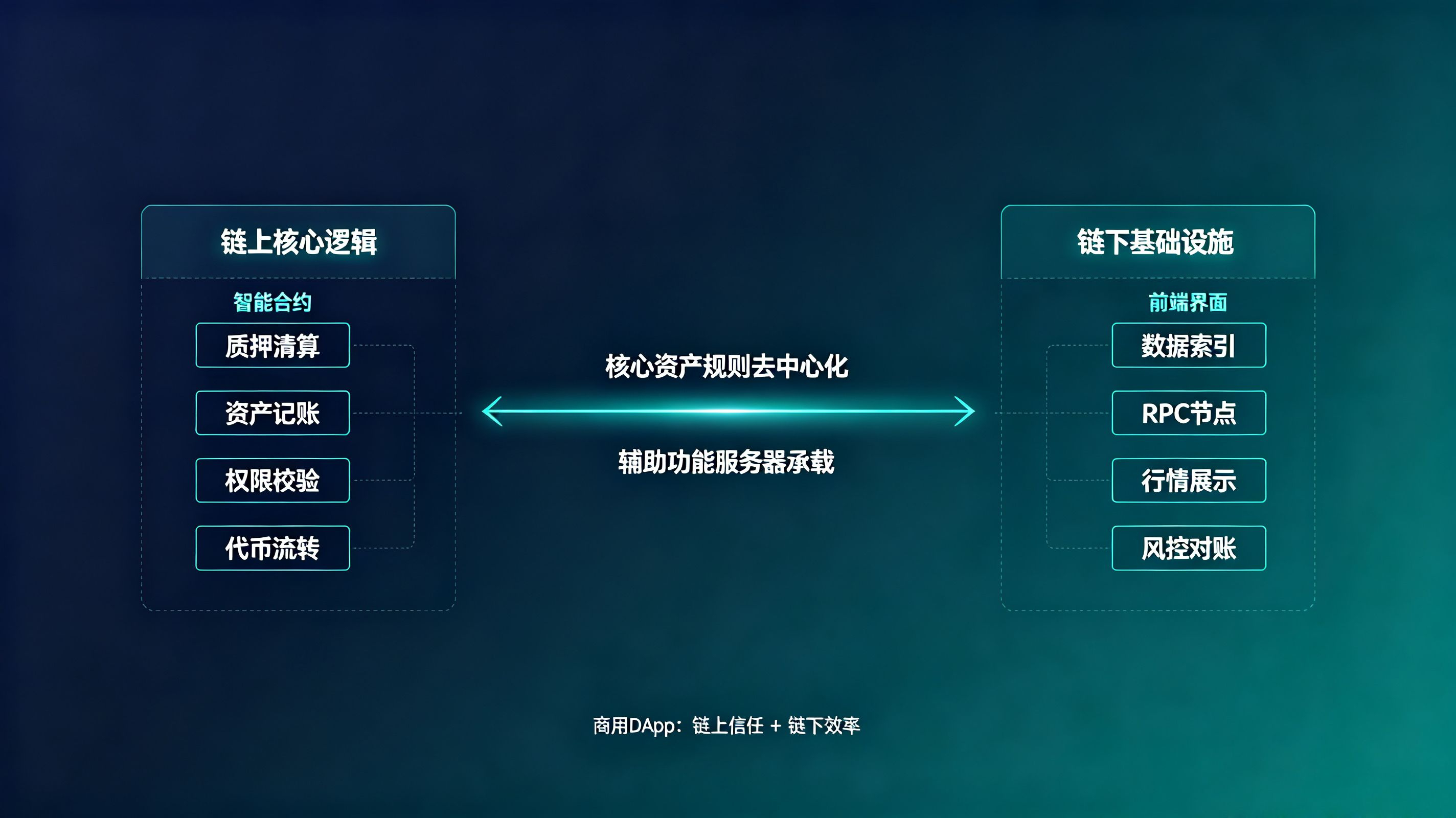
First, clarify the core definition: DApp decentralization means the core asset logic is decentralized, not that you don’t need a server at all.
Commercial DApps naturally split into two major modules: on-chain and off-chain, with clear division of responsibilities—both are indispensable. Core rules that directly relate to user asset safety, such as staking, borrowing and lending, trading and settlement, asset accounting, permission verification, and token transfers, are deployed in blockchain smart contracts. They are jointly recorded and endorsed by nodes across the network, and are not controlled by a single backend or a single server. This is also the most critical advantage of DApps over traditional Web2 products: it solves the trust problem at the foundation.
However, most of the interaction features that users encounter in daily use don’t need to be—and aren’t suitable to be—fully deployed on-chain. Server-side support is required for things like the web front-end interface, user interaction pages, on-chain data indexing, market data display, transaction logs, links to RPC nodes, static image resources, backend risk-control management, and data reconciliation and statistics.
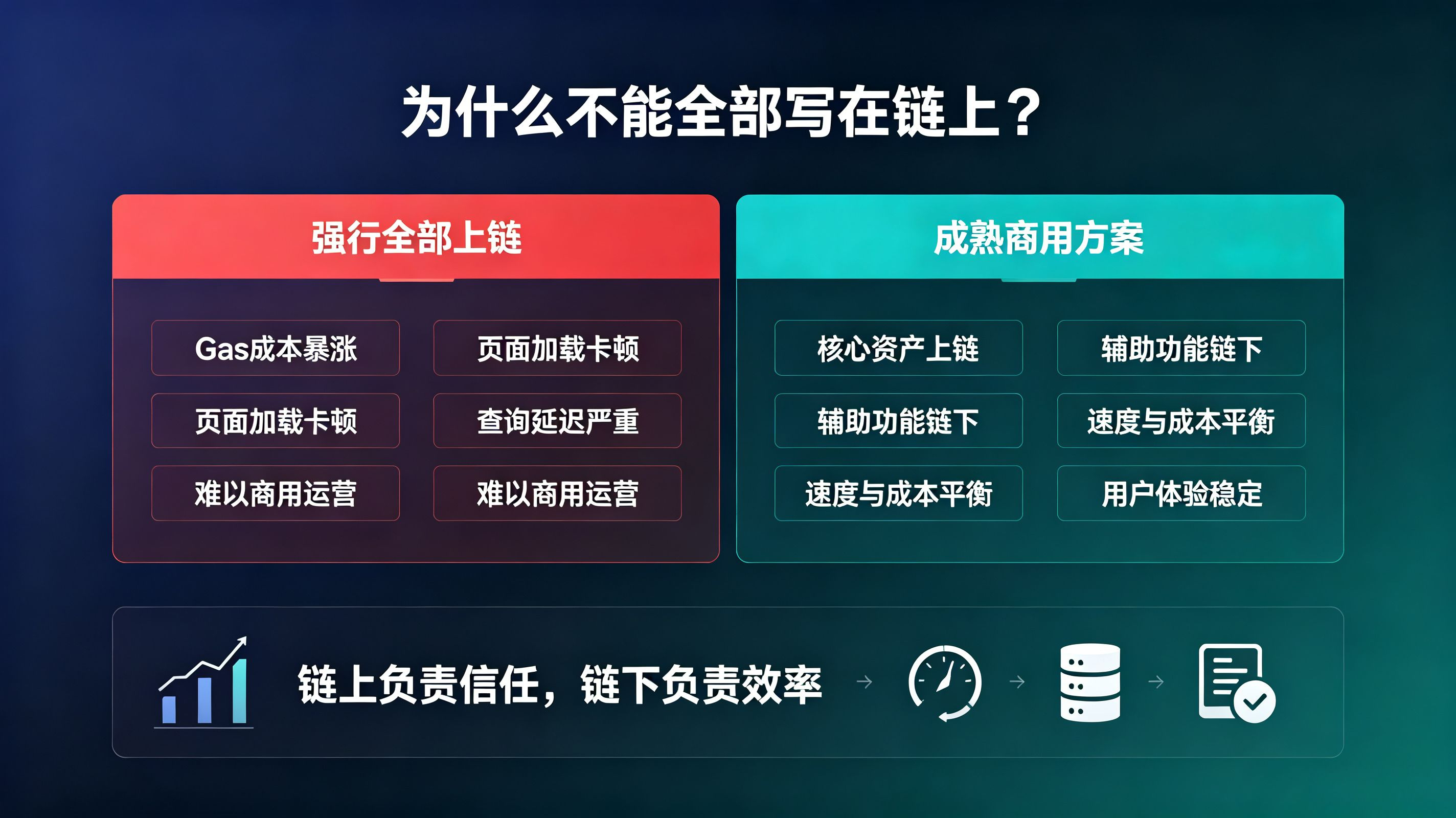
Many project owners ask: Why can’t everything be written into smart contracts? The practical answer from real-world experience is very realistic: on-chain computation is expensive, response speed is slow, and on-chain storage costs are extremely high. It’s not suitable for high-frequency queries or page-display type functionality. If you force all pages and complete business data to be deployed on-chain, Gas fees will rise exponentially, users will experience page loading lag, and data query latency will be severe—far from commercial standards. The standard solution for mature Web3 deployment is to implement core asset logic on-chain for decentralization, while auxiliary display functions are hosted off-chain on servers.
Another common misconception: many project teams think a one-time development quote includes a lifetime of servers and maintenance services. Let’s clarify this plainly: DApp development fees are a one-time investment. They cover contract development, architecture design, system customization, and deployment going live. Meanwhile, servers, domain names, RPC nodes, databases, and operations monitoring are infrastructure costs that continue to occur after the project goes live. These costs are independent from the development fees.
This logic is similar to renovating a physical store: the renovation is a one-time investment, while rent and utilities are long-term operating costs. The technical team builds the entire DApp system that can be put into practice, but as the project continues to provide external access, data hosting, and stable services, it inevitably needs server support. Server costs also aren’t a fixed high price—they can scale elastically with the project’s size: in the early stage, with fewer users, a low-spec server can run stably; later, as traffic and transaction volume increase, you can expand on demand without generating wasted budgets.
What project teams truly need to be wary of isn’t the server rental itself, but the lack of transparency from the development team. Many outsourcing deals only quote a total development price and deliberately conceal the ongoing costs for servers, RPC, and operations and maintenance. After the project goes live, costs are then added step by step. Or, the system architecture is unreasonable: functions that shouldn’t be on-chain are forced onto contracts, causing Gas waste; non-core modules are over-engineered, driving up server expenses.
Professional DApp tailored development ensures full transparency from the initial communication phase: which logic is deployed on-chain, which functionalities are deployed off-chain, what each server is used for, configuration standards, and the division of responsibilities for operations and maintenance—everything is clearly explained in advance to eliminate any “gotcha” tactics.
To wrap up: decentralization means decentralizing the asset trading rules, not making the underlying infrastructure meaningless. When professional Web3 projects are deployed, they focus on an architecture that’s appropriately balanced and clearly distinguishes public and private concerns—not on empty talk of pseudo-decentralization.