
GM, #学堂日报 9.24 Market Snapshot
1️⃣ Market Overview
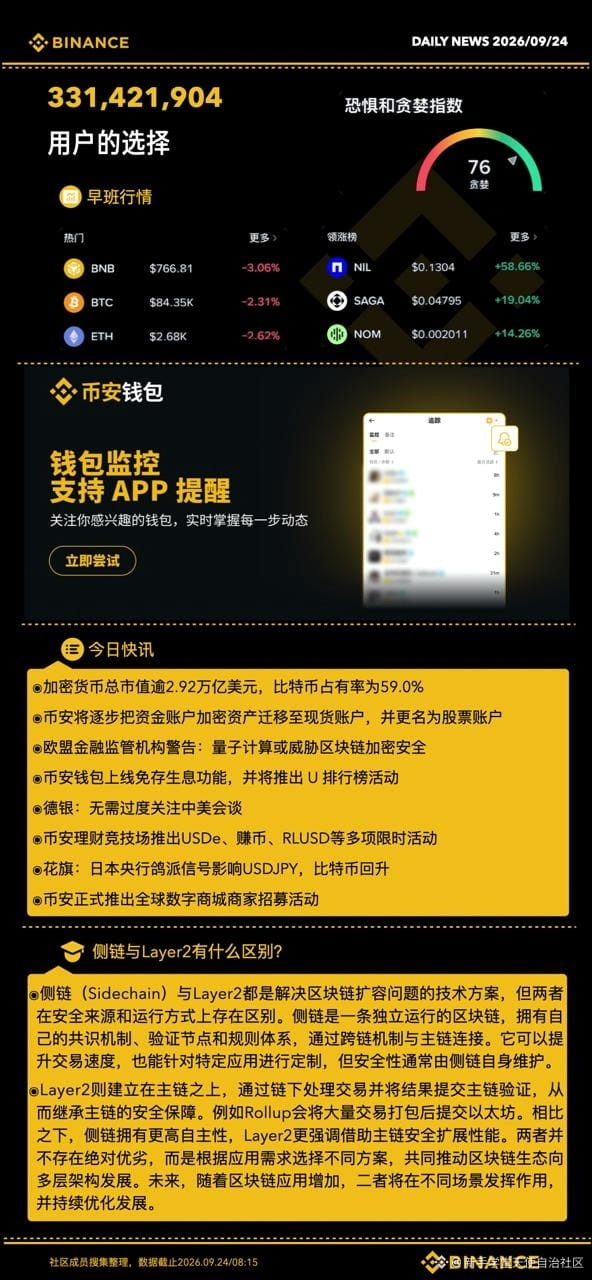
▪ The total market capitalization of cryptocurrencies is about $2.92 trillion, with Bitcoin’s market share at 59.0%.
▪ The Fear and Greed Index is 76 (Greed), and market sentiment remains elevated.
2️⃣ Binance Updates
▪ Binance Wallet has launched a wallet monitoring app with alert features, allowing users to follow wallets they’re interested in and track updates in real time.
▪ Binance will gradually transfer crypto assets in users’ funds accounts to spot accounts and rename them as “stocks accounts.”
▪ Binance Wallet has enabled interest-free earnings features and will roll out a U leaderboard campaign.
▪ Binance Wealth Arena has launched multiple limited-time events, including USDe, Earn Coins, RLUSD, and more.
▪ Binance has launched a global digital marketplace merchant recruitment campaign, continuing to expand payment and consumption scenarios.
3️⃣ Industry Hot Topics
▪ The EU’s financial regulatory authorities warn that quantum computing may threaten blockchain crypto security, and the industry continues to push forward with preparations for quantum-safe security.
▪ Deutsche Bank says there’s no need to overly focus on the U.S.-China talks for now; the market is more focused on actual policy implementation.
▪ Citigroup believes signals suggesting the Bank of Japan may be more loosely oriented could affect USD/JPY, while Bitcoin in the same period shows a rebound.
▪ Stablecoins and digital asset yield products continue to expand, further deepening the integration of traditional finance and on-chain finance.
4️⃣ Today’s Explainer: What’s the Difference Between Sidechains and Layer 2?
🔸 What is a sidechain?
▪ A sidechain is an independently operating blockchain with its own consensus mechanism, validating nodes, and rule system.
▪ It is typically connected to the main chain via cross-chain bridges, and its security depends more on the sidechain itself.
🔸 What is Layer 2?
▪ Layer 2 is built on top of the main chain, moves large volumes of transactions off-chain for processing, and then submits the results back to the main chain for settlement.
▪ Its core goal is to increase transaction speed and reduce fees while inheriting the main chain’s security as much as possible.
🔸 Key Differences
▪ Source of security: Sidechains rely on their own validation mechanisms; Layer 2 relies more on main-chain security.
▪ Independence: Sidechains are more autonomous; Layer 2 is more tightly connected to the main chain.
▪ Use cases: Sidechains are suited for independent ecosystems and customized rules; Layer 2 places more emphasis on scaling.
Follow @新手学堂天使自治社区 for more info 🚀
1️⃣ Market Overview
▪ The total market capitalization of cryptocurrencies is about $2.92 trillion, with Bitcoin’s market share at 59.0%.
▪ The Fear and Greed Index is 76 (Greed), and market sentiment remains elevated.
2️⃣ Binance Updates
▪ Binance Wallet has launched a wallet monitoring app with alert features, allowing users to follow wallets they’re interested in and track updates in real time.
▪ Binance will gradually transfer crypto assets in users’ funds accounts to spot accounts and rename them as “stocks accounts.”
▪ Binance Wallet has enabled interest-free earnings features and will roll out a U leaderboard campaign.
▪ Binance Wealth Arena has launched multiple limited-time events, including USDe, Earn Coins, RLUSD, and more.
▪ Binance has launched a global digital marketplace merchant recruitment campaign, continuing to expand payment and consumption scenarios.
3️⃣ Industry Hot Topics
▪ The EU’s financial regulatory authorities warn that quantum computing may threaten blockchain crypto security, and the industry continues to push forward with preparations for quantum-safe security.
▪ Deutsche Bank says there’s no need to overly focus on the U.S.-China talks for now; the market is more focused on actual policy implementation.
▪ Citigroup believes signals suggesting the Bank of Japan may be more loosely oriented could affect USD/JPY, while Bitcoin in the same period shows a rebound.
▪ Stablecoins and digital asset yield products continue to expand, further deepening the integration of traditional finance and on-chain finance.
4️⃣ Today’s Explainer: What’s the Difference Between Sidechains and Layer 2?
🔸 What is a sidechain?
▪ A sidechain is an independently operating blockchain with its own consensus mechanism, validating nodes, and rule system.
▪ It is typically connected to the main chain via cross-chain bridges, and its security depends more on the sidechain itself.
🔸 What is Layer 2?
▪ Layer 2 is built on top of the main chain, moves large volumes of transactions off-chain for processing, and then submits the results back to the main chain for settlement.
▪ Its core goal is to increase transaction speed and reduce fees while inheriting the main chain’s security as much as possible.
🔸 Key Differences
▪ Source of security: Sidechains rely on their own validation mechanisms; Layer 2 relies more on main-chain security.
▪ Independence: Sidechains are more autonomous; Layer 2 is more tightly connected to the main chain.
▪ Use cases: Sidechains are suited for independent ecosystems and customized rules; Layer 2 places more emphasis on scaling.
Follow @新手学堂天使自治社区 for more info 🚀