

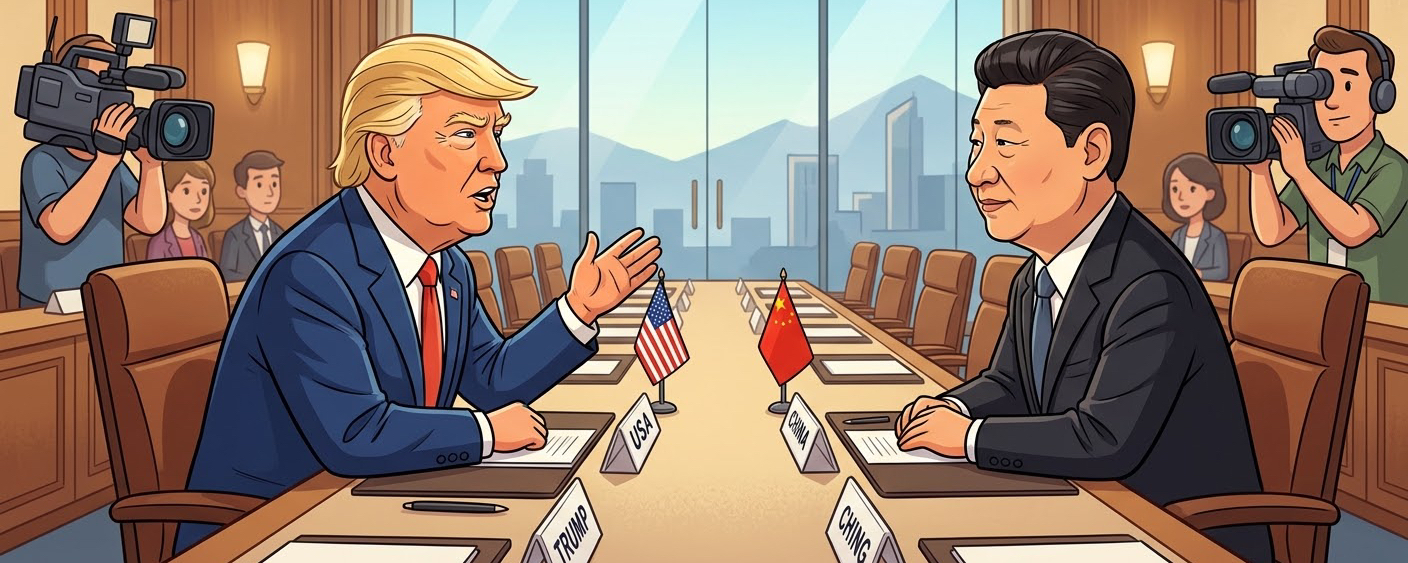

In the meeting between Trump and Xi Jinping, on the surface they talk about tariffs, rare earths, AI, semiconductors, and supply chains. But if you pull the camera back, this isn’t an ordinary trade negotiation at all—it’s about: who controls AI? Who controls chips? Who controls rare earths? Who controls the supply chain? And who can set the rules of the game for the next decade?
What’s most interesting is that my AI simulations weren’t actually about a sudden “mutual reconciliation” between the two sides—but instead:
The United States: I want chips, rare earths, and trade concessions.
China: We can talk, but you also have to give in.
The United States: You go first and concede.
China: You go ahead and lower the tariffs first.
...Then both sides fall silent together.🤣
Because the real problem is this: you can sanction me, but I can find alternative markets; you can restrict my AI chips, but I’ll speed up independent R&D; you can control rare earths, but you’ll also start building alternative supply chains. And then both sides suddenly realize: “Wait… it doesn’t seem like we can really kill the other side.” This is the most awkward part.
So I actually think this meeting is most likely to produce a very interesting new pattern—“You can compete, but don’t let it get out of control.”
Chips continue to compete, AI continues to compete, supply chains continue to reorganize, rare earths continue to be negotiated, but at the same time leaving a channel for communication. This isn’t peace, and it isn’t full de-coupling—it’s more like: “We’ll keep guarding against each other, but let’s not flip the table.” 🤣
What could really surprise the market is how everyone responds after the negotiations end:
Trump: “We achieved major results!”
China: “We safeguarded our core interests!”
Investors worldwide: “????? So who’s actually losing out?”
BTC: “So am I supposed to go up or down right now?”
Gold: “You keep bickering—I'll stay put for now.”
AI: “Don’t rush—the real show is in the next act.”
Because in the next act, what really matters isn’t who sounds better at the press conference, but this: AI + chips + energy + rare earths + finance + supply chains—who can connect these six things, and that could decide the next decade’s global asset landscape.
So for this China-U.S. meeting, I’m not just looking at whether there’s an agreement—I want to see:
1. Which restrictions are truly lifted?
2. Which parts of the supply chain are truly reconnected?
3. Is there any real change in AI and chip constraints?
4. Have rare earth export policies loosened?
5. How will the U.S. dollar and global risk appetite react?
Because real market moves usually don’t happen the moment the news headline drops. They happen when: “Everyone thinks the story is over—then the next story is only just beginning.”
🦅 In this game, we might just be in the first move.
#ChinaU.S. Talks #Trump #XiJinping #AI #Chips #RareEarths #Semiconductors #BTC #ETH #BNB #Cryptocurrency #Web3 #GlobalMarkets #Investing