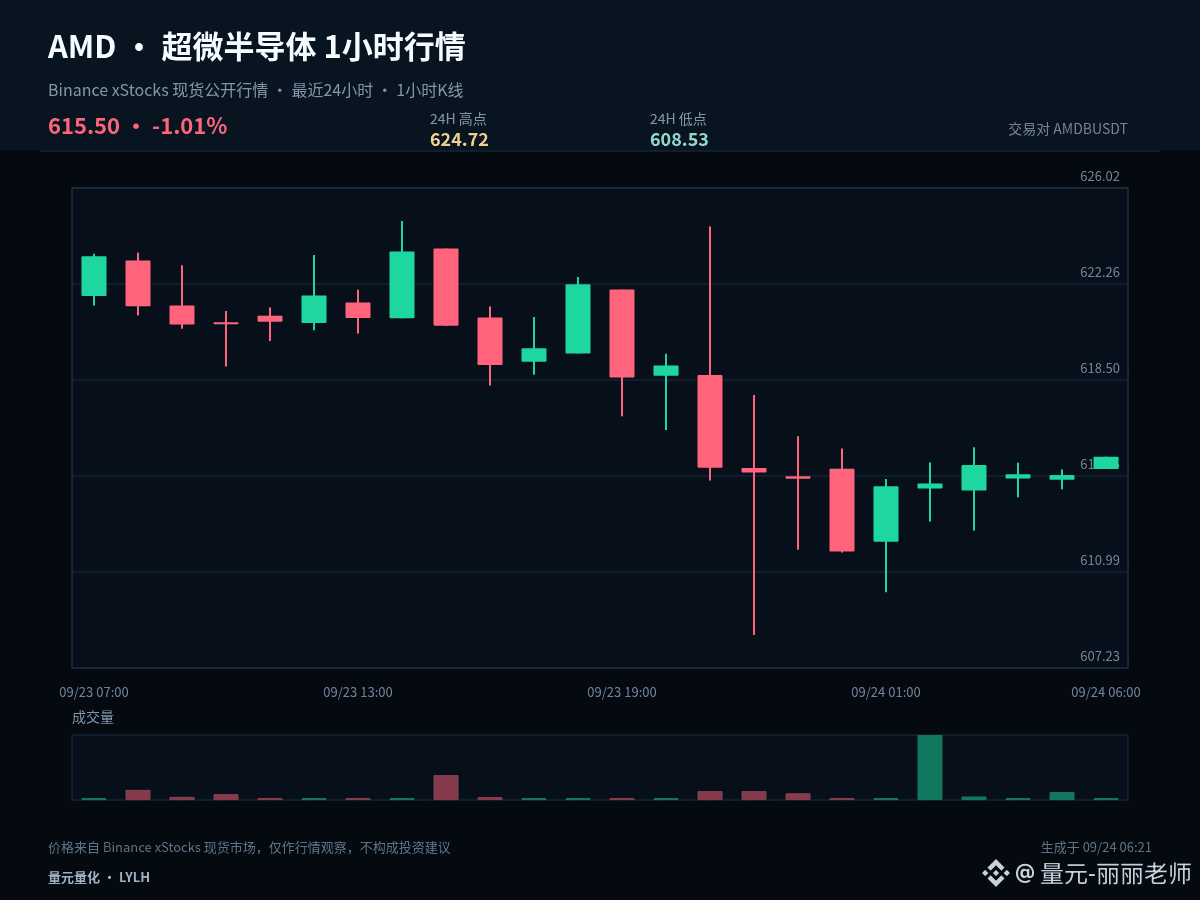
$AMDB #AMD At the moment, it’s more suitable to first confirm a rebound rather than define a reversal in advance. Current price is 615.5; 1 hour +0.12%, 24 hours -0.95%. Whether the two timeframes realign in the same direction is the key focus going forward.
Currently, 1 hour is +0.12% and 24 hours is -0.95%, and the two cycles have not formed a sufficiently clear same-direction alignment. In a range-bound market, the tolerance for chasing or getting stopped out is low. It’s more appropriate to use the upper boundary to confirm the direction and the lower boundary to confirm the pullback/hold, while the midline only serves as a strong/weak dividing line.
If the rebound can recover 616.625 and then further hold above 624.72, it would indicate that buying pressure is starting to change the prior weakness. If price moves up to the midline and then falls back again—especially if it drops back toward 608.53—it looks more like a failed repair, and you shouldn’t continue to use a “strengthening” expectation.
Even if you confirm that the rebound has failed, you still need evidence. You shouldn’t immediately chase a short just because there was one spike high followed by a pullback. A more reasonable sequence is to observe whether the resistance level is rejected, whether the lows start moving lower again, and then decide the next action based on whether any subsequent retracement pulls back above key levels.
Position management should distinguish between medium-term and short-term holdings. For existing medium-term positions, first check whether the structure is broken; don’t let repeated fluctuations in a single 1-hour candlestick repeatedly influence you. For short-term positions, execute trades around support, resistance, and close confirmation. Those without a position don’t need to chase price in the middle of the range; waiting for a clearer setup is usually advantageous.
Risk control still comes before the conclusion: only act when conditions are met, and reassess promptly if the price action invalidates your thesis. The larger the volatility, the more restrained a single position should be. The above is an outlook based on the current 1-hour and 24-hour data; it does not constitute any promise of returns.
#21SharesLaunchesEuropesFirstZcashETP
Currently, 1 hour is +0.12% and 24 hours is -0.95%, and the two cycles have not formed a sufficiently clear same-direction alignment. In a range-bound market, the tolerance for chasing or getting stopped out is low. It’s more appropriate to use the upper boundary to confirm the direction and the lower boundary to confirm the pullback/hold, while the midline only serves as a strong/weak dividing line.
If the rebound can recover 616.625 and then further hold above 624.72, it would indicate that buying pressure is starting to change the prior weakness. If price moves up to the midline and then falls back again—especially if it drops back toward 608.53—it looks more like a failed repair, and you shouldn’t continue to use a “strengthening” expectation.
Even if you confirm that the rebound has failed, you still need evidence. You shouldn’t immediately chase a short just because there was one spike high followed by a pullback. A more reasonable sequence is to observe whether the resistance level is rejected, whether the lows start moving lower again, and then decide the next action based on whether any subsequent retracement pulls back above key levels.
Position management should distinguish between medium-term and short-term holdings. For existing medium-term positions, first check whether the structure is broken; don’t let repeated fluctuations in a single 1-hour candlestick repeatedly influence you. For short-term positions, execute trades around support, resistance, and close confirmation. Those without a position don’t need to chase price in the middle of the range; waiting for a clearer setup is usually advantageous.
Risk control still comes before the conclusion: only act when conditions are met, and reassess promptly if the price action invalidates your thesis. The larger the volatility, the more restrained a single position should be. The above is an outlook based on the current 1-hour and 24-hour data; it does not constitute any promise of returns.
#21SharesLaunchesEuropesFirstZcashETP