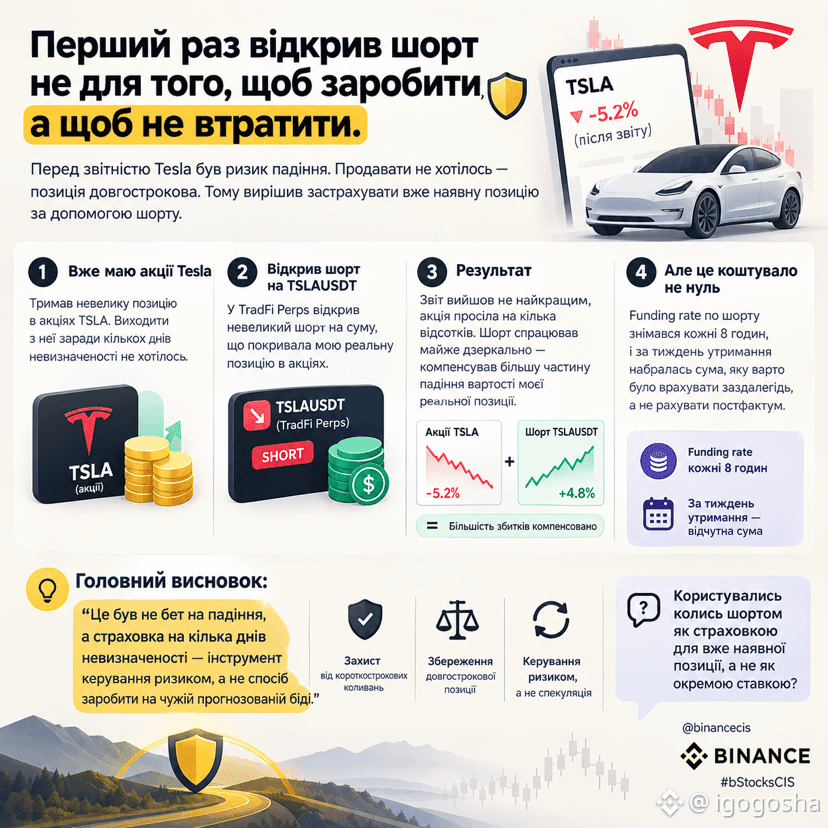
I opened the short not to make money, but so I wouldn’t lose. 🛡️
I kept a small position in Tesla shares—and before the quarterly earnings report, I had a feeling there might be a downside drop. I didn’t want to sell: it’s a long-term position, and exiting it for the sake of a few days of uncertainty felt wrong.
So I tried something else: I opened a small short on $TSLAUSDT on TradFi Perps, roughly for an amount that covered my actual share position. In other words—if the price drops, the loss on the shares is partially offset by profit on the short, and vice versa: if I’m wrong about the direction, I lose a bit on the short but win on the main position.
The report didn’t come out the best—the stock fell by a few percent. The short on TSLAUSDT worked almost like a mirror—it offset most of the drop in the position value.
It wasn’t free, though: the short’s funding rate was charged every 8 hours, and over a week it accumulated a sum worth accounting for in advance, not after the fact.
To sum up: this wasn’t a “bet on the downside,” but insurance for a few days of uncertainty—an instrument for risk management, not a way to profit.
Have you ever used a short as insurance for a position rather than as a standalone bet?
@Binance_Ukraine #bStokscis $TSLAB
I kept a small position in Tesla shares—and before the quarterly earnings report, I had a feeling there might be a downside drop. I didn’t want to sell: it’s a long-term position, and exiting it for the sake of a few days of uncertainty felt wrong.
So I tried something else: I opened a small short on $TSLAUSDT on TradFi Perps, roughly for an amount that covered my actual share position. In other words—if the price drops, the loss on the shares is partially offset by profit on the short, and vice versa: if I’m wrong about the direction, I lose a bit on the short but win on the main position.
The report didn’t come out the best—the stock fell by a few percent. The short on TSLAUSDT worked almost like a mirror—it offset most of the drop in the position value.
It wasn’t free, though: the short’s funding rate was charged every 8 hours, and over a week it accumulated a sum worth accounting for in advance, not after the fact.
To sum up: this wasn’t a “bet on the downside,” but insurance for a few days of uncertainty—an instrument for risk management, not a way to profit.
Have you ever used a short as insurance for a position rather than as a standalone bet?
@Binance_Ukraine #bStokscis $TSLAB