
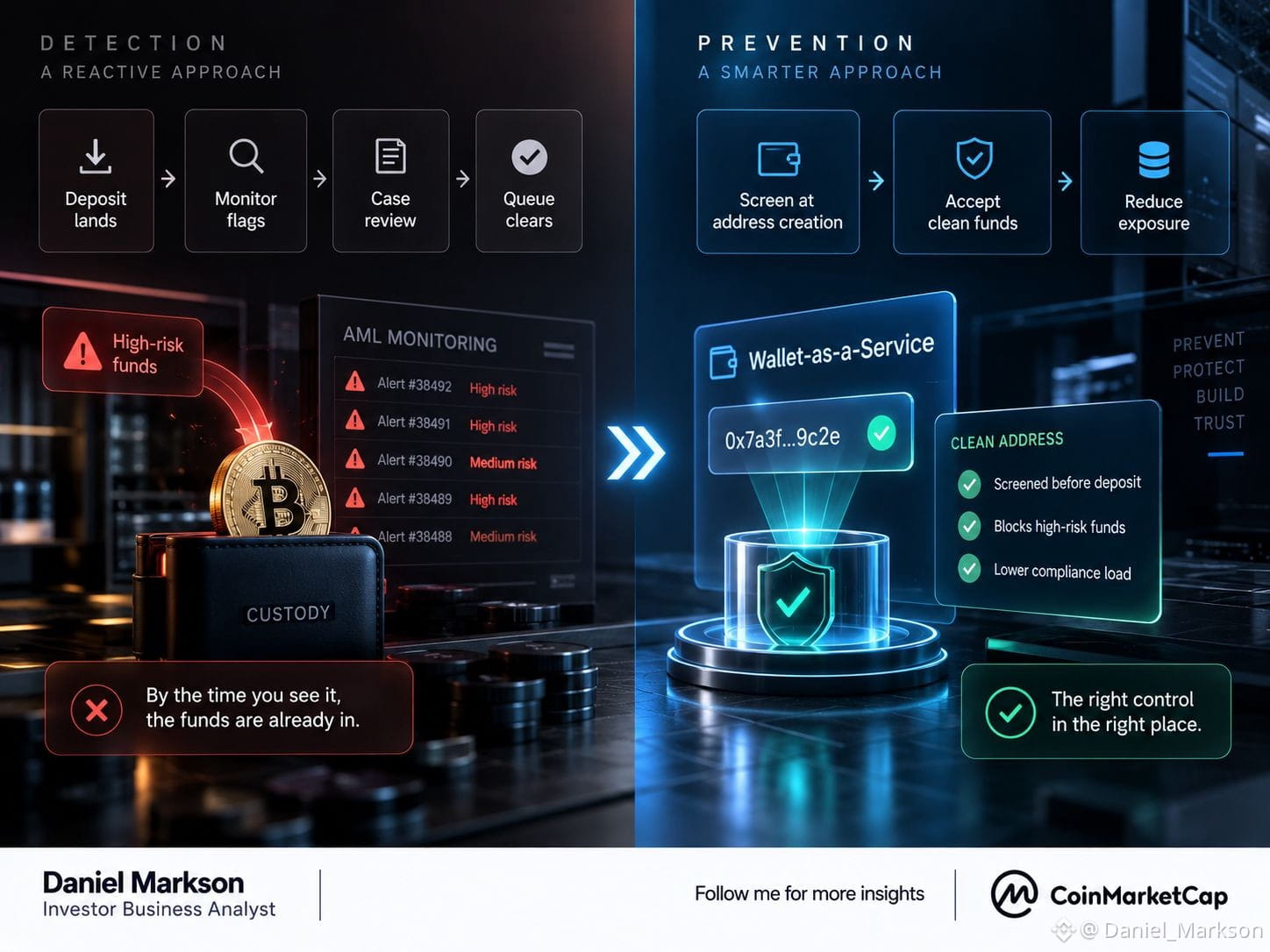
❓ What Happens Between a Deposit Landing and a Flag Firing We used to treat the monitoring dashboard as proof the AML program worked. Alerts fired, cases got reviewed, and the queue emptied by Friday - the ops team called that compliance. 💡 Nobody questioned it until someone asked, "What happens between a tainted deposit landing and the monitor flagging it?" By then the $BTC or whatever asset came in is already in custody, sometimes withdrawn. The alert tells you about a problem you already own. Detection was never the control; it was the receipt. The usual fix is tuning the monitor harder - more rules, tighter thresholds, faster review. That shortens the delay, not the exposure. 👇 Prevention sits at the deposit address, not the log - screening at address generation, before funds are accepted. If we take a WhiteBIT Wallet-as-a-Service: https://institutional.whitebit.com/crypto-wallets-for-business?utm_source=coinmarketcap&utm_medium=waas_dan&utm_campaign=post 🧩 AML screening at address creation 🧩 across 340+ cryptocurrencies and 80+ networks, not bolted onto one chain. 🧩 integration runs around four weeks with predictable costs. Or there is the Openfort Wallet-as-a-Service which answers a different one: https://www.openfort.io/wallet-as-a-service?utm_source=coinmarketcap&utm_medium=waas_dan&utm_campaign=post 📍white-label 📍every wallet is a smart account, giving gas sponsorship, session keys, and batched transactions out of the box - useful for UX, not a substitute for screening upstream. No screen catches funds with no on-chain history yet. A control that only detects is one step behind; one that screens at creation stands in the right place. Disclaimer: This is not financial or investment advice. DYOR before making any decisions. Use at your own risk. #BTC Price Analysis# #Bitcoin Price Prediction: What is Bitcoins next move?#


Post
Disclaimer: Includes third-party opinions. No advice. Binance AI may be used without guarantee. See T&Cs.