#bitwisenear质押etp资产突破1亿美元
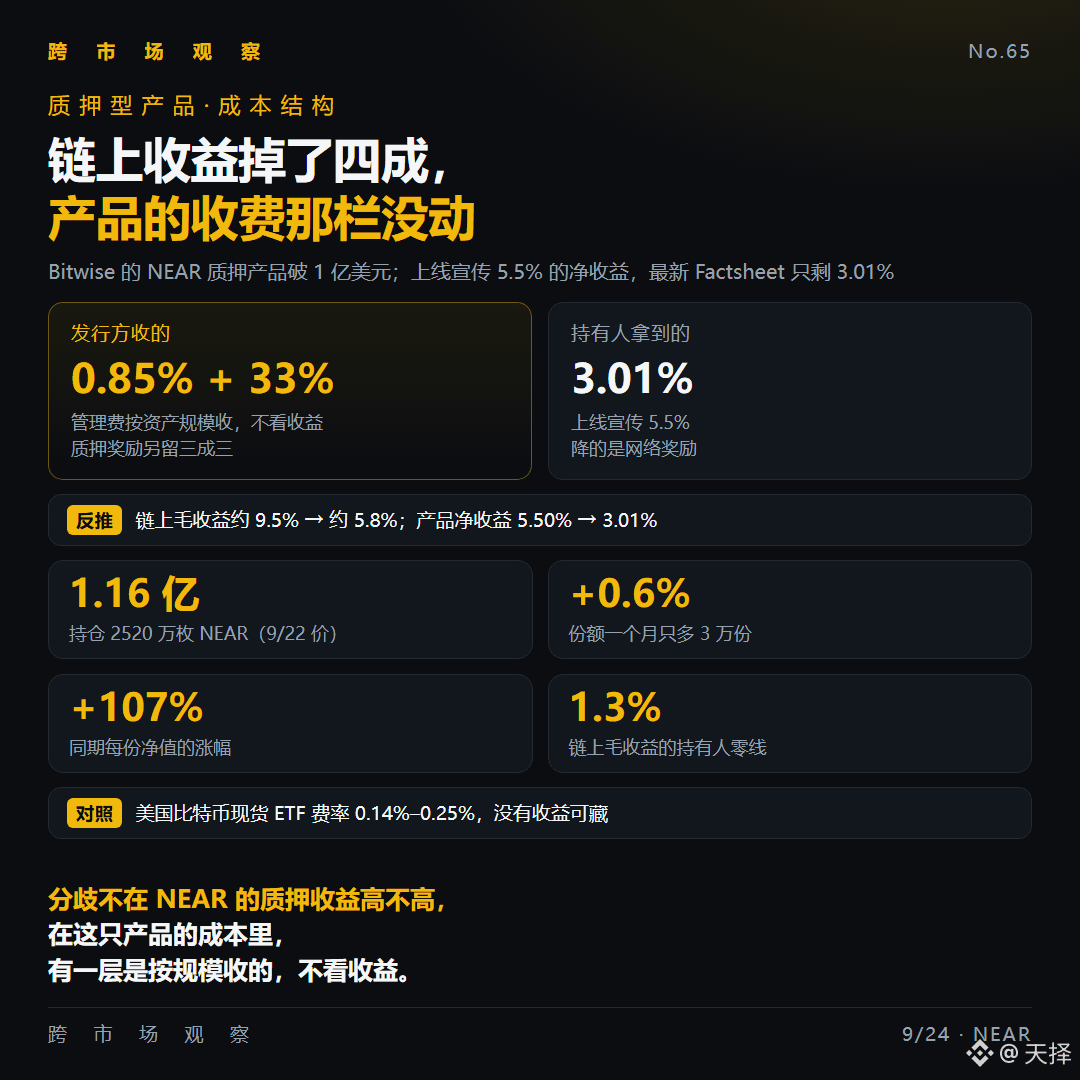
Bitwise’s NEAR staking product has just broken $100 million in assets, launched with a net yield of 5.5%. Now it’s down to just 3.01%.
▪️The fund holds 25.2 million NEAR, worth about $116 million based on the 9/22 price
▪️Only 30,000 more shares were issued—up 0.6% (about $639,000). Over the same period, the net asset value per share increased by 107%
▪️Management fee is 0.85% per year. The issuer keeps another 33% of the staking rewards, while investors receive 67%
▪️What declines is the network rewards; the cut-rate tier itself hasn’t changed
Let’s break down the 5.5%: first deduct the 0.85% management fee. What remains is 67% paid back to holders. That implies the on-chain gross yield was about 9.5% at the time, and is now about 5.8%. On-chain revenue is down about 40%, and the product’s net yield is down about 45%. The “extra” few percentage points are essentially that layer of fees charged based on asset size.
Its break-even line is here too: once the on-chain gross yield falls to around 1.3%, holder yield goes to zero, and the 0.85% fee still gets collected.
For comparison: the fee rate of U.S. spot Bitcoin ETFs is in the range of 0.14%–0.25%. With no staking yield to hide behind, the cost is out in the open.
I don’t have a NEAR position. I’m watching three things:
① The net yield rate in the next Factsheet (using the same methodology as the 3.01%)
② The NEAR on-chain staking annualized yield—how far it still is from that break-even line
③ The filing progress for the U.S. version of NRR.
For staking-type products, do you annualize based on the advertised yield, or do you first account for the cost of that layer that doesn’t depend on returns?
$NEAR $BTC
Bitwise’s NEAR staking product has just broken $100 million in assets, launched with a net yield of 5.5%. Now it’s down to just 3.01%.
▪️The fund holds 25.2 million NEAR, worth about $116 million based on the 9/22 price
▪️Only 30,000 more shares were issued—up 0.6% (about $639,000). Over the same period, the net asset value per share increased by 107%
▪️Management fee is 0.85% per year. The issuer keeps another 33% of the staking rewards, while investors receive 67%
▪️What declines is the network rewards; the cut-rate tier itself hasn’t changed
Let’s break down the 5.5%: first deduct the 0.85% management fee. What remains is 67% paid back to holders. That implies the on-chain gross yield was about 9.5% at the time, and is now about 5.8%. On-chain revenue is down about 40%, and the product’s net yield is down about 45%. The “extra” few percentage points are essentially that layer of fees charged based on asset size.
Its break-even line is here too: once the on-chain gross yield falls to around 1.3%, holder yield goes to zero, and the 0.85% fee still gets collected.
For comparison: the fee rate of U.S. spot Bitcoin ETFs is in the range of 0.14%–0.25%. With no staking yield to hide behind, the cost is out in the open.
I don’t have a NEAR position. I’m watching three things:
① The net yield rate in the next Factsheet (using the same methodology as the 3.01%)
② The NEAR on-chain staking annualized yield—how far it still is from that break-even line
③ The filing progress for the U.S. version of NRR.
For staking-type products, do you annualize based on the advertised yield, or do you first account for the cost of that layer that doesn’t depend on returns?
$NEAR $BTC