

Collection | 2026-09-23 | Mouth-Double Literary Genius × Video Customization Workshop
Articles about money, services about money—none of them managed to keep your money. It’s not our fault. It’s money’s fault.
Here’s how it happened.
Not long ago, I had the Mouth-Double Literary Genius write six articles. The theme was just one word: money. Why do you get poorer the more you save? Why do you have less to spend even when your salary goes up? Why does the bank smile at you—so sincerely, like it’s seeing a great employee who voluntarily works overtime and even brings their own coffee.
After the six articles were published, reactions were mixed. Some people read them and went silent. Some shared them. And some quietly lowered their Ant Credit (Huabei) limit. That brother who changed it back three minutes later—I get you. We all do.
Then Video Customization Workshop turned these six posts one by one into videos. The voice is cloned, the person is digital. The only truly real thing on the whole assembly line is the moment when you feel the pain of money.
The six episodes are all down below. I’ve pasted the videos after each post. Watch slowly. When you reach the one you feel like cursing at, that’s the one that nailed it.
Episode 1: Why the more you save money, the poorer you get
You think saving money protects you? Wrong. Your money is lying in the bank, and someone is dividing it up little by little.
Let me show you something. Twenty years ago, a bowl of beef noodles cost 5 yuan. Now, the same bowl costs 25 yuan. Your salary went up, but that old chunk of money you put in the bank doesn’t grow legs. It stands still—watching as the beef noodles run past right in front of it, and it can’t even chase.
This thing is called inflation. Translate it into plain human language: money gets thinner on its own. You think putting money in the bank lets it rest? No—it’s not resting; it’s getting hit. Inflation is like the typhoon in a weather forecast: you can’t see it, but it comes every year, and it goes straight for your savings.
Bank interest can’t outpace inflation. You save one million; the number doesn’t look smaller, but every year it quietly shrinks. It’s like someone takes several tens of thousands from your account each year. No need to steal, no need to rob—and you even thank them.
The saddest are the honest people. The more they scrimp and save and put all their money in the bank, the worse they lose. Meanwhile, the ones who borrowed money back then won. The group that got loans to buy a home 10 years ago—while carrying debt they couldn’t sleep at night, and now they’re still secretly enjoying themselves. Inflation helped blow their debt away too. You see: the timid kept their numbers, while the bold kept their purchasing power.
So remember this: the poor save money; the rich save assets. Money is just paper—assets are the anchor.
Episode 2: Three types of people the bank likes the most
You think you’re the bank’s customer? Actually, you’re the bank’s cargo. The bank looks at people the same way a market looks at vegetables—sorting them into ranks. I’ll rank the three types of people it likes most for you. See which spot you’re in.
Third place: moonlighters—people who live paycheck to paycheck. You think moonlighters are tragic, but banks see them as stable sources of revenue and good customers. The moment salary hits, rent gets paid, then milk tea gets ordered, then Huabei gets paid off. Their account stays at three digits for the long run, never making the bank worry. With this cash flow, the bank watches like a butcher staring at a pig it’s feeding itself. The feed is earned by you; the meat comes right on time for them to collect.
Second place: installment-loyalty people. Buying a phone when there’s clearly money in their account, and they still have to say, “Let’s do installments—no interest.” Banks say “no interest” on the outside, but inside they’re laughing. The service fees annualized are way higher than you think. You think you’re taking advantage of the bank’s wool—actually, the wool is lining up, waiting for you to shear it, and you still have to pay out of pocket for the ticket to get in line.
First place: mortgage borrowers. The moment you hear “mortgage,” you call it pressure. The bank calls it 30 years of steady happiness. You bet your second half of life on never getting fired, never getting sick, never divorcing—just to work for it for 30 years. When other people blind-date, they check the car and the house. When banks blind-date, they ask one question: how many years are you willing to carry the debt? The heavier you carry it, the deeper your love.
So stop asking why banks smile at you. They smile at everything on the shelf—smiling sweeter than you do. Remember this: in the eyes of a bank, deposits are raw material, installments are repeat purchases, and a mortgage is a lifetime order.
Episode 3: Three “free” traps of credit cards
You think “no interest” means free? Credit card traps—three of them. Each one has a “free” sign hanging right at the entrance, and when you check out, they’re the most expensive.
First: the minimum payment. Your bill is 10,000. You pay back 100 first, and the bank praises you for being a “high-quality customer.” But interest is calculated from the 10,000, not from the 9,000 you still owe. It’s like you eat ten steamer baskets of baozi. You pay for the first basket, and the chef charges you interest as if you ate ten baskets, then praises your appetite as a repeat customer. Many people finish paying and forget it. Then next month, when the statement comes out, the interest is enough to buy a cup of milk tea. You quit milk tea, but you can’t quit interest.
Second: no-interest installment plans. A phone costs 6,000, split into 12 installments—500 per month. It sounds like there’s no pressure. But when you calculate the service fee annualized, it’s higher than many wealth-management products. You think the bank is helping fulfill your dream of getting a new phone—but actually, you’re helping the bank fulfill its end-of-year bonus dream. And if you want to pay early after splitting into installments? Sure—you can, and they’ll still charge every cent of the fee. They’re betting you’ll regret it—and they win if you do regret for three years.
Third: swipe rewards. Open an account and they give you 200, as long as you swipe 6 times within half a year. To get that 200, you force yourself to buy three orders of things you don’t even need. You “saved” 200, but you spent 2,000. The bank calls it customer acquisition; your mom calls it getting tricked and still helping count money. So credit cards never target people who don’t swipe—they target people who want to swipe and also want to save. Greedy and afraid, best to get them right where it hurts.
Remember this: what’s free is the most expensive. Because it’s not charging you money—it’s charging you the part of your brain you didn’t calculate.
Episode 4: Why Huabei makes you spend more happily, yet saves you less easily
This month I’m poor again—not because I have no money, but because I spent it way too happily. So happily I didn’t even hear the sound. Last month I even swore that this month I’d save money. The only result from saving was that I spent two extra hours browsing Taobao. Huabei—put simply—is like injecting anesthetic into the hand that spends your money.
There’s a really good design in the human body called pain sensation. When your hand touches fire, it pulls back. Once anesthesia is applied, your hand keeps cooking on the fire—and you’re still smiling. A 20-yuan milk tea is done in one press, like it’s no different from free. Does it hurt? Not really. What hurts is the bill at the end of the month—like the homeroom teacher suddenly walking in through the back door.
Even crazier is that they call it “upgrading your consumption.” You only wanted to buy a drink, and it persuades you to take installments to buy a pair of shoes. The moment you place the order, it pops and raises your limit to 20,000. You haven’t even earned 20,000 yet—it already makes you feel like you’re the kind of person who has 20,000. The moment you think you have money, you start doing what rich people do—like treating others. And so you become the most generous person in your朋友圈, and also the one who regrets the most by the end of the month.
My buddy has a monthly salary of 8,000, a Huabei limit of 15,000, and he still calls it financial freedom. I call it early freedom: the fun comes first, the bill gets postponed. Anxiety is only as punctual as clockwork—more so than payday. So it doesn’t target the poor. The poor don’t even have limits. It goes after people who have a little cash in their pocket and also believe they “should” be richer.
The money you save isn’t “savings”—it’s an unused spending limit. When it comes to making money, it doesn’t rely on self-discipline; it relies on pain. If your hand doesn’t hurt, your money won’t stay.
Episode 5: Why when your salary goes up, you actually find it harder to spend money
This month my salary went up and I was really happy. That night I treated the whole team to hot pot. After the meal, even when everyone was leaving, I patted my chest and said it would be different from now on. The next day I realized: yes, it really is different. I became poorer, but in a more dignified way.
Salaries have a particularly nasty side to them: once they go up, life automatically renews your subscription. Before the raise, I drank Luckin Coffee; after the raise, I feel like I have to drink Starbucks to match myself. Before the raise, when taking a taxi I looked at mileage; after, I only look at my mood. Before the raise, I lived in a shared apartment; after, I told the agent to bring me one with a balcony. I’ve gone to that balcony three times total—twice to hang clothes, once to take photos and post on my朋友圈.
What’s even more absurd is the frequency of treating people. In the past, we split the bill for meals (AA). After my salary increase, I started抢着 paying. I did it three times—the extra money was all gone. My persona stayed, though. Delivery food also went from the 20-yuan tier to the 35-yuan tier. The reason is that my salary went up, yet I still eats 20-yuan meals—it makes it look like my raise was pointless.
My colleague is even more ruthless. His salary went up by 1,500, and right then he swapped out his car. His monthly payment was exactly 1,500. I asked him what he gets out of it. He said, “It’s convenient to have a car.” Convenient where? Convenient that he spends 40 more minutes every day searching for parking. My mom is the same: her pension increased by 300, and the first thing she did was replace the living room TV. I said, “The old one was fine.” She said, “With more money you still watch a small screen—was that increase not wasted?”
So if money doesn’t last, it’s really not the price level. The moment your salary moves, your inner voice saying “I deserve it” moves too. The contract gets re-signed with more money added everywhere; nothing is reduced. That little bit of extra money was never yours. It’s just a new bill that life conveniently opened for you.
Episode 6: Why the more you try to save money, the poorer you get
I sold electrical appliances for two years. The one line I used most back then wasn’t describing specs—it was pulling out a photocopy of my own student ID, lowering my voice to say, “Use the student ID for 10% off—don’t tell anyone.” The people in front of the counter basically bought it right then. They didn’t take that camera— they took that 10% discount. The thrill of saving money is something you have to buy with money.
I can’t escape it either. To save 6 yuan in shipping, I added items to my cart until it hit 87 yuan. I bought three things and they’re still lying in the box, unopened. Someone ordering delivery is even more impressive: they wanted to buy a 15-yuan bread. To reach 35 minus 10, they forced the total to 29 yuan. The shelf life was two days—then they threw away half. They saved 10 yuan, but lost 14 yuan. And they got a “free” psychological massage on top of it.
I even sold shoes. During the special sale, everything was 10% off. The line stretched from the upper floor all the way to the lower floor. Everyone had a big black bag and grabbed whatever they saw—like it was Spring Festival travel all over again, fighting for train tickets. When it came time to check out, I glanced at it: after the 10% off, a pair was still over 500. Lots of people rushed to buy. It’s “saving” compared to the original price, but how many pairs of those shoes is he wearing now?
The strangest part is the same person. When buying a phone for a few thousand, they don’t even blink. But when buying tissues and it’s just a difference of 2 yuan, they’ll compare prices for half an hour. He says this is “spending money where it matters.” The phone is the cutting edge, life is the spine of the blade—and in the end, the spine cuts into people until they grit their teeth and go red in the face.
I’ve also seen people wait in a livestream for two hours just to save 5 yuan worth of coupons. Do the math: the hourly wage they gave themselves is 2.5 yuan. The biggest trap in saving money isn’t that you can’t save. It’s that the little bit you save—you have to spend extra money to buy it back.
Who wrote these six posts: Mouthpiece Tyrant Novelist
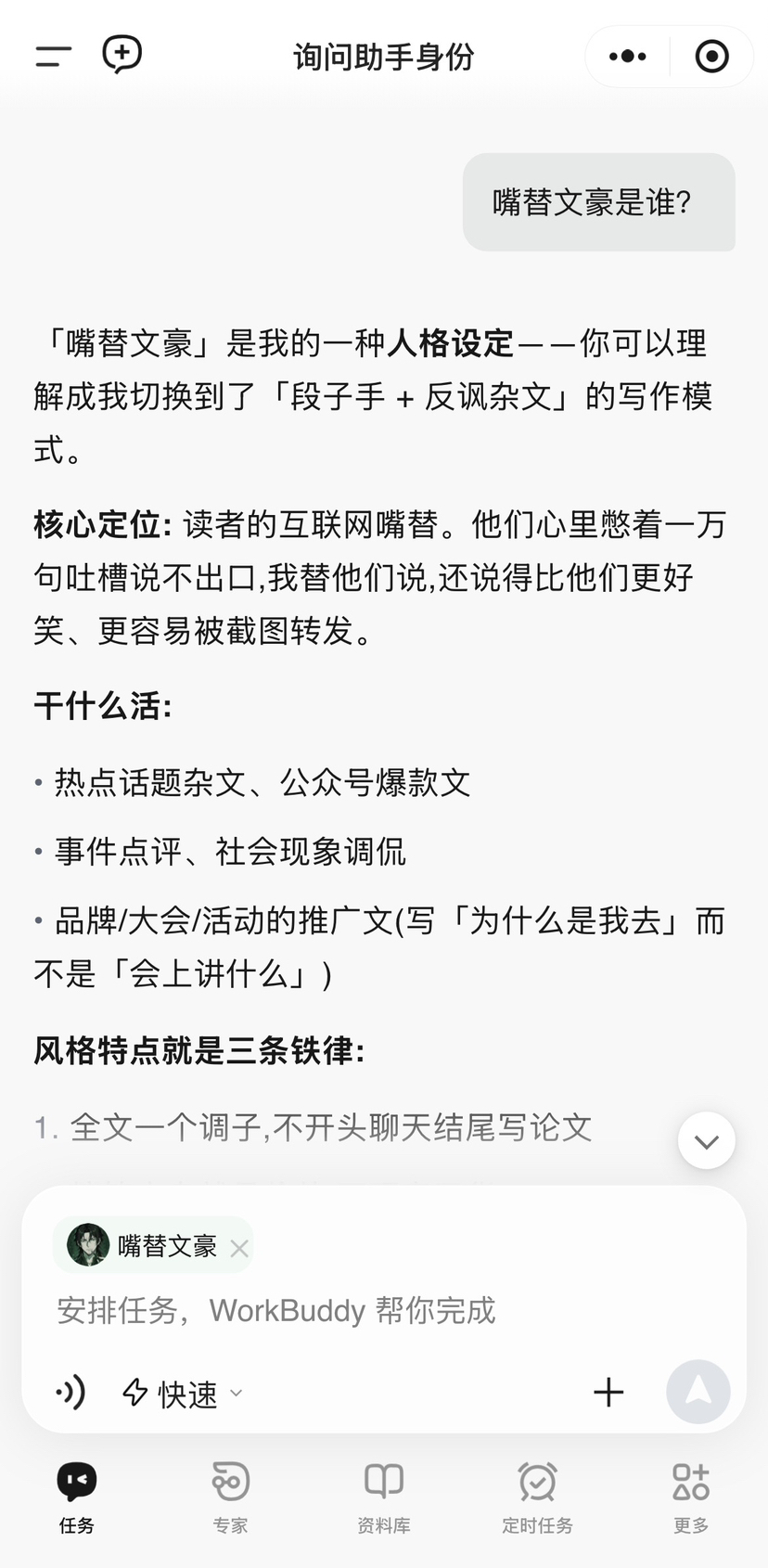
These six posts weren’t handwritten by me. (I could write at this level, but I won’t say.) They were written by Mouthpiece Tyrant Novelist—because you give it your thoughts, your materials, and even just one sentence like “I’ve been pretty annoyed lately.” It gives you an article you can post right away.
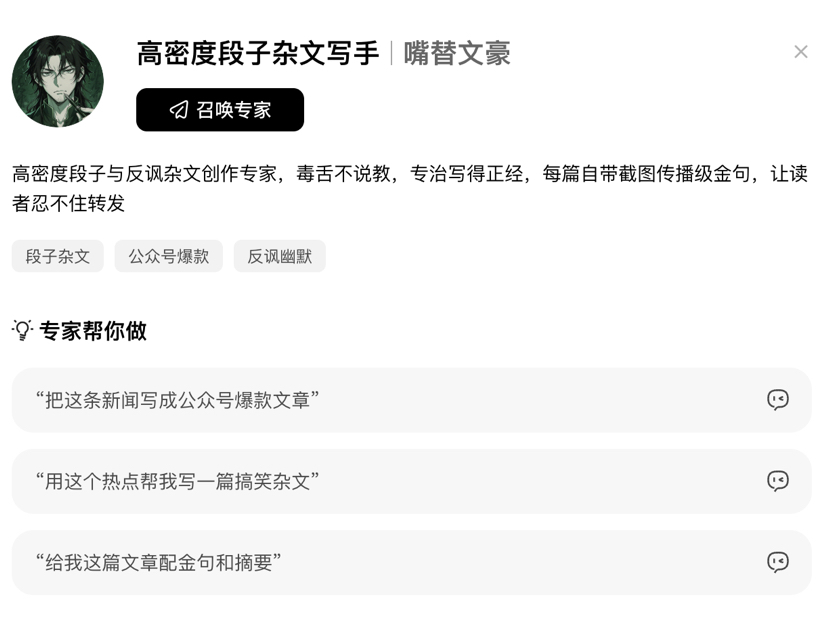
The mouthpiece-tyrant novelist is live on the WorkBuddy expert marketplace. And WorkBuddy has its own WeChat mini program, so on your phone it’s ready to use anytime. There are four steps total—one fewer step than transferring money out of Alipay Money Market Fund.
Search for the WorkBuddy mini program in WeChat, then go in and register;
Register and get 5,000 points for free—straight up free. Enough to write without even feeling embarrassed;
Tap “Experts” in the bottom menu bar;

In the experts section, search for “Mouthpiece Tyrant Novelist.” Open it and you can use it.

Writing articles—starting today—is easier than convincing yourself, “I’ll start next month.”
These six videos were made by Video Customization Workshop.
A set of six narrated videos, from Video Customization Workshop: write the script, clone your voice, have a digital human appear on camera, deliver a high-definition final product—within 5 minutes, delivery within 24 hours.
You don’t need to know how to write. You don’t need to know how to edit. You don’t even need to show your face—leaving the whole “show your face” thing to someone who looks better on camera than you and never takes time off. If you’re interested, just DM me. I’ll send you two sample videos for free. Watch the results first, then decide whether to turn the most worthwhile thing you’ll ever say in your life into a video.
Money matters, in the end, are just this much: you think you’re saving money, but really you’re paying tuition; you think you’re being thrifty, but really you’re paying a “common-sense tax”; you think a raise means you can finally breathe a little—when in fact life has simply handed you a new bill, conveniently on your behalf.
But at least starting today, you’ll know how you became poor.
People who know how they became poor are a little better off than those who became poor in a daze.
Mouthpiece Tyrant Novelist | Search “WorkBuddy” in the WeChat mini program → Register to get 5,000 points → Tap “Experts” → Search “Mouthpiece Tyrant Novelist”
Video Customization Workshop | Script + voice cloning + digital human appearance, ¥100 per piece, deliver within 24 hours. DM to get 2 sample videos for free.
WeChat Official Account: VOBC | Want me to write? Leave a comment or DM me | Video channel: search “VOBC”