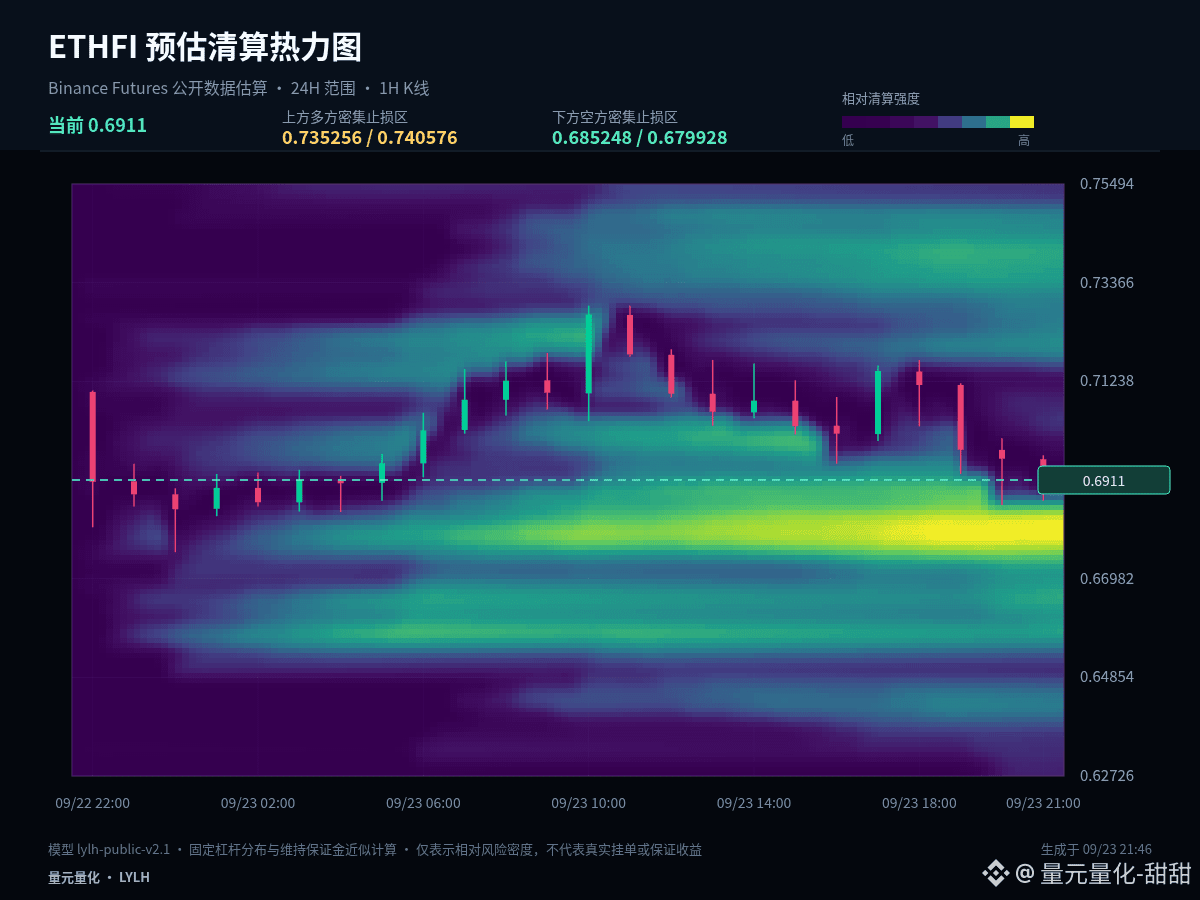
$ETHFI #ETHFI It only prepares to enter after momentum picks up; more importantly, it needs to first assess the position. In the current 1-hour period: -0.80%, and in the last 24 hours: -2.07%. The space that has already moved can’t simply be treated as the next segment to copy.
$ETHFI #ETHFI is still repeatedly switching hands within the past 24-hour range, and there isn’t a clear directional advantage. The middle position is the hardest test of patience; waiting for boundary signals is usually more effective.
In a weak phase, it’s easiest to misjudge a rebound as a reversal. Before 0.70335 is reclaimed, observe first for repair; if it breaks again below 0.6773, it indicates that effective support from below is still lacking.
There are three ways to handle the next path: if price upward is effective and holds above 0.7294, wait for a pullback that doesn’t break and then reassess for continuation; if price breaks downward below 0.6773, prioritize risk control and wait for new support; if it continues to trade around 0.70335 in a range-bound manner, treat it as range rotation rather than repeatedly chasing direction in the middle.
Positioning needs to distinguish between spot and contracts. If you already hold spot, you can manage it in segments around key levels without frequently switching direction due to a single 1-hour candlestick. Staying in cash and waiting for confirmation, then entering in batches, is more comfortable. Contracts place more emphasis on entry position and invalidation conditions. When volatility amplifies, actively reduce position size to avoid turning short-term judgment into passive holding.
Missing a segment of the market doesn’t directly cause losses; it’s chasing at the end of volatility without a plan that makes your position passive. Risk control still comes before the conclusion: only execute when conditions appear, reassess immediately if the price becomes invalid. The greater the volatility, the more you must restrain each single-position size. The above is a scenario analysis based on the current 1-hour and 24-hour data of the order book; it does not constitute a promise of returns.
#CardanoJoinsX402PaymentStandard
$ETHFI #ETHFI is still repeatedly switching hands within the past 24-hour range, and there isn’t a clear directional advantage. The middle position is the hardest test of patience; waiting for boundary signals is usually more effective.
In a weak phase, it’s easiest to misjudge a rebound as a reversal. Before 0.70335 is reclaimed, observe first for repair; if it breaks again below 0.6773, it indicates that effective support from below is still lacking.
There are three ways to handle the next path: if price upward is effective and holds above 0.7294, wait for a pullback that doesn’t break and then reassess for continuation; if price breaks downward below 0.6773, prioritize risk control and wait for new support; if it continues to trade around 0.70335 in a range-bound manner, treat it as range rotation rather than repeatedly chasing direction in the middle.
Positioning needs to distinguish between spot and contracts. If you already hold spot, you can manage it in segments around key levels without frequently switching direction due to a single 1-hour candlestick. Staying in cash and waiting for confirmation, then entering in batches, is more comfortable. Contracts place more emphasis on entry position and invalidation conditions. When volatility amplifies, actively reduce position size to avoid turning short-term judgment into passive holding.
Missing a segment of the market doesn’t directly cause losses; it’s chasing at the end of volatility without a plan that makes your position passive. Risk control still comes before the conclusion: only execute when conditions appear, reassess immediately if the price becomes invalid. The greater the volatility, the more you must restrain each single-position size. The above is a scenario analysis based on the current 1-hour and 24-hour data of the order book; it does not constitute a promise of returns.
#CardanoJoinsX402PaymentStandard