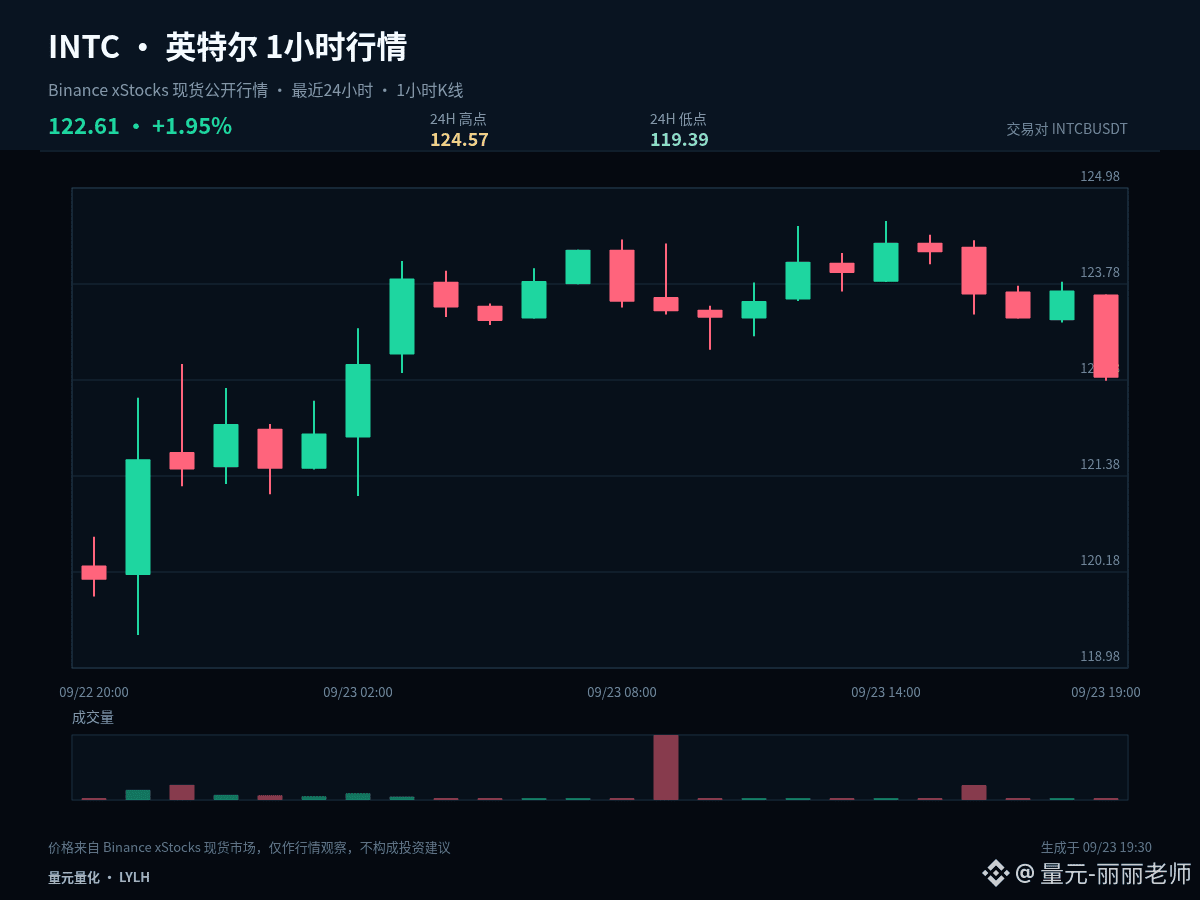
$INTCB #INTC Current price 122.61, -0.88% in the past 1 hour, +1.58% in the past 24 hours. Instead of deciding long or short too early, it’s better to list the possible paths and the corresponding actions.
From the cycle alignment, the past 24 hours remain +1.58%, while the 1-hour timeframe has pulled back to -0.88%, which looks more like a cooling-off within an upward structure. If the pullback doesn’t break the key support, it’s normal rotation; if support is lost and the rebound lacks strength, short-term control shifts from the bulls to the bears.
The first path is upward: price needs to break 124.57 and form stable closes above it. Only then does a subsequent retest that doesn’t break count as effective confirmation. The second path is downward: once 119.39 is breached and the subsequent rebound can’t reclaim it with strength, it indicates insufficient support—focus on defense first rather than rushing to average down.
If price continues to hover between 124.57 and 119.39, 121.98 is only a reference for short-term control. The middle of the range has no clear advantage, so don’t force a trade just for the sake of participation—wait for the market to show direction.
Existing positions can be handled in segments based on the key levels to avoid making all decisions at once. Those with no position should wait for confirmation of the breakout or for the pullback to stabilize. For U.S. stock/asset targets, also watch for volatility caused by trading-session transitions—your plan should follow price conditions, not replace execution with emotions.
The key of a short-term position isn’t to predict every single K-line; it’s to ensure there’s a rationale for entry, scaling out, and exiting. Do less until there’s confirmation. If key levels fail, redo the plan—control single-trade risk first, then discuss the next upside/downside potential.
#21SharesLaunchesEuropesFirstZcashETP
From the cycle alignment, the past 24 hours remain +1.58%, while the 1-hour timeframe has pulled back to -0.88%, which looks more like a cooling-off within an upward structure. If the pullback doesn’t break the key support, it’s normal rotation; if support is lost and the rebound lacks strength, short-term control shifts from the bulls to the bears.
The first path is upward: price needs to break 124.57 and form stable closes above it. Only then does a subsequent retest that doesn’t break count as effective confirmation. The second path is downward: once 119.39 is breached and the subsequent rebound can’t reclaim it with strength, it indicates insufficient support—focus on defense first rather than rushing to average down.
If price continues to hover between 124.57 and 119.39, 121.98 is only a reference for short-term control. The middle of the range has no clear advantage, so don’t force a trade just for the sake of participation—wait for the market to show direction.
Existing positions can be handled in segments based on the key levels to avoid making all decisions at once. Those with no position should wait for confirmation of the breakout or for the pullback to stabilize. For U.S. stock/asset targets, also watch for volatility caused by trading-session transitions—your plan should follow price conditions, not replace execution with emotions.
The key of a short-term position isn’t to predict every single K-line; it’s to ensure there’s a rationale for entry, scaling out, and exiting. Do less until there’s confirmation. If key levels fail, redo the plan—control single-trade risk first, then discuss the next upside/downside potential.
#21SharesLaunchesEuropesFirstZcashETP