

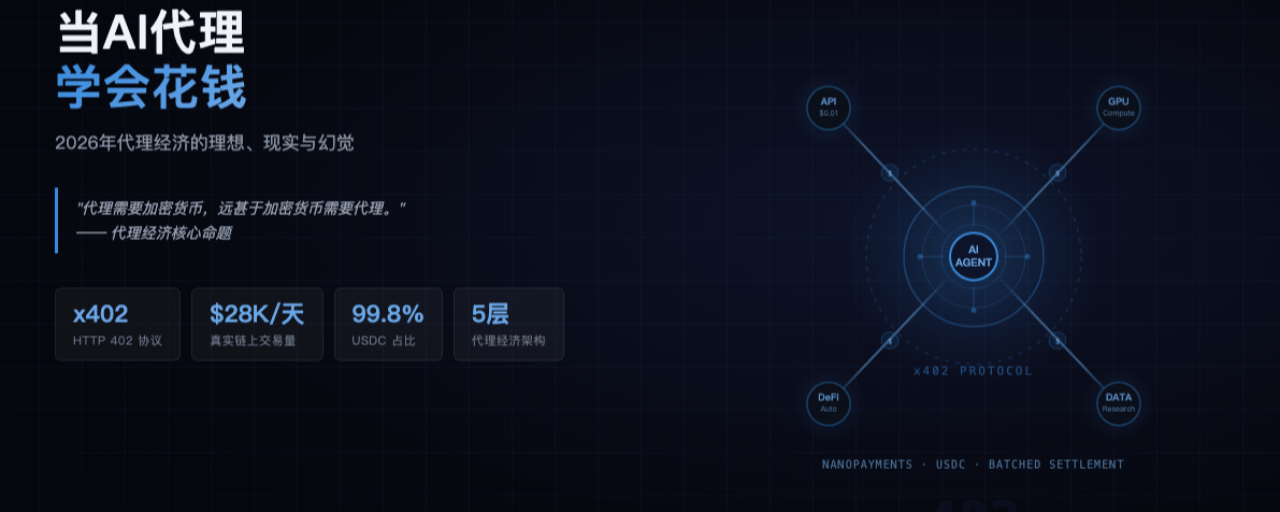

On September 22, 2026, Bitcoin broke through $86,000; the crypto Fear & Greed Index rose to 78—extreme greed. But the real focus isn’t on the price—it’s on a clue that most people overlook: AI agents are evolving from “can chat” to “can spend,” and the financial infrastructure enabling this leap is being built on the blockchain at astonishing speed.
Circle’s Agent Stack, Coinbase’s x402 protocol, Stripe’s preview of machine payments—when payment giants, stablecoin issuers, and cloud infrastructure providers all bet on the same direction, it isn’t coincidence; it’s a sign of an impending paradigm shift.
But what the data tells is another story: x402’s daily transaction count crashed 92% from the Dec 2025 peak of 730k to 57k; real commercial transactions may be only about half. Behind the official narrative of 150 million "cumulative transactions" is only about $28k/day of real settlements.
The ideal is rich, but reality is harsh. This article cuts through the narrative bubble and comprehensively examines the true picture of the agent economy in 2026—from technical architecture, ecosystem landscape, security risks, to the token paradox.
1. Why AI agents need cryptocurrency
To understand this transformation, first answer a fundamental question: why can’t AI agents just use bank accounts directly?
The answer is simple and brutal: autonomous processes can’t open bank accounts, can’t pass KYC, can’t sign legal contracts—but they can hold a private key.
This isn’t a detour; it’s the only path. An AI agent that runs 7×24 and requires micro-payments to be settled globally at millisecond frequency has no legitimate identity in traditional financial systems. Bank accounts are tied to natural persons or legal entities; credit cards require billing addresses; PayPal needs identity verification. But smart contract wallets on the blockchain only care about signatures—whether the signer is human or machine doesn’t matter.
This structural mismatch gives rise to a new proposition: agent economy (Agent Economy)—an economic system in which AI agents self-custody assets, discover services, and execute transactions. In this system, stablecoins (USDC) become a universal currency between machines; the blockchain becomes the settlement layer between machines; and in the HTTP protocol, the 402 status code that has been buried for 28 years unexpectedly found its mission.
Two. The x402 protocol: HTTP status code sleeping for 28 years
In 1997, the HTTP/1.1 specification defined status code 402 "Payment Required"—reserved for "future network-native payment mechanisms." This "future" gets first-class treatment for 28 years.
The reason is direct: credit card networks are too slow and fees are too high (2–3%), so they can’t handle micropayments; PayPal floats outside the HTTP layer; Stripe simplifies online payments but still needs merchant accounts, API integration, and high fees. The internet ultimately chose ads, subscriptions, and API keys as monetization modes—402 became a "placeholder" that was never turned on.
Stablecoins changed everything. On Base, transaction fees below $0.001 and second-level confirmations finally provide a payment channel that is fast enough, cheap enough, and programmable enough.
How x402 works: challenge-response payment flow
x402 is an HTTP-based challenge-response payment protocol. It doesn’t require a new transport protocol, doesn’t need WebSocket, and doesn’t need a custom authentication scheme. The entire payment flow is as follows:
The agent sends a normal HTTP request → GET /api/market-data
Server returns 402 + payment conditions → price $0.01 USDC, payee address, chain info
Agent pays authorization using a wallet signature (EIP-3009 TransferWithAuthorization)
The agent re-requests with a payment signature attached → PAYMENT-SIGNATURE header
Facilitator verifies the signature and submits the on-chain transaction
The server returns data → 200 OK
The whole process completes on the Base chain in about 2 seconds, and payment is confirmed on-chain before the response even arrives at the client.
Key technical decision: the agent uses EIP-3009 signed USDC transfer authorization—this is a no-Gas payment. The agent only needs to sign; it doesn’t need to submit an on-chain transaction and doesn’t need to hold ETH. The Facilitator submits the transaction. This means an agent only needs to hold USDC, massively lowering deployment barriers.
Key improvements in V2
The V2 version released in December 2025 brought three key upgrades:
Request header V1 → X-PAYMENT V2 → PAYMENT-SIGNATURE
Session support V1 → none (pay every time) V2 → wallet identity authentication, reusable sessions
Chain support V1 → Base/Ethereum V2 → Multi-chain (CAIP standard)
SDK architecture V1 → monolithic V2 → modular (expandable chains and solutions)
Session support is the biggest improvement. In V1, every API call requires an on-chain transaction, which is infeasible for high-frequency scenarios (streaming data, continuous calls). V2’s wallet identity authentication allows multiple requests after a single authentication, greatly reducing overhead.
Three. Circle Agent Stack: full-stack financial infrastructure for the agent economy
If x402 is the payment protocol, then Circle Agent Stack is an end-to-end financial operating system built for the agent economy.
Agent Stack, released in May 2026 with the latest update on Sept 14, is a chain-agnostic, protocol-agnostic infrastructure layer. Core components include:
Five major modules
Agent Marketplace — a directory where agents discover and pay for services Machine-readable format including pricing, capabilities, call methods; Discovery API supports programmatic queries
Agent Wallets — programmable USDC wallets Global caps, per-service limits, contract/chain allowlists, time-bounded sessions
Circle Skills — Best practices for paying with agent USDC Cross-chain transfers, wallets, smart contract interactions; the MCP server provides the latest SDK
Circle CLI — the agent original command-line interface Usable by both humans and agents: create wallets, define strategies, discover services, trigger transactions
Nanopayments — USDC payments with sub-tier granularity, no Gas Based on Gateway Nanopayments, batch settlement spreads Gas costs across thousands of payments
Supported chain ecosystems
Agent Stack currently supports 9 chains: Arbitrum, Arc testnet (mainnet coming soon), Avalanche, Base, Ethereum, Monad, OP Mainnet, Polygon PoS, and Unichain.
Notably, USDC has driven 99.8% of x402 transaction value—its dominance in the agent economy is almost unshakable.
What agents can do
An agent connected to Agent Stack can perform the following on-chain actions:
Onramp
Transfers
Executing smart contract calls
Signatures
Cross-chain bridging
Transactions/exchanges
Pay the endpoint fee via nanopayments
The technical elegance of nanopayments
Nanopayments is the most elegant design in Agent Stack. It solves a core contradiction: AI agents need high-frequency micropayments ($0.001 each), but the Gas cost per on-chain transaction can exceed the payment amount itself.
The solution is batch settlement: Gateway bundles many payment authorizations, settles them in a single on-chain transaction, and spreads Gas costs across thousands of payments. Agents don’t pay Gas per individual transaction—this is a paradigm-level innovation for traditional crypto payments.
A concrete use case: an AI agent doing deep research may need to call data APIs tens of thousands of times, each time paying $0.001. Credit cards can’t handle this granularity (fees exceed the payment amount), while nanopayments make $0.001 payments economically feasible each time.
Four. Big players enter: who is betting on agent payments
x402 protocol and the infrastructure of the agent economy have already attracted core players from Silicon Valley and Wall Street:
Coinbase (protocol designer) x402 released in May 2025; official Operator Facilitator; provides MPC wallets
Circle (stablecoin issuer) Agent Stack full-stack infrastructure; USDC accounts for 99.8% of x402 transaction volume
Cloudflare (infrastructure) Agent SDK integrates x402; MCP server supports x402 payments; co-founded the x402 foundation in Sept 2025
Stripe (traditional payments giant) Integrated x402 on the Base chain on Feb 10, 2026, supporting both crypto and credit-card dual rails; valuation reaches $140B
Google (an ecosystem competitor) Launches Agent Payments Protocol (AP2), focusing on human authorization compliance, extendable via x402 to support stablecoins
Anthropic (AI model provider) Cooperates with x402 (while keeping its own API billing system)
Stripe’s entry is the most iconic signal. As one of the largest online payment processors in the world, Stripe’s decision to heavily back x402 is a top-tier confirmation of the incremental market of "machine customers." Its machine payments preview lets developers, with just a few lines of code, have AI agents pay API fees on the Base chain using USDC.
CoinGecko also simultaneously activated the x402 endpoint, offering real-time on-chain data to agents at $0.01 USDC per request—one of the first API services to truly accept agent payments.
But big-player entry also means competition. Google’s AP2 focuses on human authorization compliance, while x402 focuses on M2M (machine-to-machine) settlement. Are they complementary or competitive? 2026 is the critical window.
Five. The full landscape of the AI agent crypto ecosystem: who is doing what
Expanding the view from the payment layer to the entire AI×Crypto ecosystem, the landscape in 2026 shows a clear five-layer architecture:
A five-layer stack for the agent economy
Compute layer — GPU inference/training compute markets Representative projects: Render (RENDER), Akash (AKT)
Model & inference layer — decentralized model production and pricing Representative project: Bittensor (TAO)
Agent infrastructure layer — wallets/key management, payment protocols, identity registration Representative projects: Circle Agent Stack, x402, Chainlink (LINK)
Framework & platform layer — open-source runtime, agent starters Representative projects: ElizaOS/ai16z (AI16Z), Virtuals (VIRTUAL)
Application layer — trading agents, DeFi management agents, research agents Representative projects: Olas (OLAS), Fetch.ai (FET)
Critical project reviews
Bittensor (TAO) — an incentive-driven machine intelligence network. Subnet miners produce digital goods (inference, embeddings, data, predictions); validators score them and emissions are allocated by score. Fixed supply of 21 million, with a halving schedule. Bull logic: if any subnet produces frontier-level results, incentive mechanisms can scale without central coordination. Bear logic: validator scoring is a central point of failure; subnet quality varies widely; most TAO demand historically comes from emission chasers rather than terminal customers.
Fetch.ai / the Artificial Superintelligence Alliance (FET) — a pioneer concept of autonomous economy agents, later merged with Ocean Protocol and SingularityNET. It has long-term engineering accumulation, usable agent registries, and real enterprise pilots. But the merged entity diluted focus; it was commercialized by others repeatedly after the concept was proposed earlier than they did.
Virtuals Protocol (VIRTUAL) — agent launcher. Anyone can create tokenized agents priced via bonding curves. It drove massive speculation and proved the real product-market fit of "launching agents"—if the agent itself may not be so. Core question: does token value come from agent utility, or only from launch speculation?
ElizaOS / ai16z (AI16Z) — the open-source agent framework most forked in the crypto space. Plugin architecture covers social platforms, chains, and model providers. The key contradiction: the framework is adoptable in a real, measurable way, but the software is under permissive licensing—anyone can run it without touching the token. Winning the framework battle and monetizing it are two different things.
Olas / Autonolas (OLAS) — autonomous services across multi-agent systems, with on-chain accountability. The staking design is bound to the agents’ "actual executed work"—one of the more rigorous attempts to relate emissions to outputs rather than locked-in amounts. Technically intensive, but never a retail-frenzy narrative moment.
Render (RENDER) and Akash (AKT) — distributed GPU compute markets. The cleanest demand mechanism: customers pay for truly large-scale real services; usage is directly observable. But they face the harshest competitive reality—competing with hyperscalers that have scale advantages.
A fight at the execution layer
Solana Advantages: sub-tier fees make high-frequency autonomous behavior feasible Positioning: consumer-level agent activity and token issuance
Ethereum Advantages: standards are set here; the largest value pool Positioning: account abstraction, delegation, agent identity registration
NEAR Advantages: intent architecture—the agent expresses goals, not transactions Positioning: cross-chain intent execution
TON Advantages: a message-platform distribution channel Positioning: consumer-grade agent interface
Solana captures a disproportionate share of consumption-level agent activity and token issuance—sub-tier fees make high-frequency autonomous behavior feasible. Ethereum is where standards are set; L2 inherits standards and also provides fee levels close to Solana.
Six. The "autonomy illusion" in the agent economy
This is the most underestimated issue in the entire track.
Most agents branded as "autonomous" are not actually autonomous.
Let’s look at four key modes of key management:
Mode One: Operator holds the hot key Feature: simplest and most common; the operator can do everything the agent can do Autonomy: autonomy is marketing, not architecture
Mode Two: Threshold signatures/MPC Feature: no single party can sign independently; increased requirement for active coordination Autonomy: trust is transferred to the arbitration strategy
Mode Three: Smart contract accounts + scoped session keys Feature: On-chain enforced restrictions (max value/transaction, cumulative spending/time window, contract allowlists, expiration) Autonomy: the mainstream model in 2026
Mode Four: Keys inside the TEE Feature: Keys only exist within the authenticated enclave; the operator cannot secretly change behavior Autonomy: The only defensible configuration for a "no one controls the agent" setup
A simple fact check: Unless the agent runs inside an authenticated enclave (TEE), generates keys internally, and its code hash is publicly known, "autonomy" is intent, not architecture.
Rule of thumb: unless authentication is verifiable, assume the operator controls it.
A harsher observation from security researchers: "A project that describes its agent as 'reading social media and trading autonomously' but doesn’t describe these controls is describing a vulnerability."
Seven. Real data vs promotional narratives: a calm look at x402
This is the most controversial part of this article—also the most valuable part.
Official narrative
x402 official (as of March 2026) claims:
Cumulative 150M+ transactions
Settlement volume of tens of millions of dollars
On-chain reality
An on-chain report released by Artemis in March 2026 reveals a completely different picture:
Daily transaction volume Official narrative → 150M+ cumulative On-chain reality → about $28,000/day
Daily transaction count Official narrative → not disclosed On-chain reality → about 131,000 txs (estimated)
Average transaction value Official narrative → not disclosed On-chain reality → about $0.20 per tx
Share of fake transactions Official narrative → not mentioned On-chain reality → about 50% (including self-trades and wash trading)
Real commercial transactions Official narrative → tens of millions of dollars On-chain reality → possibly only about $14,000/day
An even more alarming trend: the number of trades crashed from a daily average peak of 731,000 in Dec 2025 to 57,000 in Feb 2026—a drop of over 92%.
What does that mean?
This isn’t a technical failure; it’s a value reversion after the hype tide. The core driver behind the transaction volume crash is a phase pullback in the "infrastructure & tools" track—testnet application activity like x402secure.com fell by over 80%, showing the current phase is still a inventory cycle of "tools ready, demand waiting to be incubated."
But this also reveals a deeper problem—cold-start dilemma: no merchants → agents have no services to get paid for → developers have no incentive to integrate x402 → no merchants. The classic "chicken-and-egg" problem.
A sobering analogy: Stripe in 2011. The technology was fine, but who used it? Stripe took years to become infrastructure. x402 may need the same kind of patience.
McKinsey’s long-term projection
Even though data is cold right now, a McKinsey October 2025 report (automation curve in agent commerce) predicts that by 2030 AI agents could mediate $30–50 trillion of global consumer commerce. That number is larger than the entire crypto market’s current market cap.
The problem is: from a daily transaction volume of $28,000 in 2026 to trillions of dollars in 2030—the gap to cross is not just technical, but also regulatory, business models, and trust.
Eight. The deep abyss of security: the most dangerous vulnerability in agent economies
Prompt injection—an unresolved class of vulnerability
Any agent that reads untrusted text (webpages, social posts, token names, memos, governance proposals) may have instructions injected. LLMs can’t reliably distinguish data from instructions.
Demonstrations in the crypto space have already proved it: agents can be tricked into leaking system prompts, approving transfers, and endorsing assets controlled by attackers.
No fully defensible solution. Mitigations are layered: strict instruction/data separation, deterministic allowlists (model outputs can’t cover), on-chain spending caps, manual confirmation when above thresholds, and treating all ingested content as hostile.
"A project that describes its agents as 'reading social media and trading autonomously' but doesn’t describe the controls is describing a vulnerability."
Economic manipulation
Adversarial manipulation of known inputs: low-liquidity price manipulation triggering rebalancing, coordinating emotions, adversarial ordering/front-running. Agents are an ideal target for mature counterparties: consistent, fast, and unable to notice they’re being harvested.
Defense mechanisms: randomize timing, private transaction submission, oracle pricing, and non-deterministic strategy elements—almost nobody implements them.
Cascading risk
Many agents share the same model providers, data sources, and similar strategies → correlation. A change in a single upstream component (model update, oracle outage, API downtime) can trigger synchronized actions across large groups of agents.
This is a cascaded simulation of programmatic trading in the agent economy—systemic risk that doesn’t exist under heterogeneous independent human timetables. Mitigations (circuit breakers, interleaved execution, strategy diversity)—almost no projects implement them.
Key compromise and permission sprawl
Agents accumulate authorizations; long-running DeFi agents may hold unlimited approvals for dozens of contracts. The scope of compromise isn’t limited to balances, but to everything that has ever been approved.
Nine. The paradox of token value: agent success ≠ agent token success
This is the deepest investment insight in the entire AI×Crypto space:
"Treat the agent argument as roughly correct, and treat the agent token basket as roughly wrong."
Core contradiction
Adoption of open-source frameworks is real and measurable, but the software is under permissive licensing—anyone can run it without touching tokens. Unless the token is a necessary condition to access scarce resources, the connection between token success and software success is emotional, not mechanistic.
Three models of value capture
Consumption-based — burn/pay proportional to usage Mechanism strength: strongest Representatives: compute markets, oracle networks
Permissioning type — necessary to participate in the network Mechanism strength: medium Representatives: incentive networks, staking protocols
Demand-seeking — shares platform activities but not required Mechanism strength: weakest Representatives: most launcher/framework tokens
The fatal flaw of demand-seeking tokens: the underlying product runs well even without the token. The relationship between token and product is only the name.
Real demand validation
A simple question can filter out lots of noise: who pays, what currency, and why can’t they get it cheaper elsewhere? If the answer is mainly governance/ecosystem/community → no demand model.
Most likely outcome distribution
A small number of infrastructure assets: consumption-linked demand, with room to grow as categories grow
Fewer application-layer projects: sitting in defensible niches (two-sided markets or accumulating reputation)
The vast majority (framework tokens without monetization, launcher products, persona tokens) → become irrelevant
The most practical strategy: if you want to bet on the agent economy, buy the underlying layer that agents will use—execution layer, oracles, compute networks—rather than the agent token itself.
Ten. Three future scenarios
Scenario One: Infrastructure absorbs it (highest-probability path)
Agents become ubiquitous, but value ultimately sinks into the underlying layer. Payment protocols, identity registration, the execution layer, and compute networks see measurable usage growth. Frameworks become fully commoditized. Most agents’ exclusive tokens fade away; a few infrastructure assets compound.
Observation markers: M2M stablecoin settlement growth; agent-initiated transactions become a measurable share on major chains; framework tokens and framework adoption decouple.
Scenario Two: the agent economy takes shape
Massive agent trading; autonomous service providers have durable reputations; an agent-to-agent supply chain; capital allocated to agents’ operating businesses; on some chains, agent-to-agent transaction volume exceeds human-initiated volume. Reputation registration becomes critical infrastructure.
Prerequisite: reliable task-execution verification + legal/economic recourse frameworks.
Scenario Three: capture by closed platforms (bearish path)
Major AI platforms release integrated agent payments/identity/business offerings, gaining regulatory approval and distribution. Encrypted channels keep the real but narrow subsegments (unlicensed finance, anti-censorship, cross-border). The industry becomes specialized rather than scaled.
Things that could happen in all scenarios
Standard integration: by 2028, one dominant tool access protocol, one or two payment protocols, and a small number of identity/reputation registrations
Regulation is clear: rules for autonomous financial agents (identify accountable humans/entities, transaction limits/reporting, allocation of responsibility)
Verification costs decrease: if proof costs keep dropping, cryptographically verifiable inference will become practically usable
Specialization beats generalization: niche-domain agents win commercially over general agents; durable applications will be unglamorous
A major incident: a high-confidence prediction—one large public agent-related loss (prompt injection drained the treasury, correlated liquidation, compromised plugins). Consequence: a hard shift toward authenticated execution and bounded authority
Eleven. Cold thoughts: three walls blocking scale
The first wall: business model reshaping
Tech giants are used to taking a 30% cut through the channel. Point-to-point machine payments naturally have "disintermediation" genes. Cloudflare’s proposed "delayed payment + batch settlement" solution (supports a mix of credit cards and stablecoins) may be the best compromise point between giants and traditional models—but it also means that x402 could become a plugin inside a giant’s ecosystem instead of an independent standard.
The second wall: the regulatory vacuum
Autonomous payments by agents involve complex legal issues: if an agent spent money, who is responsible? What if it goes beyond budget? Who do you pursue in a dispute? There is currently no clear legal framework.
This is not just a technical problem, but an institutional design problem. Enterprise-scale adoption before a regulatory framework is implemented is almost impossible. Personal agents may be able to roam in gray areas, but agents holding institutional funds must comply.
The third wall: the verification bottleneck
Blockchains are deterministic; neural inference isn’t. This is the hardest problem in the agent economy.
TEE (trusted execution environment) Advantages: hardware-authenticated execution of specific code on specific inputs Disadvantages: trust ultimately comes down to the silicon vendor; side-channel attacks are actively studied
Optimistic verification + challenge window Advantage: assume honesty, publish claims, and let observers challenge within the window Disadvantage: adds latency; requires honest incentivized observers to challenge
Cryptographic proofs for inference Advantages: ZK proofs produce a specific output from a specific model—gold standard Disadvantages: still too expensive for large models to make it practical
In practice: most systems use consensus among redundant executors + economic staking, keeping expensive validation for the highest-value decisions. Ask any project what exact approach they use—answers are often "none."
Twelve. What a "good" agent is: a pragmatic evaluation framework
Between hype and skepticism, how do you identify agent projects with real value? The following 7-step framework can complete an initial assessment in 1 hour:
Demand validation: who pays, what currency, and why can’t it be cheaper elsewhere? If the answer is governance/ecosystem/community → no demand model.
Independent verification by usage: directly inspect on-chain data—contract calls, unique active addresses (30 days, excluding team wallets), fee revenue, external/internal transaction ratios. Look at 6-month trends, not absolute numbers.
Reading security architecture: how do agents sign? does the operator hold the key? limits on-chain vs app layer? simulation? deterministic strategy layer? authenticated execution? The absence of documentation itself is a discovery.
Token distribution and calendar: FDV, circulating percentage, allocation table, unlock calendar; monthly issuance as a percentage of daily transaction volume; concentration of holdings.
Alignment: aligned with which tool/payment/identity standard? Aligning with emerging leading standards = inheriting the ecosystem.
Engineering surface: look at the repos, not announcements—test coverage for unique contributors, issue responses, and tests for funding-related code; audit history.
Pressure-test failure modes: what if the model provider changes behavior/pricing? what if main data sources go offline? prompt injection? token down 80%? the founding team stops working?
Red flag (exclude immediately)
Agents hold user funds but have no public authentication and anonymous operators
Non-verifiable claims of autonomous profitability
Revenue numbers include token emissions or internal transfers
The only relationship between a framework token and the framework is the name
Marketing emphasizes agent personas instead of functionality
Insiders hold the majority and recently unlocked
Green flag (focus on)
Publish external revenue and include paid-party details
Authenticated execution with verifiable code hashes
On-chain enforced permission limits (not a promise)
Integrate emerging cross-ecosystem standards
Specific and narrow use cases with measurable success criteria
Consumption-linked token mechanisms (eliminating supply via usage)
Engineering communication: candid discussions of failure modes
Thirteen. Real-world use cases for agent economies, and the long war
Existing real-world use cases today
DeFi automation: recently commercialized use cases—fully digital environment, instant feedback, and counter-parties are smart contracts (market making within narrow risk boundaries: liquidation monitoring, cross-chain routing, compliance filtering)
Machine-to-machine commerce: high-frequency, low-value transactions that traditional rails can’t serve
Consumer-grade intent execution: natural language goals, cross-chain multi-protocol execution—possibly proportional to the number of users max
Use cases being repriced
Autonomous social personas + tokens—this is a distribution innovation, not a durable business. The market has repriced it: after the speculation wave of 2024–2025, most launcher tokens retraced 90%+ and most launched agents are dormant.
In 2026, a clear K-shaped divergence emerges: on one end, pure Meme-type AI agent token heat cools down and money flows out; on the other end, Facilitator and audit-layer projects that can integrate x402 start getting rational buy-side demand.
Characteristics of the long warfront
Truly durable applications will be unglamorous—not chatty AI personas, but autonomous services silently executing clearing, routing, and compliance checks in the background. Like the infrastructure layer of the internet—you use it every day but never notice.
Fourteen. Conclusion: when machines start using money
In 2026, the agent economy is at the "bubble burst valley" point on Gartner’s technology maturity curve.
The sudden drop in on-chain transaction volume isn’t a technical failure; it’s a return to value after the hype tide recedes. Similar to early internet TCP/IP—building payment standards often requires a dormancy period of 5 to 10 years.
But the trend is real: model reliability has crossed a threshold, and payment and identity standards are in place; stablecoins have become true financial infrastructure. When Stripe, Coinbase, Cloudflare, and Google all step in, it’s not a coincidence.
The key tension is across three layers:
At the technical level, verification is the unresolved bottleneck. Blockchains are deterministic; neural inference isn’t. Until reliable execution verification exists, "autonomy" is always a matter of degree—not a binary judgment.
Economics: value capture for agent tokens is highly uneven. Infrastructure-layer needs are measurable; most framework and application-layer lack a mechanism-based connection. If you believe in the future of agents, buy the underlying layer; if you believe in specific agent projects, require seeing external revenue.
Institutional layer: when agents spend autonomously, who is responsible? Before regulators answer that question, enterprise-scale adoption is a locked door.
So, returning to the opening premise—"agents need cryptocurrency, far more than cryptocurrency needs agents"—it still holds in 2026. Agents are a brand-new class of customer for crypto infrastructure: 7×24 operation, millisecond-level settlement, not dependent on emotions, and not limited by how many decisions humans can make per day.
But agent tokens may need longer to prove themselves.
When an AI agent first autonomously decides to pay you $0.001 in USDC for your research, you might marvel at the technical elegance. But when it transfers your entire balance to an attacker because of an injected prompt, you’ll realize—autonomy isn’t a switch; it’s a spectrum, and we’ve just stepped onto the starting point of that spectrum.
When machines start using money, humans need to answer not only "how much it can spend" but also "if something goes wrong, who is responsible"—and an even more fundamental question:
If an agent can self-custody assets, make decisions autonomously, and trade autonomously, does it still need a master? Or has it already become its own master?