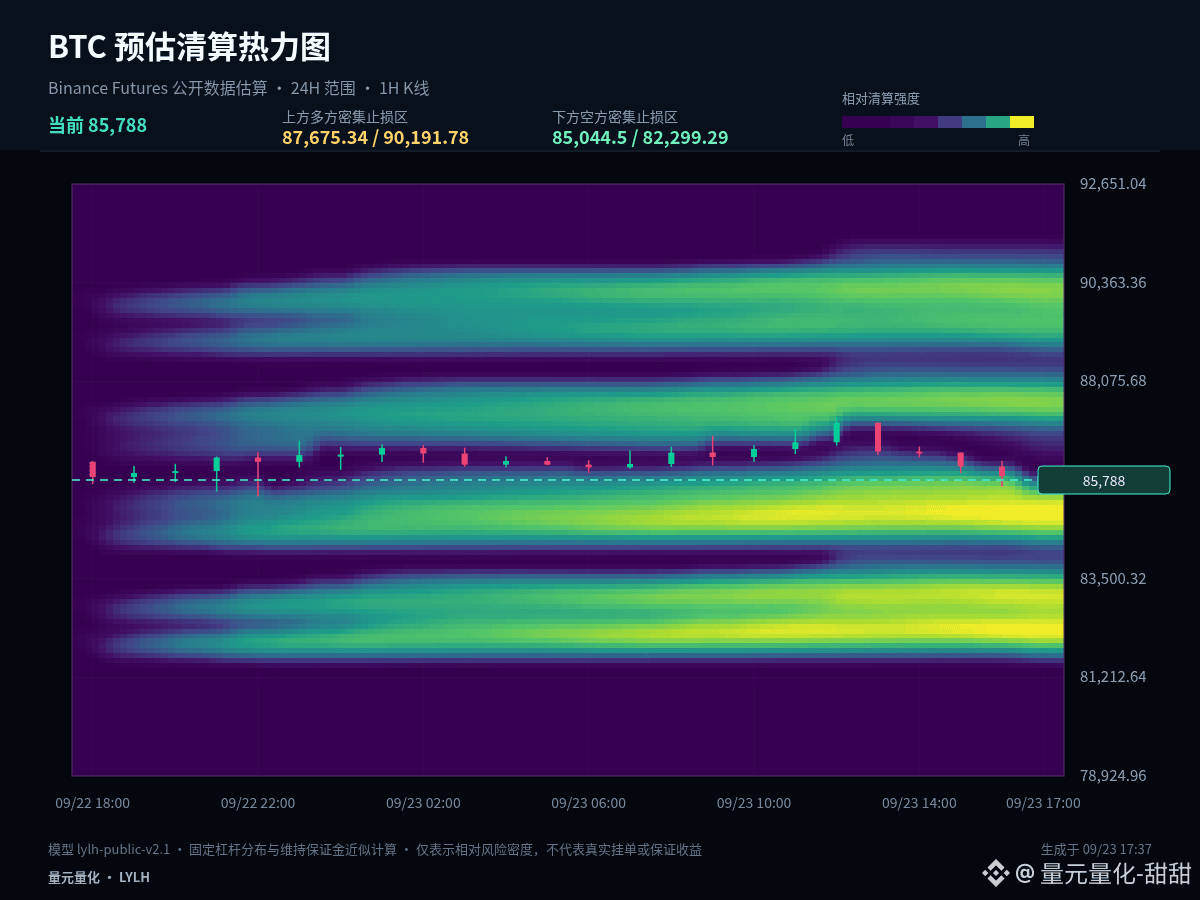
$BTC #BTC Order book record: Current price 85,819.92, 1 hour -0.09%, 24 hours -0.22%, recent 24-hour amplitude about 2.1%. First write down the data and my judgment at this moment, then verify later using the price action.
$BTC #BTC is still trading within the range of the past 24 hours, repeatedly switching hands. There isn’t a clear directional advantage. The mid-range area is the most challenging for patience; waiting for boundary signals is usually more effective.
For a short-term view, first watch whether 85,461.53 can form continuous support, then whether 86,370.04 can be regained. The former determines whether the selloff can slow down, and the latter determines whether the rebound can strengthen. Without confirmation for both, it’s not advisable to judge opportunities based solely on the magnitude of the drop.
My analysis isn’t a one-way bet. If the price breaks above 87,278.54 and can hold, it means upside space has been reopened. If it breaks below 85,461.53 and can’t reclaim it on a retest, it indicates the structure is further weakening. If it trades between the two levels, continue observing the closing behavior on both sides around 86,370.04.
When reviewing later, I will check three things: how the price reacts when it first approaches the key level, whether the 1-hour close completes the confirmation, and whether the plan is adjusted according to time once the judgment is invalidated. Compared with only recording outcomes, these three items reveal execution problems more effectively.
Risk control still comes before the conclusion: execute only when conditions are met; if the price invalidates the setup, reassess promptly. The greater the volatility, the more restrained you should be with each single position. The above is a scenario-based analysis based on the current 1-hour and 24-hour data, and it does not constitute a promise of returns.
#CardanoJoinsX402PaymentStandard
$BTC #BTC is still trading within the range of the past 24 hours, repeatedly switching hands. There isn’t a clear directional advantage. The mid-range area is the most challenging for patience; waiting for boundary signals is usually more effective.
For a short-term view, first watch whether 85,461.53 can form continuous support, then whether 86,370.04 can be regained. The former determines whether the selloff can slow down, and the latter determines whether the rebound can strengthen. Without confirmation for both, it’s not advisable to judge opportunities based solely on the magnitude of the drop.
My analysis isn’t a one-way bet. If the price breaks above 87,278.54 and can hold, it means upside space has been reopened. If it breaks below 85,461.53 and can’t reclaim it on a retest, it indicates the structure is further weakening. If it trades between the two levels, continue observing the closing behavior on both sides around 86,370.04.
When reviewing later, I will check three things: how the price reacts when it first approaches the key level, whether the 1-hour close completes the confirmation, and whether the plan is adjusted according to time once the judgment is invalidated. Compared with only recording outcomes, these three items reveal execution problems more effectively.
Risk control still comes before the conclusion: execute only when conditions are met; if the price invalidates the setup, reassess promptly. The greater the volatility, the more restrained you should be with each single position. The above is a scenario-based analysis based on the current 1-hour and 24-hour data, and it does not constitute a promise of returns.
#CardanoJoinsX402PaymentStandard