


As the issuance models for Meme, RWA, and new types of Tokens on BNB Chain continue to evolve, the choice for projects is no longer just about “where to launch tokens.” It also includes how the tokens are traded after issuance, liquidity, and subsequent operations.
Among them, Four and Flap are currently the two most representative routes.
Four: a more direct Meme Launch model
Four’s core strength is that its issuance process is relatively straightforward.
In general, it can be understood as:
Create Token → Bonding Curve → Meet the conditions → DEX
After the project completes the basic settings such as Token Name, Symbol, and Logo, the Token enters the Bonding Curve phase. As market trading progresses, it ultimately moves into the next-stage DEX liquidity phase.
This model is more suitable for Meme projects that want to launch quickly. Four also supports multiple Raised Tokens, including BNB, USDT, USD1, ASTER, U, USDC, CAKE, and more, so the project team can choose different quote assets based on the issuance scenario.
For projects that don’t need complex Tokenomics, the simple issuance process itself is an advantage.
Flap: more emphasis on Tokenomics and programmability
By contrast, Flap is more oriented toward Programmable Token Launch.
In addition to basic Token creation and the Bonding Curve, Flap also offers mechanisms such as Tax Token, Creator Buy, Dividend, Burn, Liquidity, Vault, and more.
For example, the project team can set Buy Tax and Sell Tax, and further allocate the related funds to purposes such as Creator Funds, Dividend, Burn, or Liquidity.
This allows the Token to incorporate more economic mechanisms already at creation, rather than just locking in the name, supply, and logo.
Flap’s Permissionless Launch further expands the issuance modes and supports custom quote assets. For RWA, ecosystem tokens, or projects associated with specific assets, the Quote Token itself can also become part of the issuance design.
In addition, Flap also provides mechanisms such as Anti-Farmer Protection, starting to focus on the early trading and liquidity environment after the token goes live.
What’s the difference between Four and Flap?
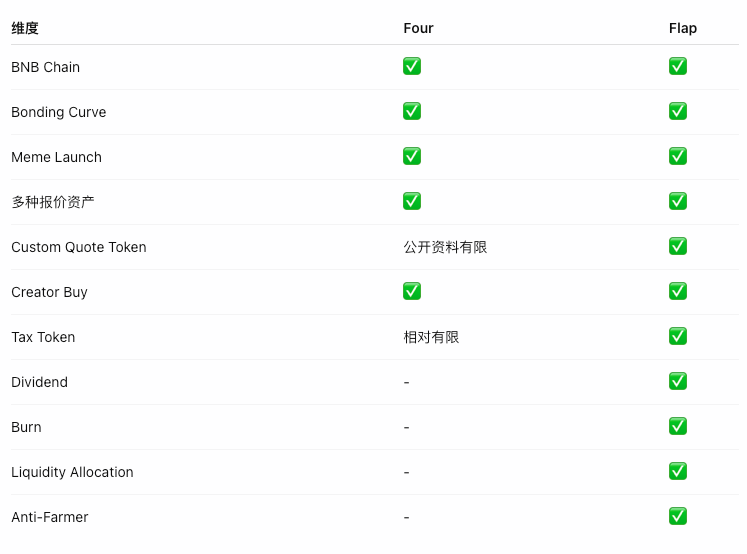
In short, Four is more geared toward a mature, straightforward Meme launch; Flap, on the other hand, provides more Tokenomics and issuance parameters.
If you’re only issuing a single, structurally simple Meme, the focus may be on the issuance process and market launch efficiency; if the project involves Tax, Holder Rewards, Burn, Liquidity, or a custom Quote Token, you’ll need to consider the Token model itself further.
After the token is issued, it’s followed by another set of operational workflow.
Whether you choose Four or Flap, creating the Token doesn’t mean the project is over.
After that, it typically also involves Creator Buy, multi-wallet trading, Bonding Curve phase operations, DEX trading, liquidity management, and ongoing market operations.
Therefore, in actual operation, besides the Launchpad itself, you will also come into contact with different on-chain tools. For instance, some third-party tools provide features like bundlers, multi-address trading, and batch operations for issuance platforms such as Four and Flap, helping project teams reduce repetitive manual work.
CiaoTool is also in this category of third-party tools. It currently provides Bundler, multi-address buying/selling, and other BNB Chain on-chain operations related to Four and Flap.
It doesn’t change the issuance mechanism of Four or Flap itself. The project team still needs to choose the corresponding Launchpad based on the Token type and issuance requirements.
Four or Flap?
This is actually not a simple “either-or” choice.
Four is better suited for standardized, fast-launch Meme tokens; Flap is better suited for projects that need further design for Tax, Dividend, Burn, Liquidity, or a Quote Token.
As BNB Chain Token Launch gradually expands from purely Meme issuance into more diverse token models, what truly needs to be considered in the future may not only be:
What issuance mechanism should the Token use, and how will it run after issuance.
From this perspective, Four and Flap are more like two different issuance approaches, and the subsequent on-chain tools are designed to solve the specific operational problems based on these issuance models.