


TIA is Celestia’s native cryptocurrency, a first-layer infrastructure that pioneered a significant structural shift in the architecture of decentralized systems.
Unlike conventional blockchains, which process all operational stages in a single unified protocol, Celestia was designed as a modular network specialized exclusively in consensus and data availability.
The TIA token functions as the economic foundation of this mechanism, ensuring operational security, the settlement of data storage fees, and ecosystem governance.
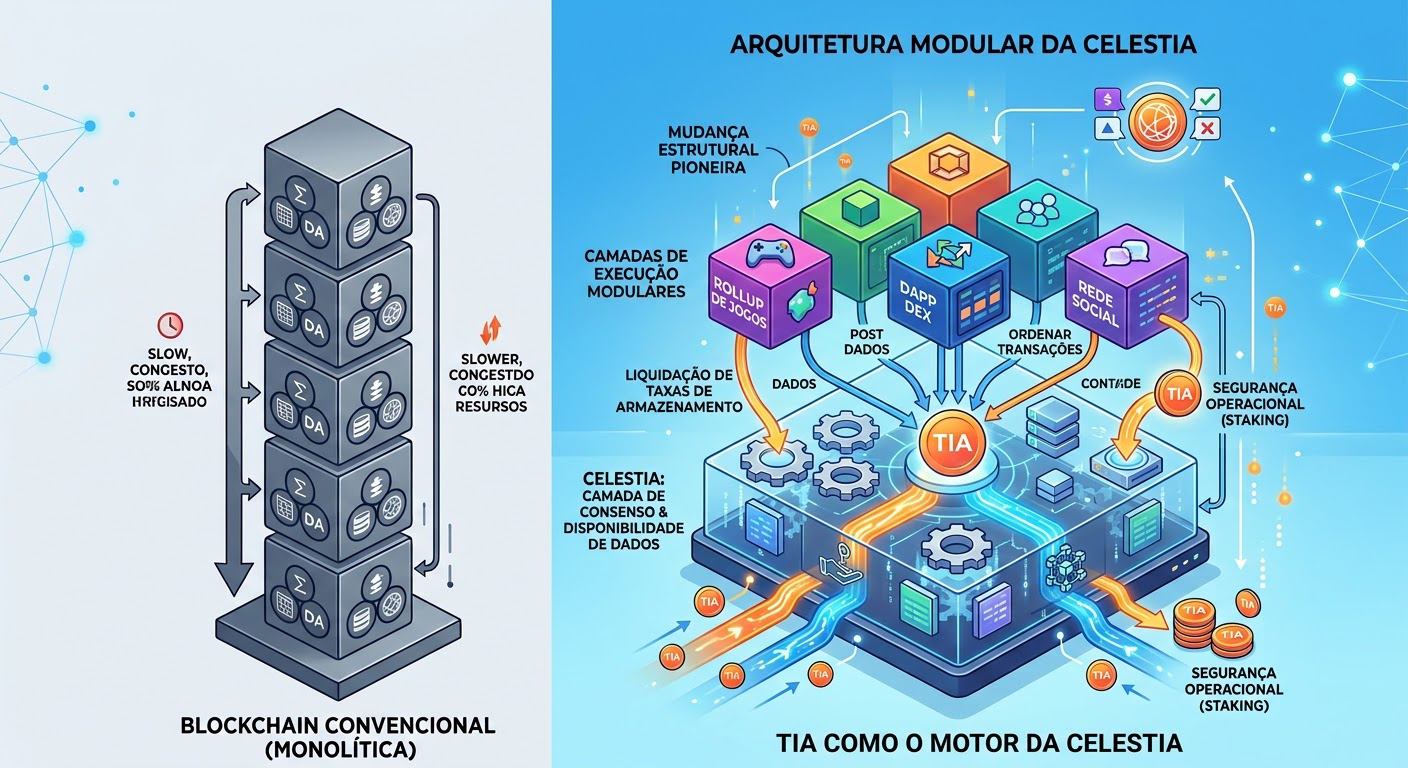
What Is Celestia and the Role of the TIA Token
To understand TIA’s role, it is essential to grasp the limitations of traditional, called monolithic networks.
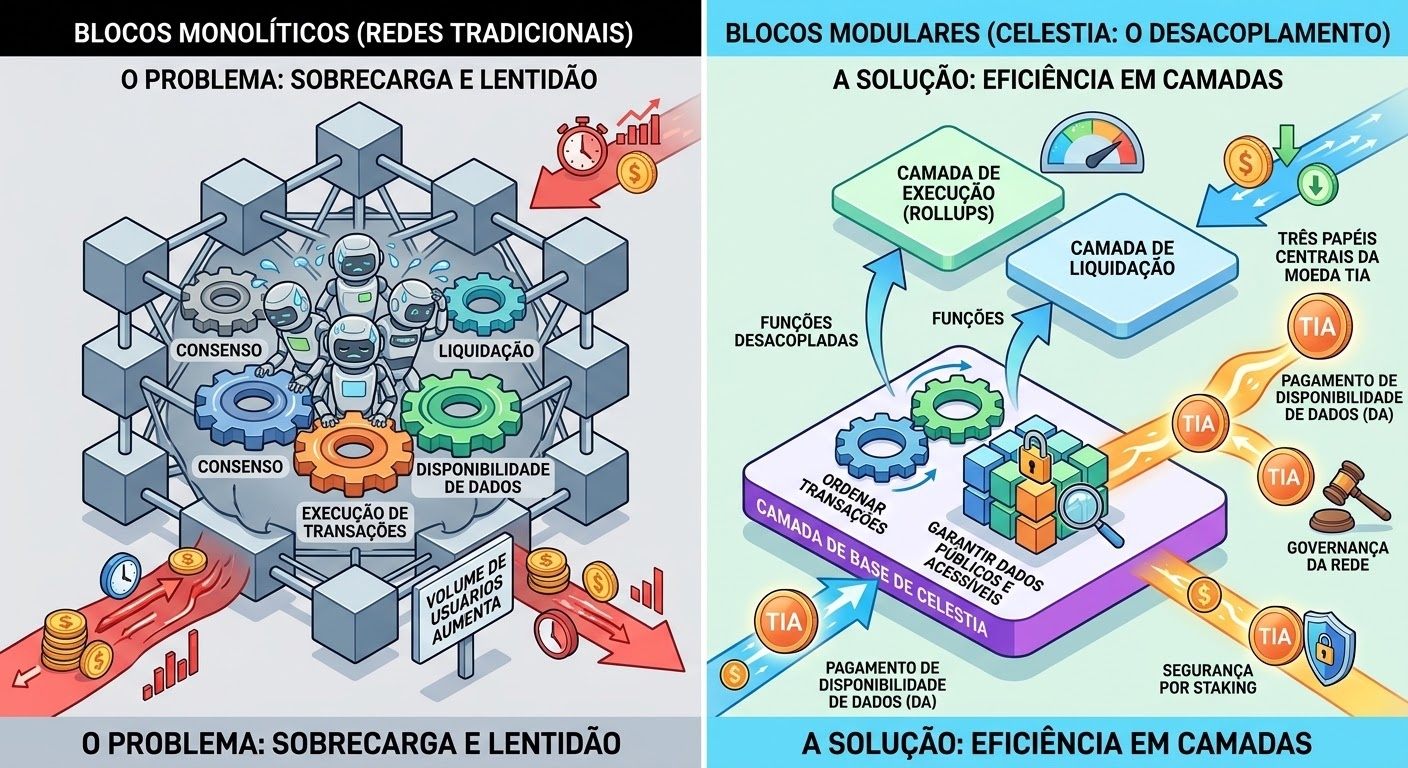
In networks like Bitcoin and Ethereum in their basic design, the same set of validators needs to simultaneously perform four functions: consensus, settlement, transaction execution, and data availability.
As the volume of users increases, this technical overhead causes sluggishness and severe increases in transaction fees.
functions in autonomous layers. The network gives up on executing smart contracts and focuses only on ordering transactions and ensuring that all block data is public and accessible for verification.
In this environment, the TIA coin plays three central roles:
1. Payment for data space:
Second-layer networks and applications that use Celestia pay fees denominated in TIA to securely write and publish their data batches.
2. Network security through consensus:
Celestia uses the proof-of-stake mechanism. TIA holders lock their tokens with validating nodes, strengthening network security and receiving incentives for that protection.
3. Decentralized governance:
Participants use TIA to vote on technical improvement proposals, fee adjustments, and the allocation of resources from the community treasury.
TIA’s Main Contributions to the Crypto World
The proposal brought by TIA and Celestia ushered in a new phase in decentralized systems engineering. Its main contributions include:
Drastic reduction in transaction costs
Historically, publishing transaction data on main networks represented up to ninety-five percent of the operating costs of second-layer networks.
By offering a dedicated, highly optimized layer for data availability, Celestia significantly lowers the cost of this process. This saving directly translates to end users, enabling minimal fees.
Decentralization with light verification
Through an innovation called data availability sampling, Celestia’s light nodes can verify the integrity of blocks by downloading only small random fractions of data.
This makes it possible for everyday users to participate in network security using modest equipment, such as personal computers and mobile phones, without giving up decentralization while the system’s capacity scales.
Agility in launching new networks
In the traditional model, creating a new blockchain requires mobilizing hundreds of validators and raising large amounts of capital to secure the network.
With the infrastructure enabled by TIA, developers can launch customized blockchains with speed similar to deploying a smart contract, leveraging the consensus and data availability already established by Celestia.
Autonomy and flexibility for developers
By decoupling the execution of the data layer, developers gain complete freedom to choose the most convenient programming environment for their application, whether it’s the Ethereum virtual machine, Solana-based technologies, or customized languages.
TIA established modularity as a viable response to work around the scalability, security, and decentralization trilemma.
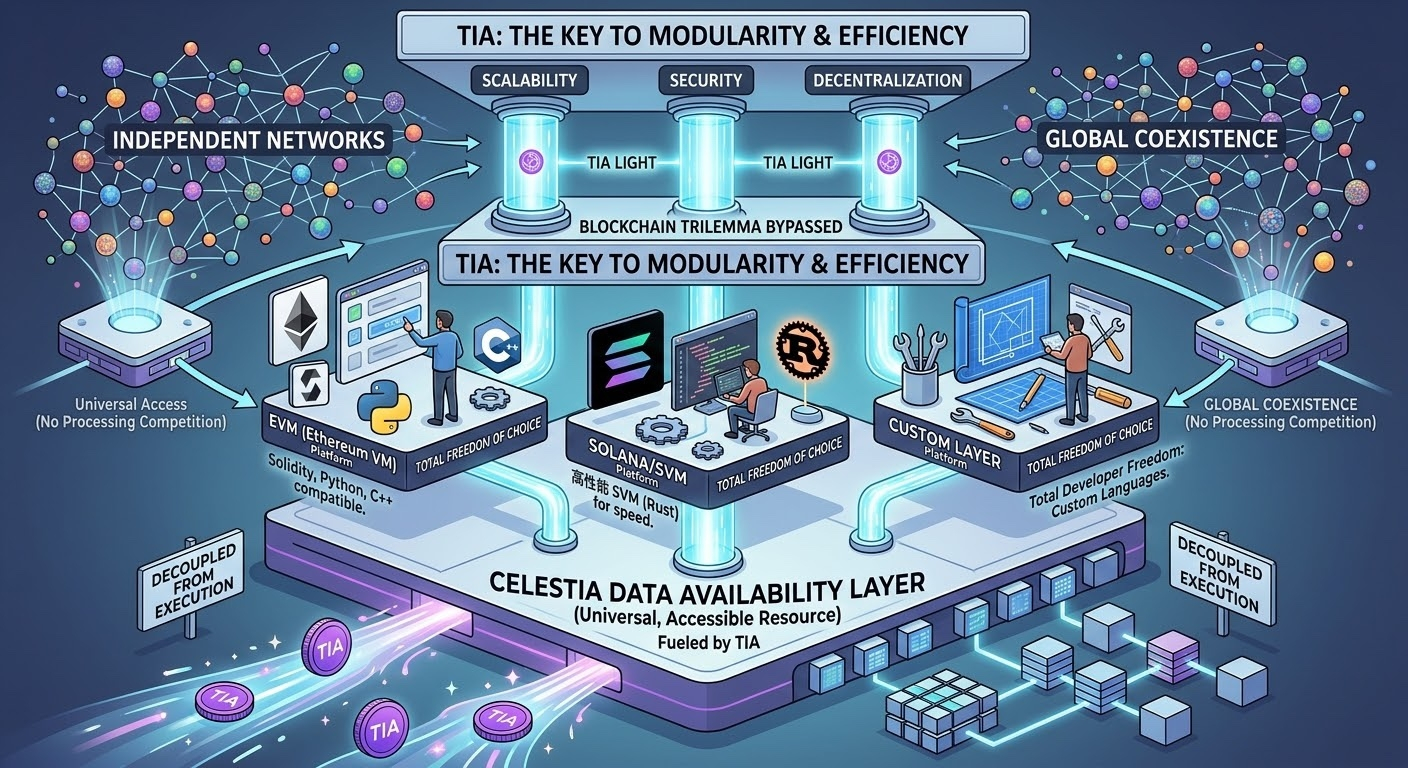
By turning data availability into a universal and accessible resource, the technology opened a path in which hundreds of independent networks coexist efficiently without competing for the same limited processing space.
