



Byline: Rita
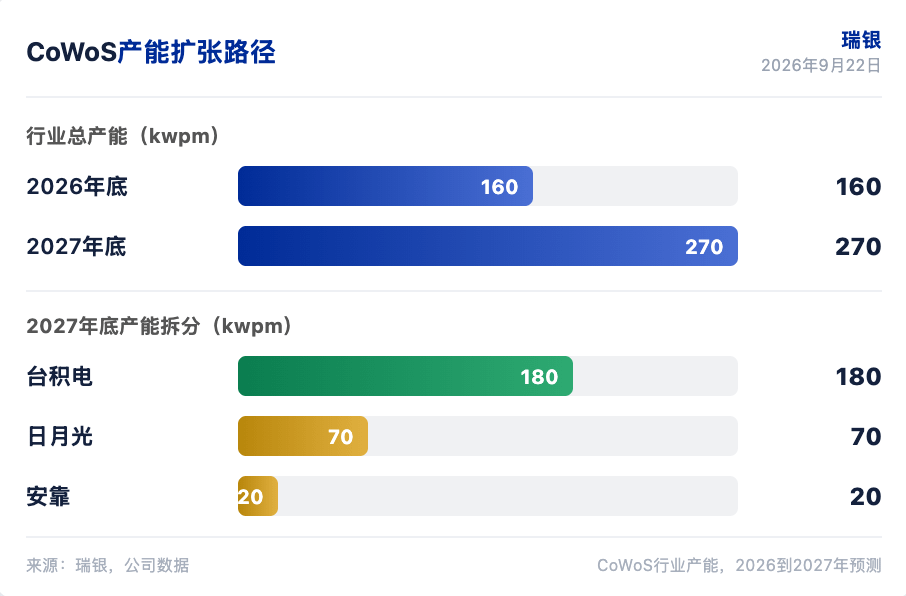
The market is concerned about a slowdown in AI chip demand, yet UBS increased its industry capacity forecast for CoWoS (chips mounted on substrates from wafers) by year-end 2027 from 260 kwpm (thousand wafers per month) to 270 kwpm. In its global input-output semiconductor report released on September 22, 2026, UBS noted that current visibility points to the need for further expansion in 2028. Even if Intel’s EMIB-T and TSMC’s CoPoS ramp up in 2028 to 2029, ASIC and CPU demand will still remain largely within the CoWoS ecosystem.
Market attention is focused on TSMC’s capacity figures, with incremental demand driven by ASICs and CPUs for wafer processing. UBS raised ASIC’s share in CoWoS wafer demand, correspondingly lowering the GPU share. Shipments forecasts for four companies—Broadcom, Marvell, NVIDIA, and AMD—were all revised upward at the same time.
ASE’s expansion cadence is more aggressive
By the end of 2026, CoWoS industry capacity is expected to reach 160 kwpm. TSMC remains the main player; by the end of 2027, CoWoS capacity reaches 180 kwpm. ASE expands from 20 kwpm at the end of 2026 to 70 kwpm at the end of 2027, with a more aggressive expansion cadence than TSMC. Amkor stays at 20 kwpm. UBS believes ASE’s expansion reflects an improvement in outsourced semiconductor packaging and testing (OSAT) capabilities, and that requirements for capacity also increase for large-size packaging.
The impact of faster OSAT capacity expansion on packaging prices has already become apparent. UBS points out that during the process of ASE’s capacity tripling, bargaining power for advanced packaging quotes is shifting from foundries toward OSAT. TSMC still holds the largest share of capacity in 2027. OSAT’s share of incremental capacity rises from 12% in 2026 to 26% in 2027. In the wafer-level packaging (WoS) segment, TSMC may introduce new OSAT partners in 2028 to add additional mass-production sources beyond ASE.
Broadcom and Marvell capture ASIC ramp-ups
Google TPU and Amazon Trainium are the two main drivers of ASIC demand. UBS expects packaging volumes to reach 9 million and 3.2 million units in 2027, respectively, versus 4.1 million and 2.5 million units in 2026. Broadcom will handle Google TPU, while Marvell will handle Amazon Trainium. Together, the two account for about 18% of ASIC demand. The share of ASIC in CoWoS wafer demand was 41% in 2024, fell to 28% in 2025, rebounded to 30% in 2026, and is expected to reach 33% in 2027.
Microsoft Maia 300 has already demonstrated competitive performance. UBS expects Maia 200 and Maia 300 to ship 50,000 and 350,000 units in 2027, respectively, and about 100,000 units across the Maia lineup in 2026. OpenAI’s Jalapeno could rise from 150,000 units in 2026 to 600,000–700,000 units in 2027. Meta’s MTIA target is about 450,000 units in 2027, with visibility lower than Microsoft and OpenAI. Broadcom’s share advantage in custom chips continues to expand in this round of ASIC ramp-ups. In 2027, among Google TPU packaging volumes of 9 million units, Broadcom is expected to handle about 5 million units.
NVIDIA AMD production revised upward in sync
NVIDIA production has been revised upward. UBS raised its 2027 AI GPU production forecast from 8.2 million units to 8.8 million units, reflecting an increased Rubin estimate of about 200,000 additional Rubin CPX units. The Rubin Ultra packaging architecture is similar; with the HBM (high-bandwidth memory) specifications lowered, ramp-up in mid-2027 may be smoother. NVIDIA’s share of CoWoS wafer demand is expected to fall from 65% in 2025 to 49% in 2027. Absolute shipment volumes will still grow; the share decline is due to faster ASIC ramp-ups.
AMD’s CoWoS demand is raised by 11%. Venice server CPU shipments are expected to reach 5 million units in 2027, up from a prior forecast of 4 million. Due to supply constraints, AMD accelerators are kept at 1.9 million units. AMD’s share of CoWoS wafer demand rises from 6% in 2025 to 18% in 2027, the largest increase among GPU and ASIC vendors. UBS gives NVIDIA, AMD, and Broadcom ratings of outperforming the broader market.
TSMC’s share of backend sales increases
UBS expects advanced packaging and testing revenue to account for a proportion of TSMC’s total sales of 12% in 2026 and 16% in 2027. Advanced packaging sales maintain about 50% compound growth from 2026 to 2030, even in the face of Intel’s EMIB competition. UBS gives TSMC a Buy rating with a target price of NT$3,650. TSMC is the most direct beneficiary of this round of CoWoS capacity expansion; its pricing power and capacity allocation determine the shipment cadence of NVIDIA, AMD, Broadcom, and Marvell.
On the equipment side, UBS lowered its target price for GPTC from NT$5,000 to NT$4,300, while maintaining a Buy rating. The downgrade mainly reflects fewer tool-confirmed sales units in 2026 and a reduced ASP assumption. UBS lowered EPS estimates for 2026 to 2028 by 25%, 21%, and 8%, respectively. UBS believes GPTC remains a key beneficiary of the expansion of advanced packaging capacity, and the valuation approach using a 33x average PE for 2027–2028 remains unchanged. ASMPT is listed in Hong Kong and is an equipment-side stock accessible to U.S. investors.
UBS’s configuration recommendations for the CoWoS industrial chain focus on three directions. On the U.S.-listed chip side, the names include NVIDIA, AMD, Broadcom, and Marvell. On the foundry side, TSMC is the representative. On the equipment side, ASMPT is the representative. The ramp-up cadence of ASIC customers is the key variable in whether capacity is revised upward again in 2028. The visibility of Google and Amazon orders handled by Broadcom and Marvell better reflects the true strength of ASIC demand than NVIDIA’s single-customer production revisions.

Disclaimer
This article is a compilation and interpretation of a research report from a third-party brokerage firm (UBS Group, dated September 22, 2026) from Chaoxiang Research, based on information available in the public market. The ratings, target prices, earnings forecasts, and related judgments cited in the text are the views of that brokerage firm’s analysts only and represent only the stance of the institution they belong to. They do not represent the views of Chaoxiang Research and do not constitute any investment advice.
The market involves risks; make independent decisions. This article should not be used as a basis for buying or selling any securities.