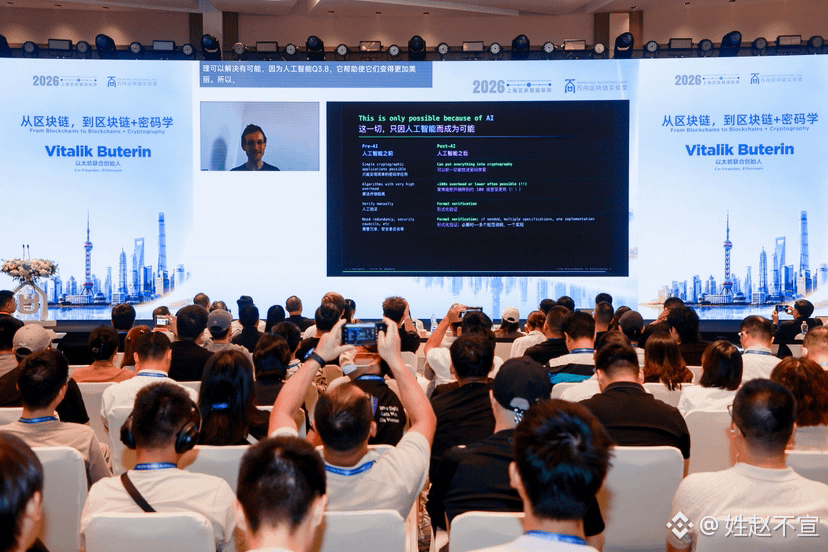

🔥 Vitalik’s speech in Shanghai today—ETH players, you have to finish this.
12 years ago, Bitcoin was still an experiment in a mailing list. Today, the core of crypto has already switched out its engine: a complete shift from “blockchain + signatures + PoW” to SNARK/STARK-driven programmable cryptography.
Back then, code only answered one question—who can send what. Now it starts answering tougher questions: who can see what. Privacy is no longer an add-on; it’s programmable.
AI has brought down the cost of formal verification and ZK overhead. SNARK reasoning can already be done at less than 10x overhead, and FHE is also dropping fast. ETH’s roadmap isn’t just slides anymore—EIP-8288, FOCIL multi-party block production, proof aggregation, and full STARKification are all pushing toward the main battlefield.
L1, L2, and the mempool are turning into a full cryptographic network: most computation happens locally for users and off-chain, while on-chain only verifies a proof. Scalability no longer relies on blindly sacrificing generality.
This isn’t another round of hype. It’s a turning point where Ethereum evolves from a “global computer” into a “programmable privacy layer.”
The next truly battle-tested application will definitely be rooted in “who can see what,” not just another token that can move money.
Which direction do you think will take off first—privacy payments, on-chain identity, or verifiable computation for AI agents?
12 years ago, Bitcoin was still an experiment in a mailing list. Today, the core of crypto has already switched out its engine: a complete shift from “blockchain + signatures + PoW” to SNARK/STARK-driven programmable cryptography.
Back then, code only answered one question—who can send what. Now it starts answering tougher questions: who can see what. Privacy is no longer an add-on; it’s programmable.
AI has brought down the cost of formal verification and ZK overhead. SNARK reasoning can already be done at less than 10x overhead, and FHE is also dropping fast. ETH’s roadmap isn’t just slides anymore—EIP-8288, FOCIL multi-party block production, proof aggregation, and full STARKification are all pushing toward the main battlefield.
L1, L2, and the mempool are turning into a full cryptographic network: most computation happens locally for users and off-chain, while on-chain only verifies a proof. Scalability no longer relies on blindly sacrificing generality.
This isn’t another round of hype. It’s a turning point where Ethereum evolves from a “global computer” into a “programmable privacy layer.”
The next truly battle-tested application will definitely be rooted in “who can see what,” not just another token that can move money.
Which direction do you think will take off first—privacy payments, on-chain identity, or verifiable computation for AI agents?