I used to think bridging and cross-chain swapping were basically the same thing.
Then I actually started using cross-chain swaps, and the difference became much clearer.
A bridge is pretty straightforward:
You have USDC on Ethereum and you want USDC on Base.
So you’re essentially moving the same asset from one network to another.
USDC → USDC
Ethereum → Base
That’s a bridge.
But what if I have USDT on Ethereum and what I actually need is USDC on Base?
Now I’m not just trying to move an asset.
I need to swap one asset for another while moving across chains.
USDT → USDC
Ethereum → Base
That’s where a cross-chain swap comes in.
And honestly, this distinction became more obvious to me when I started looking at how the process actually feels as a user.
With a traditional bridge, I might have to think:
“Okay, bridge this first…”
“Wait for it to arrive…”
“Now I need to find a swap…”
“Which network am I on again?”
“Do I have enough gas?”
That’s a lot of steps for something that should ultimately be simple:
I have this asset. I need that asset on another chain.
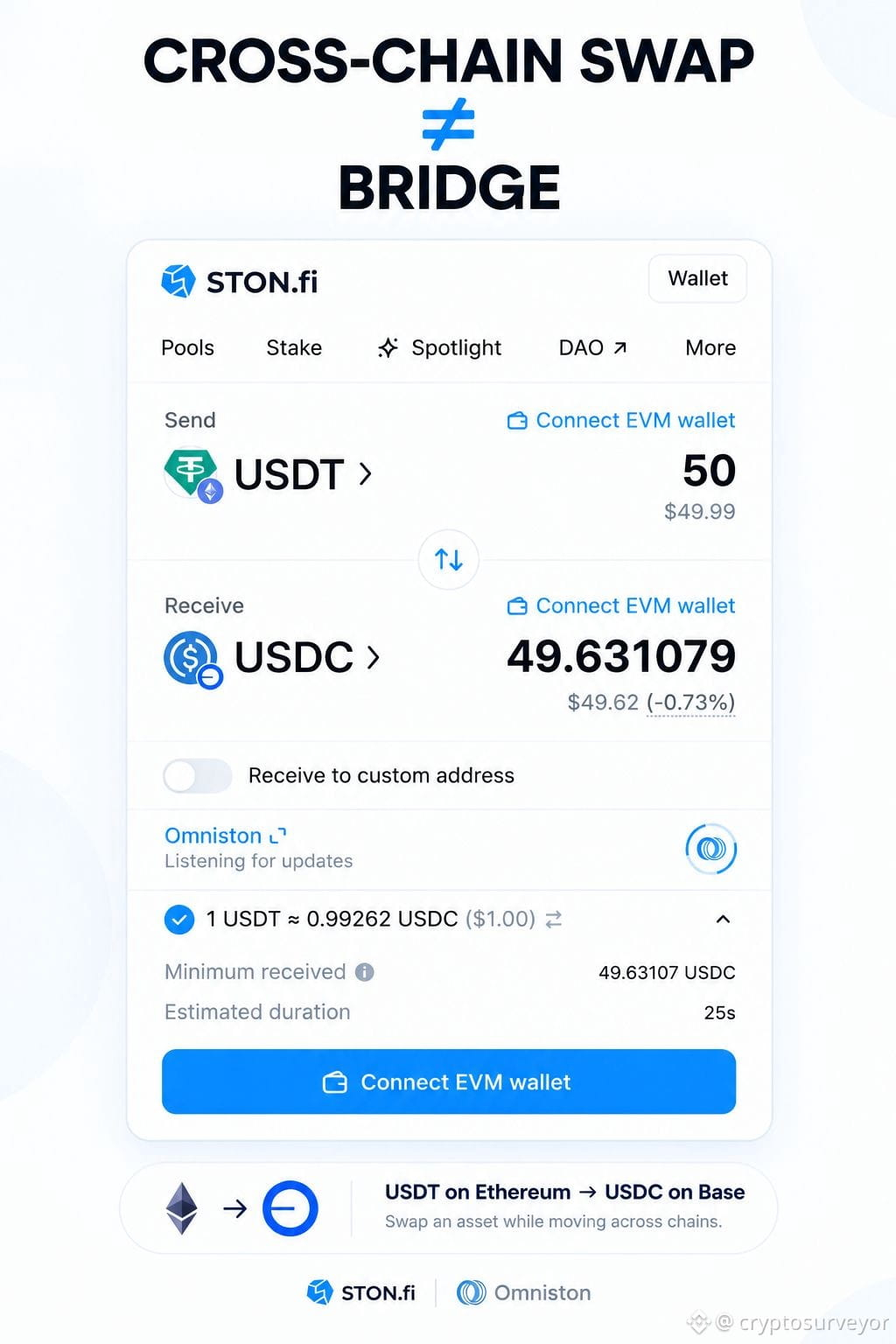
This is what caught my attention about the STON.fi + Omniston experience.
You can see the intent directly in the interface:
Send USDT → Receive USDC
while the transaction crosses networks.
You don't necessarily have to think about the underlying routing and liquidity mechanics.
You just tell the interface what you have and what you want.
And that's probably the biggest difference for me:
A bridge thinks in terms of moving an asset.
A cross-chain swap thinks in terms of getting you the asset you actually need.
The technology underneath can be complicated.
But the user experience doesn't have to be.
That’s why I think understanding the difference between a bridge and a cross-chain swap is important.
Because as more liquidity and assets spread across different chains, the question won't always be:
“How do I bridge this?
Sometimes it'll simply be:
“I have this here. I need that there.”
And that's a very different problem to solve
Then I actually started using cross-chain swaps, and the difference became much clearer.
A bridge is pretty straightforward:
You have USDC on Ethereum and you want USDC on Base.
So you’re essentially moving the same asset from one network to another.
USDC → USDC
Ethereum → Base
That’s a bridge.
But what if I have USDT on Ethereum and what I actually need is USDC on Base?
Now I’m not just trying to move an asset.
I need to swap one asset for another while moving across chains.
USDT → USDC
Ethereum → Base
That’s where a cross-chain swap comes in.
And honestly, this distinction became more obvious to me when I started looking at how the process actually feels as a user.
With a traditional bridge, I might have to think:
“Okay, bridge this first…”
“Wait for it to arrive…”
“Now I need to find a swap…”
“Which network am I on again?”
“Do I have enough gas?”
That’s a lot of steps for something that should ultimately be simple:
I have this asset. I need that asset on another chain.
This is what caught my attention about the STON.fi + Omniston experience.
You can see the intent directly in the interface:
Send USDT → Receive USDC
while the transaction crosses networks.
You don't necessarily have to think about the underlying routing and liquidity mechanics.
You just tell the interface what you have and what you want.
And that's probably the biggest difference for me:
A bridge thinks in terms of moving an asset.
A cross-chain swap thinks in terms of getting you the asset you actually need.
The technology underneath can be complicated.
But the user experience doesn't have to be.
That’s why I think understanding the difference between a bridge and a cross-chain swap is important.
Because as more liquidity and assets spread across different chains, the question won't always be:
“How do I bridge this?
Sometimes it'll simply be:
“I have this here. I need that there.”
And that's a very different problem to solve