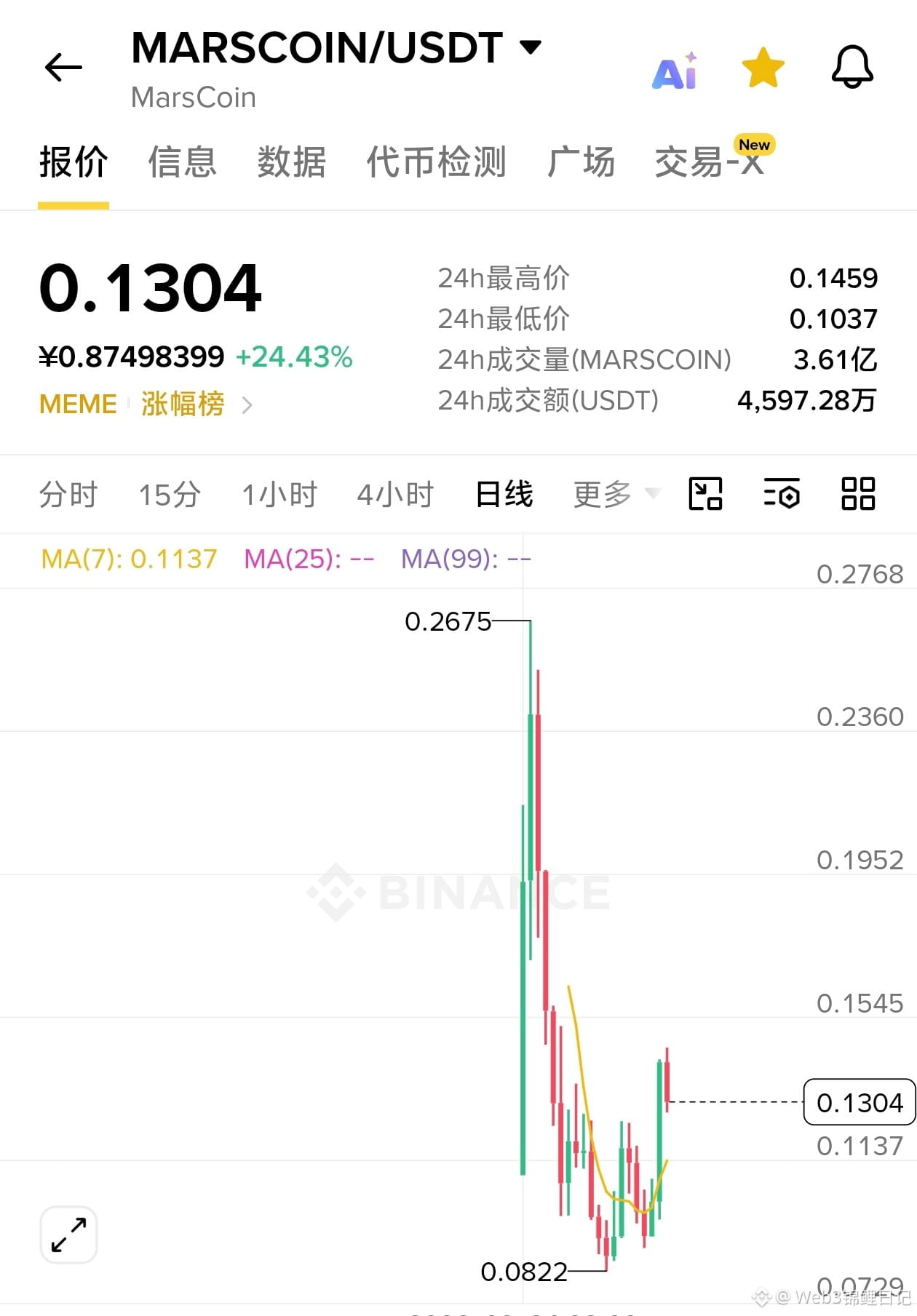
$MARSCOIN rising again from 0.08 to 0.14, up more than 70%, becoming the leading stock-MEME coin
The first wave, bringing along its core “brother,” went from a $3.2 million market cap to $270 million—an 83x move. So how much can the second wave eat?
Many people still don’t quite get $MARSCOIN . Let’s talk about it simply.
Its real potential isn’t just about viewing it as a pure meme anymore—the key is that it’s positioned on the main road that U.S. stock tokenization on-chain is, which major exchanges are all pushing hard right now!
Especially Binance—after all, it’s the leader in BSC. With Binance backing it, now Binance is both aggressively listing traditional U.S. stock trading pairs and BSTocks, while also integrating collateral, dividends, and spot all together.
The crypto market is becoming more and more compliant. There are already a few listed companies—like Robinhood—which basically means it’s allowed to bring U.S. stocks onto the chain for people to play. So major platforms aren’t just “touching a stock on the side”; they’re treating it as a crucial strategic move for the next stage of the crypto industry.
In the early days, when stocks are first brought on-chain, it’s like the crypto side “drains” liquidity from traditional finance. But in the long run, crypto will only keep draining stocks. The overall size of the crypto market still isn’t close to the U.S. stock market—add up the total crypto market cap and it’s still not bigger than the size of one major stock market. Also, for U.S. stocks, Mars/Marse-coin has become an important link that helps more people enter the meme market.
It welds crypto and stocks into the same position: holders of meme coins are passively exposed to U.S. stocks, and people who understand stocks can enter the meme segment for the first time through familiar underlying assets. Meme’s strongest advantage isn’t fundamentals—it’s the “benefit-driven effect” and speed of dissemination. In one market cycle, a coin can complete a recognition/understanding spread in just a few days that traditional stocks might take years to achieve.
And the reverse is also true: when enough people rally around the on-chain version of the same stock to trade memecoins, the momentum, trading volume, and social attention will flow back into the underlying asset itself—forming a loop where coins drive stocks and stocks feed back into coins. This pathway is being continuously recognized by the market, and people who play U.S. stocks will keep getting pulled into the meme market too.
#MarsCoin , as the first coin-stock meme leader, isn’t profiting from a single memecoin cycle—it’s benefiting from the overlap of three things: stocks going on-chain, exchanges rushing for entry, and compliance opening the gate. If the positioning is right, the volatility can be huge;
If the narrative is right, later entrants will keep refilling liquidity back into this intersection point. In the long run, Mars’ potential is extremely massive.
$币安人生 #跟着锦鲤学打百倍金狗
Follow the Web3 Koi Diary—buy coins that can turn into 10x returns
The first wave, bringing along its core “brother,” went from a $3.2 million market cap to $270 million—an 83x move. So how much can the second wave eat?
Many people still don’t quite get $MARSCOIN . Let’s talk about it simply.
Its real potential isn’t just about viewing it as a pure meme anymore—the key is that it’s positioned on the main road that U.S. stock tokenization on-chain is, which major exchanges are all pushing hard right now!
Especially Binance—after all, it’s the leader in BSC. With Binance backing it, now Binance is both aggressively listing traditional U.S. stock trading pairs and BSTocks, while also integrating collateral, dividends, and spot all together.
The crypto market is becoming more and more compliant. There are already a few listed companies—like Robinhood—which basically means it’s allowed to bring U.S. stocks onto the chain for people to play. So major platforms aren’t just “touching a stock on the side”; they’re treating it as a crucial strategic move for the next stage of the crypto industry.
In the early days, when stocks are first brought on-chain, it’s like the crypto side “drains” liquidity from traditional finance. But in the long run, crypto will only keep draining stocks. The overall size of the crypto market still isn’t close to the U.S. stock market—add up the total crypto market cap and it’s still not bigger than the size of one major stock market. Also, for U.S. stocks, Mars/Marse-coin has become an important link that helps more people enter the meme market.
It welds crypto and stocks into the same position: holders of meme coins are passively exposed to U.S. stocks, and people who understand stocks can enter the meme segment for the first time through familiar underlying assets. Meme’s strongest advantage isn’t fundamentals—it’s the “benefit-driven effect” and speed of dissemination. In one market cycle, a coin can complete a recognition/understanding spread in just a few days that traditional stocks might take years to achieve.
And the reverse is also true: when enough people rally around the on-chain version of the same stock to trade memecoins, the momentum, trading volume, and social attention will flow back into the underlying asset itself—forming a loop where coins drive stocks and stocks feed back into coins. This pathway is being continuously recognized by the market, and people who play U.S. stocks will keep getting pulled into the meme market too.
#MarsCoin , as the first coin-stock meme leader, isn’t profiting from a single memecoin cycle—it’s benefiting from the overlap of three things: stocks going on-chain, exchanges rushing for entry, and compliance opening the gate. If the positioning is right, the volatility can be huge;
If the narrative is right, later entrants will keep refilling liquidity back into this intersection point. In the long run, Mars’ potential is extremely massive.
$币安人生 #跟着锦鲤学打百倍金狗
Follow the Web3 Koi Diary—buy coins that can turn into 10x returns