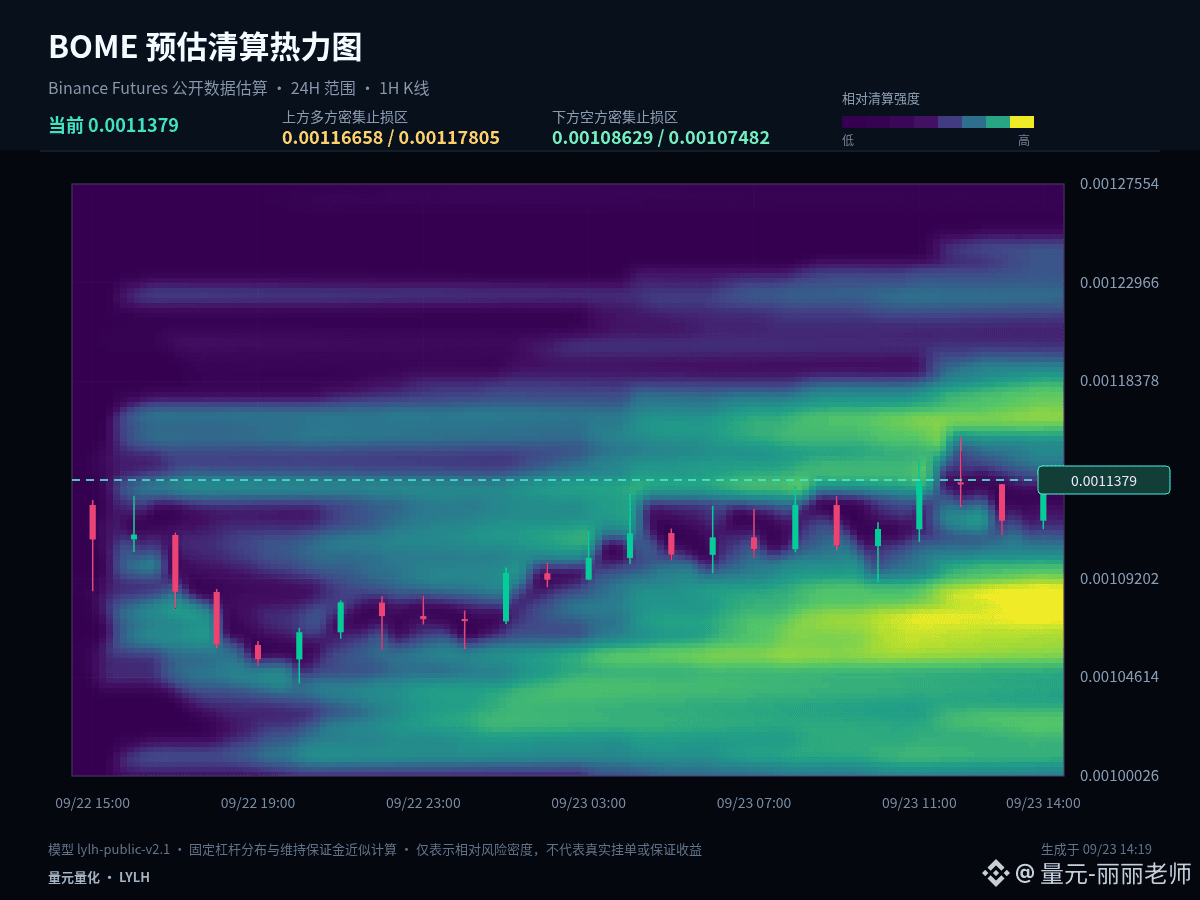
$BOME #BOME In a strong trend, pullbacks often reveal the real buying support more clearly than rapid surges. The current 1-hour change is +1.67%, and the 24-hour change is +4.66%, so we need to judge whether this is a normal cooldown or a sign of structural weakening.
The current price is near the upper end of the last 24 hours' range, with the 1-hour change at +1.67% and the 24-hour change at +4.66%. At elevated levels, the most important thing is to confirm acceptance after the breakout: if price can stay above the upper band, it shows the market recognizes a higher range; if it only briefly pierces through and then quickly falls back, a false breakout needs to be guarded against.
The short-term initiative has not been clearly damaged yet, and 0.00110015 is the primary standard for judging the quality of a retest. If it holds and then tests 0.0011559 again, that is a relatively strong consolidation; if it breaks below the midpoint and stays there, the focus should shift down to 0.0010444.
There are three possible ways to handle the next path: if it breaks upward and firmly holds above 0.0011559, wait for a pullback that does not break down before assessing continuation; if it breaks below 0.0010444, prioritize risk control and wait for new support; if it continues to fluctuate around 0.00110015, treat it as range rotation and do not repeatedly chase direction in the middle of the range.
For those already holding positions, the key is to manage based on whether support fails, rather than being driven by every fluctuation; for those with no position, it is better to wait for a breakout retest or support confirmation. Spot positions can be built in batches, while futures should shorten the decision chain: first determine the stop-loss level, then decide whether to participate.
The focus in futures is not to predict every candlestick, but to ensure entries, reductions, and exits all have a basis. Trade less without confirmation, rebuild the plan when key levels fail, control single-trade risk first, and then talk about the remaining upside.
#TokenizedStockPlatformsCouldLaunchNextQuarter
The current price is near the upper end of the last 24 hours' range, with the 1-hour change at +1.67% and the 24-hour change at +4.66%. At elevated levels, the most important thing is to confirm acceptance after the breakout: if price can stay above the upper band, it shows the market recognizes a higher range; if it only briefly pierces through and then quickly falls back, a false breakout needs to be guarded against.
The short-term initiative has not been clearly damaged yet, and 0.00110015 is the primary standard for judging the quality of a retest. If it holds and then tests 0.0011559 again, that is a relatively strong consolidation; if it breaks below the midpoint and stays there, the focus should shift down to 0.0010444.
There are three possible ways to handle the next path: if it breaks upward and firmly holds above 0.0011559, wait for a pullback that does not break down before assessing continuation; if it breaks below 0.0010444, prioritize risk control and wait for new support; if it continues to fluctuate around 0.00110015, treat it as range rotation and do not repeatedly chase direction in the middle of the range.
For those already holding positions, the key is to manage based on whether support fails, rather than being driven by every fluctuation; for those with no position, it is better to wait for a breakout retest or support confirmation. Spot positions can be built in batches, while futures should shorten the decision chain: first determine the stop-loss level, then decide whether to participate.
The focus in futures is not to predict every candlestick, but to ensure entries, reductions, and exits all have a basis. Trade less without confirmation, rebuild the plan when key levels fail, control single-trade risk first, and then talk about the remaining upside.
#TokenizedStockPlatformsCouldLaunchNextQuarter