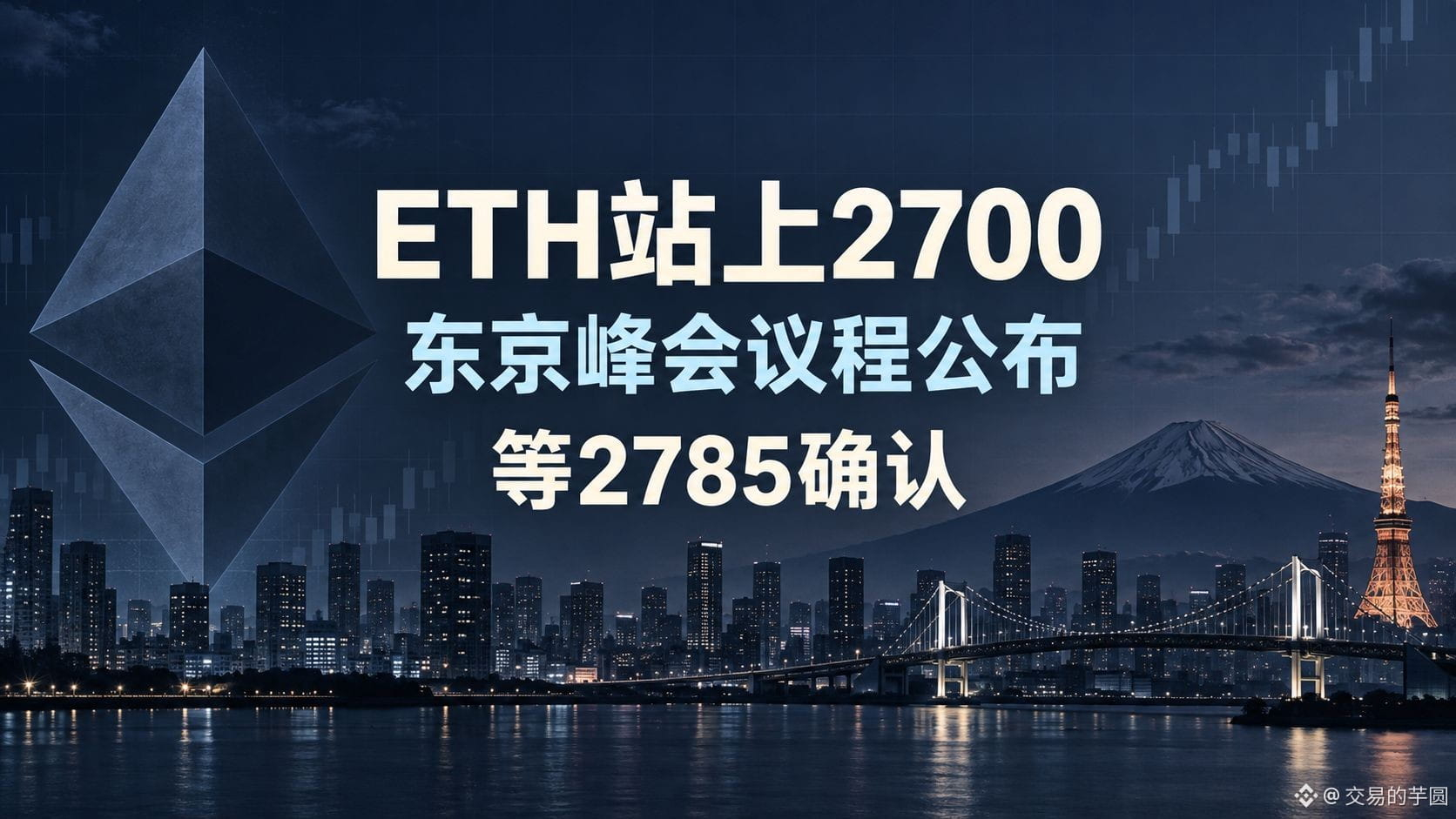
ETH above 2700 sparks widespread discussion|Tokyo summit talk on applications doesn’t equal buying pressure|I only wait for 2785 to confirm
My stance is mildly bullish and I remain conservative in operations. Binance’s Hot Topics page today shows the accurate tag “#EthereumSurpasses$2700,” but this is not an intraday signal that just broke moments ago. At 12:05 Beijing time, I checked KuCoin’s publicly available ETH perpetual quotes at about $2,768; over the past 24 hours, the low was about $2,715 and the high about $2,783. In other words, 2700 is no longer the hardest hurdle right in front of us—whether profit-taking around 2780 can be absorbed is more worth watching. Hot topics reflect attention, but they do not automatically prove new spot capital inflows. If you chase only based on the topic name, it’s easy to treat yesterday’s breakout as today’s new buy point.
Another factual item worth verifying is ETHTokyo 2026’s official agenda: on September 23, an Agentic Economy Summit is scheduled to discuss autonomous agents, payments, identity, and verifiable computation; on September 25, there is also an Ethereum Institutional Summit. The agenda indicates that developers and institutions are discussing real-world applications of Ethereum. However, holding the meetings does not mean protocol upgrades are completed, does not mean any ideas presented at the event have already generated on-chain revenue, and does not mean that participating institutions are buying ETH today. To me, its significance lies in medium-term demand clues: only when applications bring sustained trading, fees, or capital lock-in can the narrative potentially transform into verifiable fundamentals. You need to monitor subsequent product releases, user activity, and on-chain settlement data—not simply translate venue slogans directly into coin price.
On the funding side, you also need to distinguish disclosure timing. In Farside’s U.S. spot ETH ETF table, the full net inflow on September 21 was about $270 million; on September 22, as of the query time, ETHA and ETHB still show as dashes, while the other disclosed items total about $71.3 million. This combined figure cannot be written as the final all-day net inflow, and it also cannot be used to prove that today’s move higher to $2,768 was driven solely by ETFs. The price has already shown stronger acceptance than 2700—that’s an observed fact. But as of now, there isn’t enough evidence to equate causality between the meetings, fund subscriptions, and the spot price action.
For the short term, I treat 2783—2785 as the upper validation zone, and 2750 and 2715 as two defensive lines. If it breaks upward but quickly falls back below 2750, that suggests insufficient breakout quality. If 2715 is also lost, my mildly bullish view is invalidated. If it stands above 2785 and holds on a pullback, and meanwhile the major ETF missing items are filled in without any clear reversed outflow, the evidence for bulls is more complete.
If I were trading it myself, I wouldn’t participate; I would only consider going long with a small spot position and no leverage. The entry trigger is: two consecutive complete 15-minute candlesticks closing above $2,785, and then on the subsequent pullback 2778—2785 must hold. I would use at most 0.4% of total assets for the initial trial position. First target: 2805 (reached, then I take profits at the half; or reduce by half at the half level). Second target: 2830 (then reduce the remaining position or close it all). Initial stop-loss: 2755. It triggers an immediate close; no averaging down. If it drops below 2750 before entry, cancel this breakout-chasing plan. If after entering it fails to get back above 2785 after a long time, also close it proactively, not let a short-term trade turn into a passive hold.
Source references: Binance Hot Topics page, ETHTokyo official agenda, Farside fund flow tables, and KuCoin’s public quotes. #EthereumSurpasses$2700 #ETH
The above is only my personal market observation and does not constitute investment advice.
My stance is mildly bullish and I remain conservative in operations. Binance’s Hot Topics page today shows the accurate tag “#EthereumSurpasses$2700,” but this is not an intraday signal that just broke moments ago. At 12:05 Beijing time, I checked KuCoin’s publicly available ETH perpetual quotes at about $2,768; over the past 24 hours, the low was about $2,715 and the high about $2,783. In other words, 2700 is no longer the hardest hurdle right in front of us—whether profit-taking around 2780 can be absorbed is more worth watching. Hot topics reflect attention, but they do not automatically prove new spot capital inflows. If you chase only based on the topic name, it’s easy to treat yesterday’s breakout as today’s new buy point.
Another factual item worth verifying is ETHTokyo 2026’s official agenda: on September 23, an Agentic Economy Summit is scheduled to discuss autonomous agents, payments, identity, and verifiable computation; on September 25, there is also an Ethereum Institutional Summit. The agenda indicates that developers and institutions are discussing real-world applications of Ethereum. However, holding the meetings does not mean protocol upgrades are completed, does not mean any ideas presented at the event have already generated on-chain revenue, and does not mean that participating institutions are buying ETH today. To me, its significance lies in medium-term demand clues: only when applications bring sustained trading, fees, or capital lock-in can the narrative potentially transform into verifiable fundamentals. You need to monitor subsequent product releases, user activity, and on-chain settlement data—not simply translate venue slogans directly into coin price.
On the funding side, you also need to distinguish disclosure timing. In Farside’s U.S. spot ETH ETF table, the full net inflow on September 21 was about $270 million; on September 22, as of the query time, ETHA and ETHB still show as dashes, while the other disclosed items total about $71.3 million. This combined figure cannot be written as the final all-day net inflow, and it also cannot be used to prove that today’s move higher to $2,768 was driven solely by ETFs. The price has already shown stronger acceptance than 2700—that’s an observed fact. But as of now, there isn’t enough evidence to equate causality between the meetings, fund subscriptions, and the spot price action.
For the short term, I treat 2783—2785 as the upper validation zone, and 2750 and 2715 as two defensive lines. If it breaks upward but quickly falls back below 2750, that suggests insufficient breakout quality. If 2715 is also lost, my mildly bullish view is invalidated. If it stands above 2785 and holds on a pullback, and meanwhile the major ETF missing items are filled in without any clear reversed outflow, the evidence for bulls is more complete.
If I were trading it myself, I wouldn’t participate; I would only consider going long with a small spot position and no leverage. The entry trigger is: two consecutive complete 15-minute candlesticks closing above $2,785, and then on the subsequent pullback 2778—2785 must hold. I would use at most 0.4% of total assets for the initial trial position. First target: 2805 (reached, then I take profits at the half; or reduce by half at the half level). Second target: 2830 (then reduce the remaining position or close it all). Initial stop-loss: 2755. It triggers an immediate close; no averaging down. If it drops below 2750 before entry, cancel this breakout-chasing plan. If after entering it fails to get back above 2785 after a long time, also close it proactively, not let a short-term trade turn into a passive hold.
Source references: Binance Hot Topics page, ETHTokyo official agenda, Farside fund flow tables, and KuCoin’s public quotes. #EthereumSurpasses$2700 #ETH
The above is only my personal market observation and does not constitute investment advice.