


BTC has surged to 87,000. Many people are discussing: “Is this a squeeze?” “How much longer can it keep going up?” “Should I chase the price?”
But what I want to say is, none of this is the most important part.
The truly important signal is hidden in a piece of data that many people haven’t looked at carefully: on September 21, Bitcoin spot ETF had a net inflow of $998.9 million in a single day, setting the highest record since October 2025.
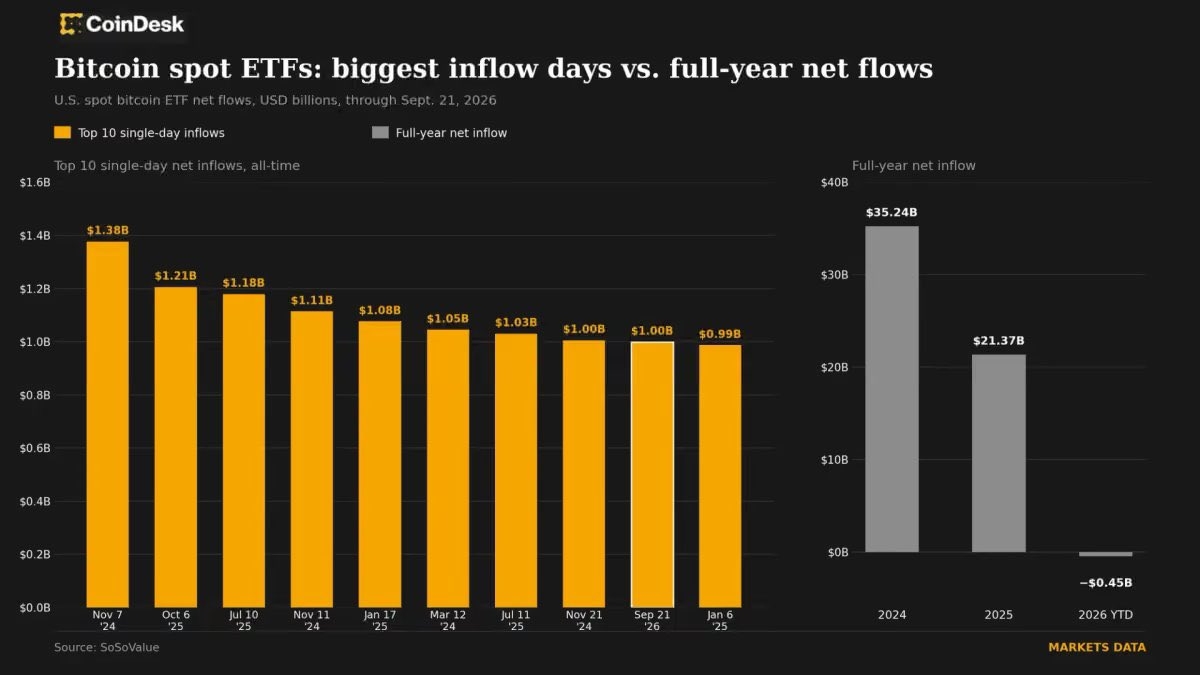
This number is more important than how high the price can go. Because it answers the most core question: is this leg higher pushed by short liquidations, or is it driven by real buyers paying with genuine money?
In today’s piece, I want to lay out this question clearly.
First, make it clear: what does a $1 billion inflow mean?
Here are a few references:
On September 15 (the day the Clear Bill failed), ETFs had $450 million outflow in a single day—the worst day since June
On September 18 (the first day after the SEC tokenization exemption), ETFs saw $433 million inflow and started turning positive
On September 21, ETF inflows reached $999 million, jumping straight to the highest single-day level in 11 months
Over the span of a week, inflows flipped 180 degrees: from $450 million outflows on a single day to $1 billion inflows on a single day.
Also, the structure of inflows is interesting: BlackRock’s IBIT has inflows of 381 million, ARK’s ARKB has inflows of 289 million, and Fidelity’s FBTC has inflows of 239 million.
Three major top institutions account for more than $900 million, which shows this isn’t retail chasing—this is institutions actively adding to positions.
This is not like the August rebound. That August move was mainly short-covering plus sentiment repair. ETF inflows were intermittent—sometimes positive, sometimes negative.
This time is different—while the price makes new highs, ETF capital is also making new highs at the same time, which is a classic “price and volume rising together.”
What does that mean? It means institutions are confirming: at this level, they’re willing to buy.
Second, a more important signal: ETF investors have all returned to breakeven overall
Bloomberg analysts have calculated that the average cost basis for US spot Bitcoin ETF investors is about $81,722.
Now BTC is around 86,000, which means that, for the first time since January this year, the average-level ETF investor has returned to an overall profitable state.
The significance of this is bigger than many people think.
Why? Because before this, ETF investors were stuck in drawdown for most of the time.
The institutional funds that rushed in during January were trapped for half a year. They definitely wouldn’t feel good about it. When a rebound brings price back near the cost line, many people will think, “Finally back to breakeven—better sell now.”
That’s why the 80,000–83,000 range has been a strong resistance zone all along—selling pressure from people trying to get out is too heavy.
But now the situation is different. Price has broken above the cost basis line, and ETF capital is still flowing in at a large scale.
What does this indicate? It indicates institutions are not selling to get out of drawdown—they’re adding to positions.
They’re not thinking, “We finally broke even—time to run,”
They believe, “The trend is established—keep buying.”
That’s the most typical feature of the early stage of a bull market: price breaks through key resistance levels, and capital doesn’t flee—it actually accelerates into the market.
Third, why I’m getting more and more certain: this isn’t a rebound—it’s a trend reversal
To judge whether a move is a rebound or a reversal, I usually look at three things:
First, check whether the funding situation is improving consistently.
A rebound relies on sentiment; a reversal relies on capital.
Sentiment comes fast and goes fast, but the hard indicator—real money inflows—is a solid signal of a trend reversal.
When ETFs have a $1 billion single-day inflow, the ETH ETFs are also seeing inflows of $270 million at the same time (also a new 11-month high). This is not a size that retail FOMO can generate.
If, over the next few days, the ETF can still maintain daily inflows of more than $200–300 million, then it can basically be confirmed: the institutions’ allocation cycle is back.
Second, check whether technical conditions have broken key levels.
BTC has already reclaimed the 365-day moving average line (i.e., the 200-day moving average).
How important is this level? CryptoQuant defines it very directly: staying above the 200-day moving average consistently is the bull market confirmation signal.
How long did BTC run below the 200-day moving average last time? 10 months. From last November to now, a full 10 months—this is the first time BTC has steadily returned above the 200-day moving average.
Historical data also supports this logic: when BTC’s weekly closes are above the 50-week moving average, excluding that Black Swan event during COVID-19, the probability of the subsequent market continuing into a bull run is 100%.
And now, BTC has not only moved above the 50-week moving average, but also above the 200-day moving average.
Third, check whether the narrative has undergone any fundamental change.
In the last bull market, the narrative was “institutions coming in to buy Bitcoin,” and the core was the ETF.
What’s the narrative this round? It’s “assets on-chain,” it’s tokenization—blockchain evolving from the “technology of cryptocurrencies” into “the infrastructure of the entire financial system.”
The scale of this narrative is much bigger than the ETF narrative.
ETFs make it easier for institutions to buy Bitcoin. At its core, it’s still “more people coming to buy existing assets.”
Tokenization moves everything—$77 trillion worth of US stocks, bonds, real estate, and all real-world assets—onto the blockchain. This is “creating an entirely new market.”
Look at UNI over the past month—it’s up 145%. The entire DeFi sector has exploded. It’s not because UNI’s fundamentals suddenly changed. It’s because the market suddenly realized that—DeFi technology might end up serving a market that’s dozens of times larger than crypto.
Fourth, but I still want to pour some cold water
After saying all this optimism, I’ll end with something that needs to be watched out for.
First, the short-term rise was too fast. From 75,000 to 87,000, it took just a week—a 16% increase. This pace can’t last; a 10–15% pullback could happen at any time.
RSI is already at 68.5, approaching the overbought zone. The Fear & Greed Index is 77, already in the greed zone. These are all short-term overheating signals.
Second, there will be $18.1 billion worth of options expiring this Friday. Quarterly options expirations typically amplify volatility, especially when the current price is at a key level. Both bulls and bears will battle ahead of expiry, and volatility will increase.
Third, there’s no fundamental change in the macro environment. The Fed has just raised rates, with interest rates still at 3.75%–4%. The high-rate environment is still there. Geopolitical risks (Middle East, China–US relations) also haven’t been fully resolved. These are swords hanging over everyone’s head.
So my advice is very clear:
Long-term positions: hold—don’t mess around
If you want to add to your position: buy in batches—don’t chase; add again when pullbacks reach around 80,000
Leverage: be cautious, especially at this level—the risk-reward of adding leverage is very low
Altcoins: you can keep an eye on them, but don’t go all-in; mainstream coins should be the core holding
In the end
Lately I’ve been getting a growing feeling: we might be experiencing the starting point of a “slow-boiling frog” bull market.
What does that mean? It means that while most people are still doubting, still hesitating, and still waiting for a “more certain signal,” the market has already quietly started moving.
When everyone is finally certain that “the bull market is here,”
Prices may already be above 100,000.
That’s how trading works,
The most certain opportunities often appear when most people are still not certain.
Once everyone is certain,
So opportunities are no longer opportunities.
Tonight at 9:00, let’s chat in the group about “how we should position ourselves now”—we’ll go deep on positions and strategies. Anyone who wants to come is welcome.