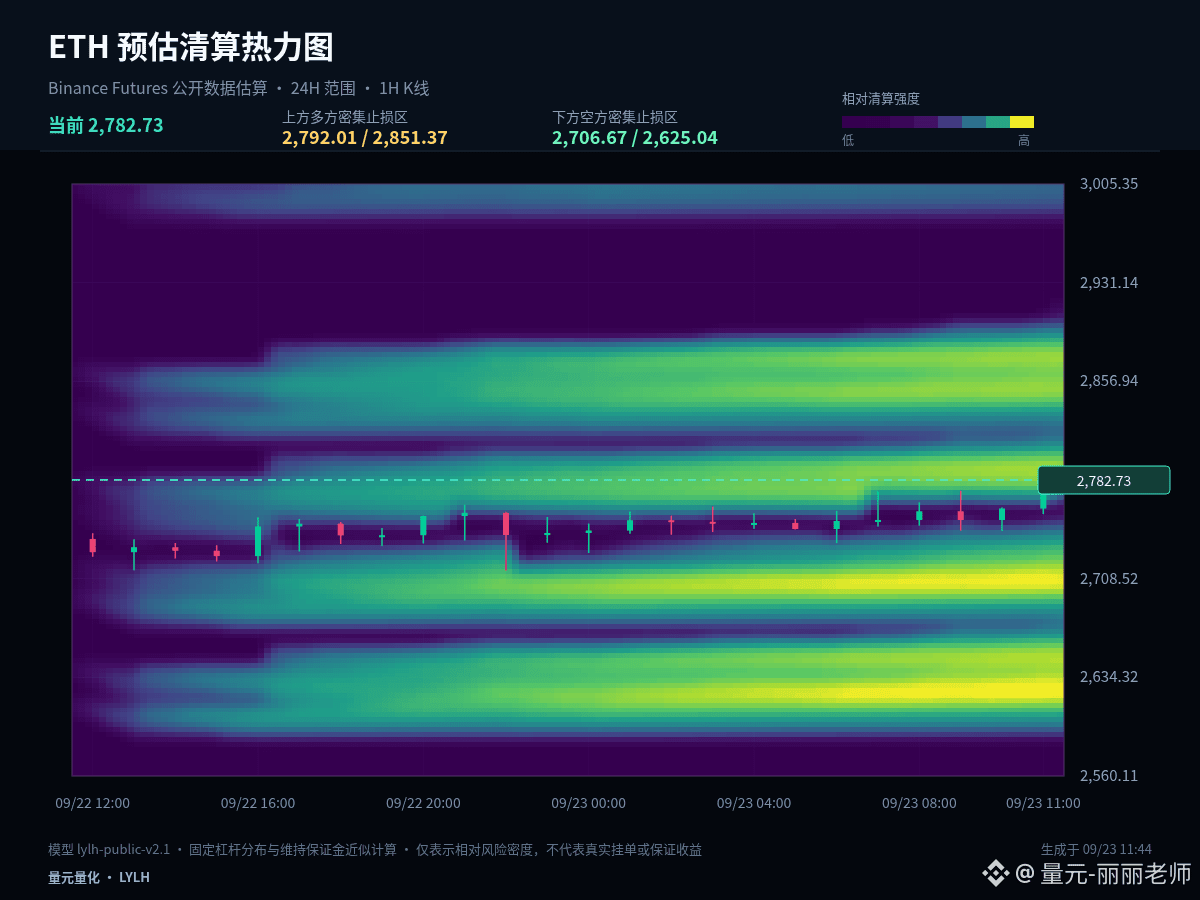
$ETH #ETH Current price 2,783.2, 1 hour +0.76%, 24 hours +1.80%. Rather than locking in long or short early, it’s better to list the possible paths and the corresponding actions clearly.
The current price is near the upper bound of the last 24 hours’ range: +0.76% in the last 1 hour and +1.80% in the last 24 hours. The most important thing for the high end is to confirm acceptance after a breakout: if the price can stay above the upper bound, it means the market recognizes a higher range. If it only briefly pierces through and quickly retreats, you need to guard against a false breakout.
The first path is upward: the price needs to break 2,784.4 and form a stable close above it; only after that, if a retest does not break, it counts as an effective confirmation. The second path is downward: once 2,715.91 is lost and the subsequent rebound cannot be reclaimed, it indicates insufficient support. Priority should be defense rather than rushing to add positions.
If the price continues to stay between 2,784.4 and 2,715.91, then 2,750.16 is only a reference for short-term initiative. The middle of the range has no clear advantage, so don’t force entries just for the sake of participation—wait for the market to show direction.
In terms of positioning, you need to differentiate spot and futures. For existing spot holdings, manage in segments around key levels, and don’t flip directions frequently due to a single 1-hour candlestick. If you’re in cash, waiting for confirmation before entering in batches is more composed. Futures place greater emphasis on entry location and invalidation conditions: when volatility increases, proactively reduce position size to avoid turning short-term judgment into passive holding.
Risk control still comes before the conclusion: execute only when conditions are met, and reassess promptly if the price becomes invalid. The larger the volatility, the more restrained each individual position must be. The above is a scenario walkthrough based on the current 1-hour and 24-hour data and does not constitute any promise of returns.
#BNBMarketCapPassesBNYMellon
The current price is near the upper bound of the last 24 hours’ range: +0.76% in the last 1 hour and +1.80% in the last 24 hours. The most important thing for the high end is to confirm acceptance after a breakout: if the price can stay above the upper bound, it means the market recognizes a higher range. If it only briefly pierces through and quickly retreats, you need to guard against a false breakout.
The first path is upward: the price needs to break 2,784.4 and form a stable close above it; only after that, if a retest does not break, it counts as an effective confirmation. The second path is downward: once 2,715.91 is lost and the subsequent rebound cannot be reclaimed, it indicates insufficient support. Priority should be defense rather than rushing to add positions.
If the price continues to stay between 2,784.4 and 2,715.91, then 2,750.16 is only a reference for short-term initiative. The middle of the range has no clear advantage, so don’t force entries just for the sake of participation—wait for the market to show direction.
In terms of positioning, you need to differentiate spot and futures. For existing spot holdings, manage in segments around key levels, and don’t flip directions frequently due to a single 1-hour candlestick. If you’re in cash, waiting for confirmation before entering in batches is more composed. Futures place greater emphasis on entry location and invalidation conditions: when volatility increases, proactively reduce position size to avoid turning short-term judgment into passive holding.
Risk control still comes before the conclusion: execute only when conditions are met, and reassess promptly if the price becomes invalid. The larger the volatility, the more restrained each individual position must be. The above is a scenario walkthrough based on the current 1-hour and 24-hour data and does not constitute any promise of returns.
#BNBMarketCapPassesBNYMellon