

易琳Ten
104 Posts

易琳Ten
Report
Block User
交易是修行,盈利是结果,纪律是信仰。🐺📈
68 Following
20.3K+ Followers
7.1K+ Liked
Posts
All
Quotes
Videos
PINNED
·
--
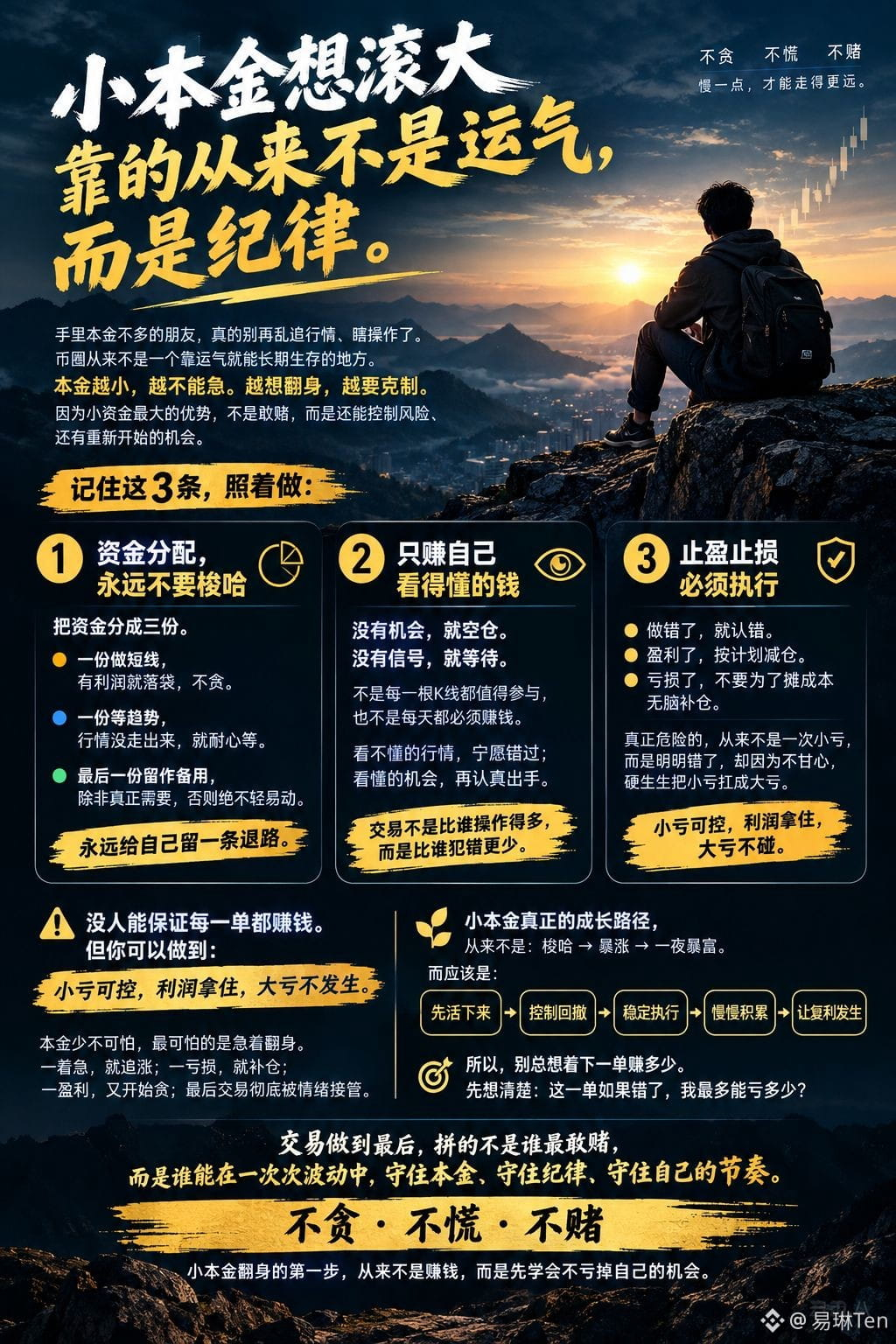
To grow the principal, you don’t rely on luck—you rely on discipline
If you don’t have much capital, really stop chasing charts blindly and making random trades.
The crypto market has never been a place where you can survive long-term by luck alone.
The smaller your principal, the less you can afford to be anxious.
The more you want to turn things around, the more you must restrain yourself.
Because the biggest advantage of small capital isn’t that you’re bold enough to gamble—it’s that you can control risk and still have a chance to start over.
Remember these 3 rules:
① Capital allocation—never go all-in
Divide your capital into three parts.
One part for short-term trades: when you have profit, take it off the table—don’t get greedy to the very end;
One part for waiting for trends: if the market hasn’t moved in your expected direction, be patient and wait;
The last part as a reserve: unless it’s truly necessary, never touch it lightly.
Always leave yourself a way to retreat.
② Only make money from what you can understand
If there’s no opportunity, stay in cash.
If there’s no signal, wait.
Not every candlestick is worth participating in,
And you don’t have to make money every day.
If you don’t understand the market, it’s better to miss it;
Only after you understand the opportunity should you act seriously.
Trading isn’t about who makes more moves—it’s about who makes fewer mistakes.
③ Take-profit and stop-loss must be executed
If you’re wrong, admit it.
If you’re in profit, reduce your position according to the plan.
If you’re at a loss, don’t mindlessly add just to average down.
The real danger has never been a single small loss.
It’s when you’re clearly wrong, but because you’re unwilling to accept it, you stubbornly turn a small loss into a big one.
No one can guarantee that every trade will be profitable.
But you can do this:
Keep small losses under control, hold onto profits, and never touch big losses.
Having a small principal isn’t scary.
What’s truly terrifying is trying to turn things around in a rush.
When you’re anxious, you chase the surge.
When you have a loss, you add.
When you get a win, you start getting greedy again.
In the end, your trading is completely taken over by emotions.
The real growth path for small capital has never been:
All-in → a sudden surge → a fortune overnight.
It should be:
First survive → control drawdowns → execute steadily → accumulate slowly → let compounding work.
So don’t always think about how much you’ll make on the next trade.
First ask yourself:
If this trade is wrong, what’s the maximum I can afford to lose?
In the end, trading isn’t about who’s most willing to gamble.
It’s about who can, through repeated fluctuations, keep their principal, keep their discipline, and keep their own rhythm.
Don’t be greedy. Don’t panic. Don’t gamble.
The first step in turning around with a small principal has never been making money—it’s learning how not to lose your chance first.
To grow the principal, you don’t rely on luck—you rely on discipline
If you don’t have much capital, really stop chasing charts blindly and making random trades.
The crypto market has never been a place where you can survive long-term by luck alone.
The smaller your principal, the less you can afford to be anxious.
The more you want to turn things around, the more you must restrain yourself.
Because the biggest advantage of small capital isn’t that you’re bold enough to gamble—it’s that you can control risk and still have a chance to start over.
Remember these 3 rules:
① Capital allocation—never go all-in
Divide your capital into three parts.
One part for short-term trades: when you have profit, take it off the table—don’t get greedy to the very end;
One part for waiting for trends: if the market hasn’t moved in your expected direction, be patient and wait;
The last part as a reserve: unless it’s truly necessary, never touch it lightly.
Always leave yourself a way to retreat.
② Only make money from what you can understand
If there’s no opportunity, stay in cash.
If there’s no signal, wait.
Not every candlestick is worth participating in,
And you don’t have to make money every day.
If you don’t understand the market, it’s better to miss it;
Only after you understand the opportunity should you act seriously.
Trading isn’t about who makes more moves—it’s about who makes fewer mistakes.
③ Take-profit and stop-loss must be executed
If you’re wrong, admit it.
If you’re in profit, reduce your position according to the plan.
If you’re at a loss, don’t mindlessly add just to average down.
The real danger has never been a single small loss.
It’s when you’re clearly wrong, but because you’re unwilling to accept it, you stubbornly turn a small loss into a big one.
No one can guarantee that every trade will be profitable.
But you can do this:
Keep small losses under control, hold onto profits, and never touch big losses.
Having a small principal isn’t scary.
What’s truly terrifying is trying to turn things around in a rush.
When you’re anxious, you chase the surge.
When you have a loss, you add.
When you get a win, you start getting greedy again.
In the end, your trading is completely taken over by emotions.
The real growth path for small capital has never been:
All-in → a sudden surge → a fortune overnight.
It should be:
First survive → control drawdowns → execute steadily → accumulate slowly → let compounding work.
So don’t always think about how much you’ll make on the next trade.
First ask yourself:
If this trade is wrong, what’s the maximum I can afford to lose?
In the end, trading isn’t about who’s most willing to gamble.
It’s about who can, through repeated fluctuations, keep their principal, keep their discipline, and keep their own rhythm.
Don’t be greedy. Don’t panic. Don’t gamble.
The first step in turning around with a small principal has never been making money—it’s learning how not to lose your chance first.
If you don’t have much capital, really stop chasing charts blindly and making random trades.
The crypto market has never been a place where you can survive long-term by luck alone.
The smaller your principal, the less you can afford to be anxious.
The more you want to turn things around, the more you must restrain yourself.
Because the biggest advantage of small capital isn’t that you’re bold enough to gamble—it’s that you can control risk and still have a chance to start over.
Remember these 3 rules:
① Capital allocation—never go all-in
Divide your capital into three parts.
One part for short-term trades: when you have profit, take it off the table—don’t get greedy to the very end;
One part for waiting for trends: if the market hasn’t moved in your expected direction, be patient and wait;
The last part as a reserve: unless it’s truly necessary, never touch it lightly.
Always leave yourself a way to retreat.
② Only make money from what you can understand
If there’s no opportunity, stay in cash.
If there’s no signal, wait.
Not every candlestick is worth participating in,
And you don’t have to make money every day.
If you don’t understand the market, it’s better to miss it;
Only after you understand the opportunity should you act seriously.
Trading isn’t about who makes more moves—it’s about who makes fewer mistakes.
③ Take-profit and stop-loss must be executed
If you’re wrong, admit it.
If you’re in profit, reduce your position according to the plan.
If you’re at a loss, don’t mindlessly add just to average down.
The real danger has never been a single small loss.
It’s when you’re clearly wrong, but because you’re unwilling to accept it, you stubbornly turn a small loss into a big one.
No one can guarantee that every trade will be profitable.
But you can do this:
Keep small losses under control, hold onto profits, and never touch big losses.
Having a small principal isn’t scary.
What’s truly terrifying is trying to turn things around in a rush.
When you’re anxious, you chase the surge.
When you have a loss, you add.
When you get a win, you start getting greedy again.
In the end, your trading is completely taken over by emotions.
The real growth path for small capital has never been:
All-in → a sudden surge → a fortune overnight.
It should be:
First survive → control drawdowns → execute steadily → accumulate slowly → let compounding work.
So don’t always think about how much you’ll make on the next trade.
First ask yourself:
If this trade is wrong, what’s the maximum I can afford to lose?
In the end, trading isn’t about who’s most willing to gamble.
It’s about who can, through repeated fluctuations, keep their principal, keep their discipline, and keep their own rhythm.
Don’t be greedy. Don’t panic. Don’t gamble.
The first step in turning around with a small principal has never been making money—it’s learning how not to lose your chance first.
261
3
15
918
PINNED
·
--
When you have something, you should cherish it well.
Research by psychologists like Robert Emmons and others has found that actively focusing on things in life that you have to be grateful for helps boost positive emotions and well-being.
The biggest mistake people make in life is taking what they have for granted.
If your parents are still here, spend more time with them; if your loved one is still there, cherish them well; if your body is healthy, don’t recklessly overdraw it.
Because nothing you have is permanent, and every reunion has its time limit.
True appreciation isn’t something you regret only after losing it—it’s knowing, while you still have it, that it’s worth cherishing.
Cherish the person in front of you, cherish what’s happening right now, and cherish everything you have at this moment.
When you have something, you should cherish it well.
Research by psychologists like Robert Emmons and others has found that actively focusing on things in life that you have to be grateful for helps boost positive emotions and well-being.
The biggest mistake people make in life is taking what they have for granted.
If your parents are still here, spend more time with them; if your loved one is still there, cherish them well; if your body is healthy, don’t recklessly overdraw it.
Because nothing you have is permanent, and every reunion has its time limit.
True appreciation isn’t something you regret only after losing it—it’s knowing, while you still have it, that it’s worth cherishing.
Cherish the person in front of you, cherish what’s happening right now, and cherish everything you have at this moment.
Research by psychologists like Robert Emmons and others has found that actively focusing on things in life that you have to be grateful for helps boost positive emotions and well-being.
The biggest mistake people make in life is taking what they have for granted.
If your parents are still here, spend more time with them; if your loved one is still there, cherish them well; if your body is healthy, don’t recklessly overdraw it.
Because nothing you have is permanent, and every reunion has its time limit.
True appreciation isn’t something you regret only after losing it—it’s knowing, while you still have it, that it’s worth cherishing.
Cherish the person in front of you, cherish what’s happening right now, and cherish everything you have at this moment.

2.3k
16
110
2.3k
·
--
666
666
易琳Ten
·
--
To grow the principal, you don’t rely on luck—you rely on discipline
If you don’t have much capital, really stop chasing charts blindly and making random trades.
The crypto market has never been a place where you can survive long-term by luck alone.
The smaller your principal, the less you can afford to be anxious.
The more you want to turn things around, the more you must restrain yourself.
Because the biggest advantage of small capital isn’t that you’re bold enough to gamble—it’s that you can control risk and still have a chance to start over.
Remember these 3 rules:
① Capital allocation—never go all-in
Divide your capital into three parts.
One part for short-term trades: when you have profit, take it off the table—don’t get greedy to the very end;
One part for waiting for trends: if the market hasn’t moved in your expected direction, be patient and wait;
The last part as a reserve: unless it’s truly necessary, never touch it lightly.
Always leave yourself a way to retreat.
② Only make money from what you can understand
If there’s no opportunity, stay in cash.
If there’s no signal, wait.
Not every candlestick is worth participating in,
And you don’t have to make money every day.
If you don’t understand the market, it’s better to miss it;
Only after you understand the opportunity should you act seriously.
Trading isn’t about who makes more moves—it’s about who makes fewer mistakes.
③ Take-profit and stop-loss must be executed
If you’re wrong, admit it.
If you’re in profit, reduce your position according to the plan.
If you’re at a loss, don’t mindlessly add just to average down.
The real danger has never been a single small loss.
It’s when you’re clearly wrong, but because you’re unwilling to accept it, you stubbornly turn a small loss into a big one.
No one can guarantee that every trade will be profitable.
But you can do this:
Keep small losses under control, hold onto profits, and never touch big losses.
Having a small principal isn’t scary.
What’s truly terrifying is trying to turn things around in a rush.
When you’re anxious, you chase the surge.
When you have a loss, you add.
When you get a win, you start getting greedy again.
In the end, your trading is completely taken over by emotions.
The real growth path for small capital has never been:
All-in → a sudden surge → a fortune overnight.
It should be:
First survive → control drawdowns → execute steadily → accumulate slowly → let compounding work.
So don’t always think about how much you’ll make on the next trade.
First ask yourself:
If this trade is wrong, what’s the maximum I can afford to lose?
In the end, trading isn’t about who’s most willing to gamble.
It’s about who can, through repeated fluctuations, keep their principal, keep their discipline, and keep their own rhythm.
Don’t be greedy. Don’t panic. Don’t gamble.
The first step in turning around with a small principal has never been making money—it’s learning how not to lose your chance first.
If you don’t have much capital, really stop chasing charts blindly and making random trades.
The crypto market has never been a place where you can survive long-term by luck alone.
The smaller your principal, the less you can afford to be anxious.
The more you want to turn things around, the more you must restrain yourself.
Because the biggest advantage of small capital isn’t that you’re bold enough to gamble—it’s that you can control risk and still have a chance to start over.
Remember these 3 rules:
① Capital allocation—never go all-in
Divide your capital into three parts.
One part for short-term trades: when you have profit, take it off the table—don’t get greedy to the very end;
One part for waiting for trends: if the market hasn’t moved in your expected direction, be patient and wait;
The last part as a reserve: unless it’s truly necessary, never touch it lightly.
Always leave yourself a way to retreat.
② Only make money from what you can understand
If there’s no opportunity, stay in cash.
If there’s no signal, wait.
Not every candlestick is worth participating in,
And you don’t have to make money every day.
If you don’t understand the market, it’s better to miss it;
Only after you understand the opportunity should you act seriously.
Trading isn’t about who makes more moves—it’s about who makes fewer mistakes.
③ Take-profit and stop-loss must be executed
If you’re wrong, admit it.
If you’re in profit, reduce your position according to the plan.
If you’re at a loss, don’t mindlessly add just to average down.
The real danger has never been a single small loss.
It’s when you’re clearly wrong, but because you’re unwilling to accept it, you stubbornly turn a small loss into a big one.
No one can guarantee that every trade will be profitable.
But you can do this:
Keep small losses under control, hold onto profits, and never touch big losses.
Having a small principal isn’t scary.
What’s truly terrifying is trying to turn things around in a rush.
When you’re anxious, you chase the surge.
When you have a loss, you add.
When you get a win, you start getting greedy again.
In the end, your trading is completely taken over by emotions.
The real growth path for small capital has never been:
All-in → a sudden surge → a fortune overnight.
It should be:
First survive → control drawdowns → execute steadily → accumulate slowly → let compounding work.
So don’t always think about how much you’ll make on the next trade.
First ask yourself:
If this trade is wrong, what’s the maximum I can afford to lose?
In the end, trading isn’t about who’s most willing to gamble.
It’s about who can, through repeated fluctuations, keep their principal, keep their discipline, and keep their own rhythm.
Don’t be greedy. Don’t panic. Don’t gamble.
The first step in turning around with a small principal has never been making money—it’s learning how not to lose your chance first.

1
327
·
--
Once a centralized exchange suffers a massive crypto theft, it is not only the hackers who are truly being put on trial, but also the platform’s security systems and information transparency. Academic research indicates that CEXs naturally carry custody risks, information asymmetry, and principal–agent problems, and that relying on “proof of reserves” alone cannot cover internal governance and key security.
Of course, we should not conclude “self-sabotage” based solely on the fact that funds were stolen. In reality, the FBI and blockchain security organizations have indeed, on multiple occasions, attributed major crypto theft incidents to hackers linked to North Korea.
So what users should really ask is not “who’s to blame,” but: where is the evidence? Where are the security mechanisms? Where did the money go?
Once a centralized exchange suffers a massive crypto theft, it is not only the hackers who are truly being put on trial, but also the platform’s security systems and information transparency. Academic research indicates that CEXs naturally carry custody risks, information asymmetry, and principal–agent problems, and that relying on “proof of reserves” alone cannot cover internal governance and key security.
Of course, we should not conclude “self-sabotage” based solely on the fact that funds were stolen. In reality, the FBI and blockchain security organizations have indeed, on multiple occasions, attributed major crypto theft incidents to hackers linked to North Korea.
So what users should really ask is not “who’s to blame,” but: where is the evidence? Where are the security mechanisms? Where did the money go?
Of course, we should not conclude “self-sabotage” based solely on the fact that funds were stolen. In reality, the FBI and blockchain security organizations have indeed, on multiple occasions, attributed major crypto theft incidents to hackers linked to North Korea.
So what users should really ask is not “who’s to blame,” but: where is the evidence? Where are the security mechanisms? Where did the money go?

1.3k
24
68
1.3k
·
--
Life is like tea,
with both bitterness and sweetness in balance.
Life is like tea; it requires a calm heart and patient waiting.
When it sinks, accept it with composure—learn to build strength.
When it rises, stay unruffled—learn to let things settle.
Hold your temper steady, and only then can you become truly great.
Life is like tea,
with both bitterness and sweetness in balance.
Life is like tea; it requires a calm heart and patient waiting.
When it sinks, accept it with composure—learn to build strength.
When it rises, stay unruffled—learn to let things settle.
Hold your temper steady, and only then can you become truly great.
with both bitterness and sweetness in balance.
Life is like tea; it requires a calm heart and patient waiting.
When it sinks, accept it with composure—learn to build strength.
When it rises, stay unruffled—learn to let things settle.
Hold your temper steady, and only then can you become truly great.

3
4
586
·
--
What do you know is the most fascinating part of trading?
In business, with different ways of thinking, you need time to communicate and put in all your effort to persuade others.
In trading, is it different in how you think?
No arguing, no persuading, no explanations.
You have your judgment, and I have my logic.
You are bullish, and I am bearish.
The market is the arena, and price is the referee.
No need to persuade anyone, and no need to prove anything to anyone.
If the direction is right, take the profit that belongs to you.
If the direction is wrong, accept the market’s lesson.
Trading is a quiet contest.
What do you know is the most fascinating part of trading?
In business, with different ways of thinking, you need time to communicate and put in all your effort to persuade others.
In trading, is it different in how you think?
No arguing, no persuading, no explanations.
You have your judgment, and I have my logic.
You are bullish, and I am bearish.
The market is the arena, and price is the referee.
No need to persuade anyone, and no need to prove anything to anyone.
If the direction is right, take the profit that belongs to you.
If the direction is wrong, accept the market’s lesson.
Trading is a quiet contest.
In business, with different ways of thinking, you need time to communicate and put in all your effort to persuade others.
In trading, is it different in how you think?
No arguing, no persuading, no explanations.
You have your judgment, and I have my logic.
You are bullish, and I am bearish.
The market is the arena, and price is the referee.
No need to persuade anyone, and no need to prove anything to anyone.
If the direction is right, take the profit that belongs to you.
If the direction is wrong, accept the market’s lesson.
Trading is a quiet contest.

4
717
·
--
Trade
Be content and always happy,
steady compounding returns,
slow and steady progress.
Trade
Be content and always happy,
steady compounding returns,
slow and steady progress.
Be content and always happy,
steady compounding returns,
slow and steady progress.

1
841
·
--
See the mindset when profits turn into give-back.
See the mindset when profits turn into give-back.
333
·
--
Bullish
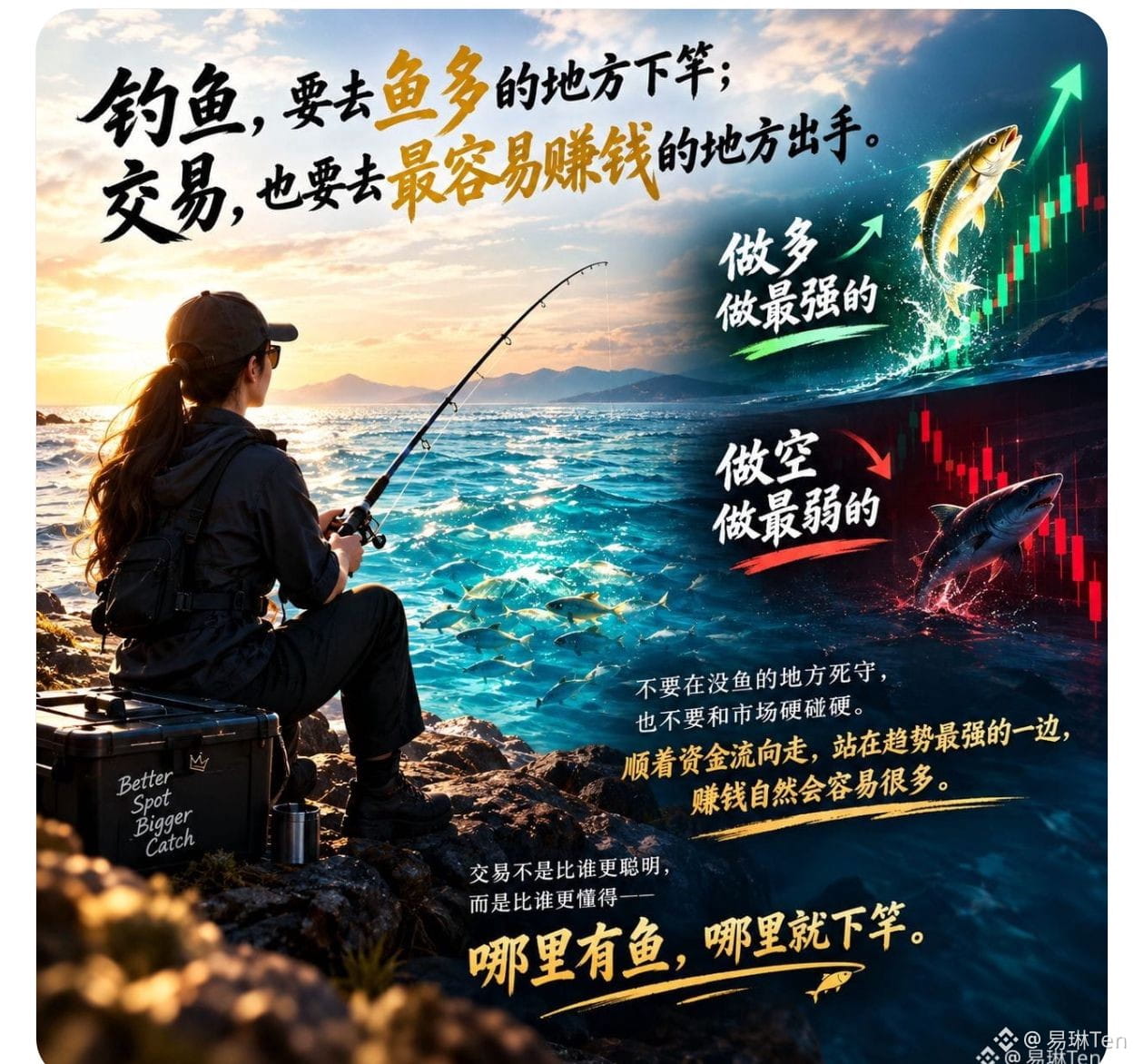
To fish, go to the places with more fish and cast your line;
for trading, go to the places where it’s easiest to make money.
For going long, choose the strongest;
for going short, choose the weakest.
Don’t hold your ground in a place with no fish, and don’t clash head-on with the market.
Follow the flow of capital, stand on the side where the trend is strongest—making money naturally becomes much easier.
Trading isn’t about who’s smarter,
but about who understands better—where there are fish, that’s where you cast your line. 🎣📈
To fish, go to the places with more fish and cast your line;
for trading, go to the places where it’s easiest to make money.
For going long, choose the strongest;
for going short, choose the weakest.
Don’t hold your ground in a place with no fish, and don’t clash head-on with the market.
Follow the flow of capital, stand on the side where the trend is strongest—making money naturally becomes much easier.
Trading isn’t about who’s smarter,
but about who understands better—where there are fish, that’s where you cast your line. 🎣📈
for trading, go to the places where it’s easiest to make money.
For going long, choose the strongest;
for going short, choose the weakest.
Don’t hold your ground in a place with no fish, and don’t clash head-on with the market.
Follow the flow of capital, stand on the side where the trend is strongest—making money naturally becomes much easier.
Trading isn’t about who’s smarter,
but about who understands better—where there are fish, that’s where you cast your line. 🎣📈
2
668
·
--
Risk control isn’t about guessing every day whether the market will suddenly crash.
Real risk control is:
how big your position is,
where you set your stop-loss,
what your worst-case loss will be,
and what you do after you’re wrong and the trade goes against you.
As for whether the market will suddenly fall—that’s the market’s business.
Risk control isn’t about guessing every day whether the market will suddenly crash.
Real risk control is:
how big your position is,
where you set your stop-loss,
what your worst-case loss will be,
and what you do after you’re wrong and the trade goes against you.
As for whether the market will suddenly fall—that’s the market’s business.
Real risk control is:
how big your position is,
where you set your stop-loss,
what your worst-case loss will be,
and what you do after you’re wrong and the trade goes against you.
As for whether the market will suddenly fall—that’s the market’s business.

1
339
·
--
Real growth in trading comes from slowly growing small capital
By practicing with small capital and gradually building it up,
what you’re really going through is a process of honing your mindset and understanding compounding.
Many people always want to get rich overnight,
thinking they can make A8, A9 directly from a single trade.
But from the underlying logic of trading, that directly goes against trading principles.
Why do so many people who suddenly get rich end up back at square one?
Because they received a large unexpected windfall,
but they didn’t build the kind of mindset, discipline, and understanding that matches that wealth.
The power of compounding never comes from extreme returns,
but from having long enough time for “pretty good” performance.
What truly matters isn’t how much you made in one year,
but whether you can go through wave after wave of volatility and still stay in the game.
A strategy that keeps you anxious every night and makes you change your plan frequently,
no matter how excellent it sounds in theory,
is hard to carry out consistently over the long run.
Trading isn’t about who can make the most money in one night,
but about who can last long enough—so that time turns “pretty good” returns into astonishing results.
It’s okay to go slower.
Stability is the real starting point of compounding.
Real growth in trading comes from slowly growing small capital
By practicing with small capital and gradually building it up,
what you’re really going through is a process of honing your mindset and understanding compounding.
Many people always want to get rich overnight,
thinking they can make A8, A9 directly from a single trade.
But from the underlying logic of trading, that directly goes against trading principles.
Why do so many people who suddenly get rich end up back at square one?
Because they received a large unexpected windfall,
but they didn’t build the kind of mindset, discipline, and understanding that matches that wealth.
The power of compounding never comes from extreme returns,
but from having long enough time for “pretty good” performance.
What truly matters isn’t how much you made in one year,
but whether you can go through wave after wave of volatility and still stay in the game.
A strategy that keeps you anxious every night and makes you change your plan frequently,
no matter how excellent it sounds in theory,
is hard to carry out consistently over the long run.
Trading isn’t about who can make the most money in one night,
but about who can last long enough—so that time turns “pretty good” returns into astonishing results.
It’s okay to go slower.
Stability is the real starting point of compounding.
By practicing with small capital and gradually building it up,
what you’re really going through is a process of honing your mindset and understanding compounding.
Many people always want to get rich overnight,
thinking they can make A8, A9 directly from a single trade.
But from the underlying logic of trading, that directly goes against trading principles.
Why do so many people who suddenly get rich end up back at square one?
Because they received a large unexpected windfall,
but they didn’t build the kind of mindset, discipline, and understanding that matches that wealth.
The power of compounding never comes from extreme returns,
but from having long enough time for “pretty good” performance.
What truly matters isn’t how much you made in one year,
but whether you can go through wave after wave of volatility and still stay in the game.
A strategy that keeps you anxious every night and makes you change your plan frequently,
no matter how excellent it sounds in theory,
is hard to carry out consistently over the long run.
Trading isn’t about who can make the most money in one night,
but about who can last long enough—so that time turns “pretty good” returns into astonishing results.
It’s okay to go slower.
Stability is the real starting point of compounding.

1
747
·
--
Control your desires, manage your fears
You think you’re researching the market.
In fact, the market is researching you.
Research your greed,
research your fear,
research your luck of the draw,
research when you’ll lose control.
Control your desires, manage your fears
You think you’re researching the market.
In fact, the market is researching you.
Research your greed,
research your fear,
research your luck of the draw,
research when you’ll lose control.
You think you’re researching the market.
In fact, the market is researching you.
Research your greed,
research your fear,
research your luck of the draw,
research when you’ll lose control.

4
6
1.1k
·
--
The Highest Realm of Trading: Ultimate Simplicity
You must rid yourself of all tedious, distracting clutter.
A trading career is radically different from ordinary life. Trading, at its core, is a minimalist way of living.
You should proactively eliminate unnecessary distractions from your life, keeping your private life simple and calm. Only then will you have enough energy to repeatedly make rational, composed decisions that are fully thought through.
In fact, trading and life influence each other:
If life is chaotic, your trading judgments are more likely to become distorted; if your trading routine is frantic and messy, it will also drag down your personal life.
So a truly mature trader should align their life rhythm with their trading rhythm.
Especially watch out for—decision fatigue.
What this industry fears most is not a lack of opportunities, but making too many meaningless decisions every day, and then—through exhaustion, anxiety, and impulsiveness—ending up with wrong judgments.
Trading doesn’t require you to make life complicated. Instead, you should remove everything that’s irrelevant.
Save energy for what truly matters:
waiting, judging, execution, and controlling risk.
The Highest Realm of Trading: Ultimate Simplicity
You must rid yourself of all tedious, distracting clutter.
A trading career is radically different from ordinary life. Trading, at its core, is a minimalist way of living.
You should proactively eliminate unnecessary distractions from your life, keeping your private life simple and calm. Only then will you have enough energy to repeatedly make rational, composed decisions that are fully thought through.
In fact, trading and life influence each other:
If life is chaotic, your trading judgments are more likely to become distorted; if your trading routine is frantic and messy, it will also drag down your personal life.
So a truly mature trader should align their life rhythm with their trading rhythm.
Especially watch out for—decision fatigue.
What this industry fears most is not a lack of opportunities, but making too many meaningless decisions every day, and then—through exhaustion, anxiety, and impulsiveness—ending up with wrong judgments.
Trading doesn’t require you to make life complicated. Instead, you should remove everything that’s irrelevant.
Save energy for what truly matters:
waiting, judging, execution, and controlling risk.
You must rid yourself of all tedious, distracting clutter.
A trading career is radically different from ordinary life. Trading, at its core, is a minimalist way of living.
You should proactively eliminate unnecessary distractions from your life, keeping your private life simple and calm. Only then will you have enough energy to repeatedly make rational, composed decisions that are fully thought through.
In fact, trading and life influence each other:
If life is chaotic, your trading judgments are more likely to become distorted; if your trading routine is frantic and messy, it will also drag down your personal life.
So a truly mature trader should align their life rhythm with their trading rhythm.
Especially watch out for—decision fatigue.
What this industry fears most is not a lack of opportunities, but making too many meaningless decisions every day, and then—through exhaustion, anxiety, and impulsiveness—ending up with wrong judgments.
Trading doesn’t require you to make life complicated. Instead, you should remove everything that’s irrelevant.
Save energy for what truly matters:
waiting, judging, execution, and controlling risk.

4
1
10
2k
·
--
Trading is never only a battle of IQ
Traditional IQ tests measure language, logic, and spatial reasoning—but they cannot determine whether a trader can stand at the top of the market.
Truly top-tier trading ability comes from three core qualities:
First, probability intuition.
It’s not about predicting the future, but quickly judging win rates amid uncertainty—knowing when to act and when to wait.
Second, emotional control.
When facing massive unrealized losses, consecutive stop-outs, and market panic, you can still stay calm and not be driven by greed or fear.
Third, pattern recognition.
From complex price fluctuations, capital flows, and market sentiment, capture patterns that others can’t see.
These abilities can’t be copied by a few books or a few indicators. It’s more like a “brain trading system” formed through long-term training—your prefrontal cortex handles rational decisions, the amygdala handles emotional reactions, and truly excellent traders can keep both in balance.
So in the end, what the market tests is not just knowledge and techniques, but a person’s cognitive structure, psychological resilience, and the ability to handle uncertainty.
Trading is a war between a person and their own brain. True experts win themselves first, then win the market.
Trading is never only a battle of IQ
Traditional IQ tests measure language, logic, and spatial reasoning—but they cannot determine whether a trader can stand at the top of the market.
Truly top-tier trading ability comes from three core qualities:
First, probability intuition.
It’s not about predicting the future, but quickly judging win rates amid uncertainty—knowing when to act and when to wait.
Second, emotional control.
When facing massive unrealized losses, consecutive stop-outs, and market panic, you can still stay calm and not be driven by greed or fear.
Third, pattern recognition.
From complex price fluctuations, capital flows, and market sentiment, capture patterns that others can’t see.
These abilities can’t be copied by a few books or a few indicators. It’s more like a “brain trading system” formed through long-term training—your prefrontal cortex handles rational decisions, the amygdala handles emotional reactions, and truly excellent traders can keep both in balance.
So in the end, what the market tests is not just knowledge and techniques, but a person’s cognitive structure, psychological resilience, and the ability to handle uncertainty.
Trading is a war between a person and their own brain. True experts win themselves first, then win the market.
Traditional IQ tests measure language, logic, and spatial reasoning—but they cannot determine whether a trader can stand at the top of the market.
Truly top-tier trading ability comes from three core qualities:
First, probability intuition.
It’s not about predicting the future, but quickly judging win rates amid uncertainty—knowing when to act and when to wait.
Second, emotional control.
When facing massive unrealized losses, consecutive stop-outs, and market panic, you can still stay calm and not be driven by greed or fear.
Third, pattern recognition.
From complex price fluctuations, capital flows, and market sentiment, capture patterns that others can’t see.
These abilities can’t be copied by a few books or a few indicators. It’s more like a “brain trading system” formed through long-term training—your prefrontal cortex handles rational decisions, the amygdala handles emotional reactions, and truly excellent traders can keep both in balance.
So in the end, what the market tests is not just knowledge and techniques, but a person’s cognitive structure, psychological resilience, and the ability to handle uncertainty.
Trading is a war between a person and their own brain. True experts win themselves first, then win the market.

1
9
1k
·
--

Article
The 20 Books a Trader Is Truly Worth ReadingWhen the market is quiet and the action is light, it’s the best time to enhance your understanding.
Truly excellent traders don’t read books to look for a “sure-win shortcut,” but to understand:
Why does the world run this way?
Why does wealth come into being?
Why do cycles repeat?
Where will future opportunities arise?
Ordinary traders study prices; great traders study the market; and top traders study—history, cycles, human nature, technology, and the future.
The following 20 books are worth reading for everyone who wants to stay in the market long-term.
Part One: Understanding the Past—How the World Was Formed
The 20 Books a Trader Is Truly Worth Reading
When the market is quiet and the action is light, it’s the best time to enhance your understanding.
Truly excellent traders don’t read books to look for a “sure-win shortcut,” but to understand:
Why does the world run this way?
Why does wealth come into being?
Why do cycles repeat?
Where will future opportunities arise?
Ordinary traders study prices; great traders study the market; and top traders study—history, cycles, human nature, technology, and the future.
The following 20 books are worth reading for everyone who wants to stay in the market long-term.
Part One: Understanding the Past—How the World Was Formed
Truly excellent traders don’t read books to look for a “sure-win shortcut,” but to understand:
Why does the world run this way?
Why does wealth come into being?
Why do cycles repeat?
Where will future opportunities arise?
Ordinary traders study prices; great traders study the market; and top traders study—history, cycles, human nature, technology, and the future.
The following 20 books are worth reading for everyone who wants to stay in the market long-term.
Part One: Understanding the Past—How the World Was Formed
2
6
912
·
--
The market won't punish you for making mistakes. It punishes you for letting your emotions control your timing.
The market won't punish you for making mistakes. It punishes you for letting your emotions control your timing.

5
1
24
1.4k
Log in to explore more content
Join global crypto users on Binance Square
⚡️ Get latest and useful information about crypto.
💬 Trusted by the world’s largest crypto exchange.
👍 Discover real insights from verified creators.
Email / Phone number
Trending Topics
CircleMints500MUSDCOnSolana
143,446 views
2,619 Discussing
#circlemints500musdconsolana 🚨 $500M USDC PUT SOLANA DEFI UNDER THE MICROSCOPE
Circle has added 500 million Dollar in USDC to Solana. That’s a number.. Here’s what traders really need to pay attention to. 👀
A 500 million Dollar jump in USDC supply doesn’t automatically mean 500 million dollar of buying pressure. That’s not how it works. The real story is what happens next.
🔹 Does the USDC move into lending protocols?
🔹 Does borrowing demand pick up more liquidity comes in?
🔹 Do USDC lending yields drop as supply grows?
🔹 Does all this stablecoin liquidity eventually shift into SOL and other Solana assets?
Circle says the USDC can be minted in advance and held before it hits the circulating supply. That means the headline number is the start. The actual flow after minting matters more than the announcement.
Jupiter is already a player on Solana for USDC lending and borrowing. So the utilization rate and borrowing activity there are metrics to watch.
📊 Here’s my main focus:
inflows → DeFi utilization → rising borrowing demand → SOL liquidity.
Is this 500 million Dollar going to sit idle?. Will it flow into DeFi first?. Then will it eventually move into riskier assets like SOL, JUP, KMNO?
The next few days could tell us a lot, about how Solana DeFi's reacting to this injection.
#solana #crypto #Khan62 #USDC
$KMNO $JUP $ORCA
Khan 62
·6 Likes
·5.1k views
PolymarketBankFailureBetsDrawFDICConcern
128,450 views
2,138 Discussing
BlackRockBuildsTokenizedPortfoliosForOndo
123,534 views
1,534 Discussing