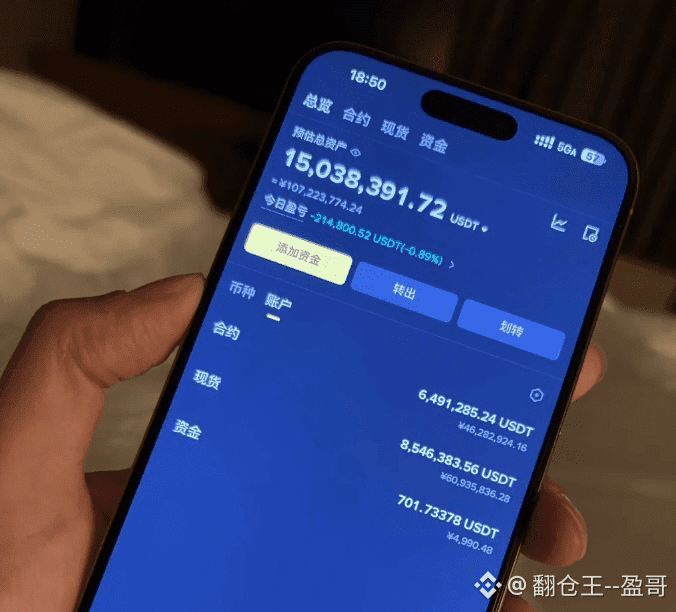
A year ago, a brother came to me with 2,100 USDT and said, “If I lose again, I’ll completely quit the market.”
Ninety days later, his account reached 50,000 USDT. What truly changed him wasn’t his technique, but three rules.
At the beginning, I didn’t teach him any complicated indicators. I first had him split the 2,100 USDT into three parts.
First: 700 USDT for short-term trades.
No more than two trades per day. Before entering, set a stop loss. If you’re wrong, leave immediately—no averaging down, no holding through losses, and absolutely no opening a revenge trade right after getting stopped.
Second: 700 USDT to wait for the trend.
If the daily and weekly direction hasn’t clearly formed, stay out of the market. Only after the volume and structure are confirmed do you enter with a small position. I’d rather you trade less than churn in a range and pay trading fees back and forth.
Third: 700 USDT as a “trump card.”
Don’t touch it casually in normal times. And you won’t keep adding to “save” a wrong position endlessly. Keep room in the account—so you can always maintain control.
Later, I added one more rule: profits must be protected.
When gains reach a certain threshold, take profit in batches. If the market keeps moving, let the remaining position run; if the price action is wrong, the stop loss still gets executed.
For small accounts, the most common mistake is this: with little capital, people often become extremely bold. They always think, “I’ll turn it around in one shot,” and in the end, they usually get wiped out in that one reckless move.
What he truly did right wasn’t catching how many “miracle trades.” It was that he started making fewer fatal mistakes.
The market always has another chance. But if the principal is gone, then nothing else matters.
#币圈生存法则
#小白必看
Ninety days later, his account reached 50,000 USDT. What truly changed him wasn’t his technique, but three rules.
At the beginning, I didn’t teach him any complicated indicators. I first had him split the 2,100 USDT into three parts.
First: 700 USDT for short-term trades.
No more than two trades per day. Before entering, set a stop loss. If you’re wrong, leave immediately—no averaging down, no holding through losses, and absolutely no opening a revenge trade right after getting stopped.
Second: 700 USDT to wait for the trend.
If the daily and weekly direction hasn’t clearly formed, stay out of the market. Only after the volume and structure are confirmed do you enter with a small position. I’d rather you trade less than churn in a range and pay trading fees back and forth.
Third: 700 USDT as a “trump card.”
Don’t touch it casually in normal times. And you won’t keep adding to “save” a wrong position endlessly. Keep room in the account—so you can always maintain control.
Later, I added one more rule: profits must be protected.
When gains reach a certain threshold, take profit in batches. If the market keeps moving, let the remaining position run; if the price action is wrong, the stop loss still gets executed.
For small accounts, the most common mistake is this: with little capital, people often become extremely bold. They always think, “I’ll turn it around in one shot,” and in the end, they usually get wiped out in that one reckless move.
What he truly did right wasn’t catching how many “miracle trades.” It was that he started making fewer fatal mistakes.
The market always has another chance. But if the principal is gone, then nothing else matters.
#币圈生存法则
#小白必看