#加密市场总市值重回3万亿美元
This news is actually a bit strange.. Everyone is staring at the K-line chart, looking for where the next high will be. But the line that’s really moving is tucked away “after you’ve finished buying things,” in that layer nobody will look at..
💥 消息第一时间
Most people see it as “yet another good piece of news about a stablecoin getting deployed.” A payment news item that doesn’t really seem to have anything to do with their own holdings.. But I think what’s truly worth watching isn’t that stablecoins have gained another use case—it’s exactly where it’s been inserted this time..
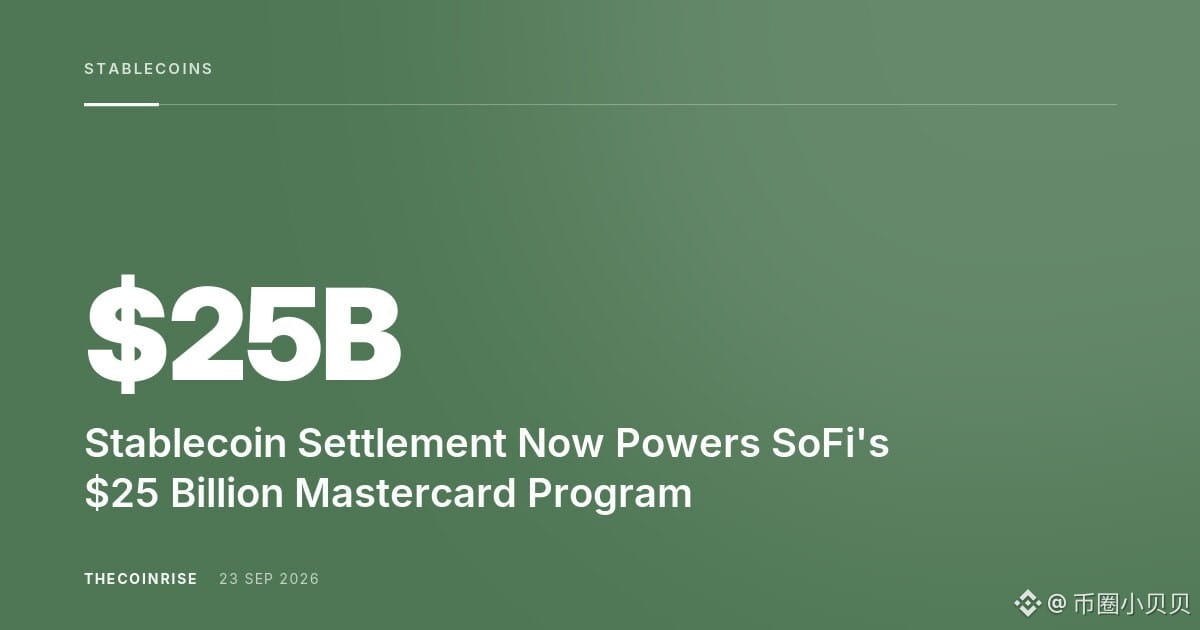
And that’s where things start to be different.. A U.S. digital bank has changed the clearing of its card project to run on a stablecoin it issues itself.. This project has roughly $25 billion in annual transaction volume. Reports say this is the first time a bank’s own issued stablecoin is being used for settlement on a mainstream global card network..
Even more interesting is what “clearing” is actually referring to.. When you swipe your card to buy something, the money doesn’t really move at that moment.. What comes next is that the bank, the card network, and the merchants all reconcile their accounts with each other. Previously, this process ran through the bank’s old pipeline—fast or not, it took more than a day..
So this time, it isn’t changing the way you pay.. The way you swipe doesn’t change for even a second, and the feeling of when the merchant receives funds doesn’t change either.. What changes is only the back-end reconciliation pipe. And that slice of infrastructure happens to be, over the past few decades, the most stable, the least touched, and the most profitable area..
This makes it a bit thought-provoking.. Also, the stablecoin this bank uses is one it issues itself, not one it adopts from someone else. That’s two completely different stances.. The former is “I’m using someone else’s tools.” The latter is “I built this infrastructure myself.”
The money line is here too.. What money cares about now isn’t really “can the coin go up,” it’s “how does money move between institutions.” Traditional banks and card networks are willing to try this not because they’re bullish on coin prices, but because clearing time and operating costs really can be saved.. What’s saved is worth more than a story..
The bigger narrative is already laid out.. Stablecoin use cases are gradually shifting from trading and remittances to “how institutions move money back and forth.” The card network itself is also building stablecoin-related infrastructure.. A project running $25 billion a year is essentially a living test scenario—not a demo from a few machines..
But here’s the question.. Can this shift turn from a case into a norm depends on whether there will be a second, third, and more banks that start issuing their own settlement tokens. If it’s always only the first one, it’s just a nice headline. If later they start to cluster together, then the segment of the pipeline that gets replaced will never be replaced back..
What’s truly worth watching are the third-party issuers who make a living by issuing tokens.. Once banks start issuing their own settlement tokens, their position in this chain needs to be recalculated.
Once stablecoin eats up the clearing layer, the line separating crypto and traditional finance will no longer be drawn on “the coin,” but on the thickness of the pipeline..
That’s what makes it interesting..
This news is actually a bit strange.. Everyone is staring at the K-line chart, looking for where the next high will be. But the line that’s really moving is tucked away “after you’ve finished buying things,” in that layer nobody will look at..
💥 消息第一时间
Most people see it as “yet another good piece of news about a stablecoin getting deployed.” A payment news item that doesn’t really seem to have anything to do with their own holdings.. But I think what’s truly worth watching isn’t that stablecoins have gained another use case—it’s exactly where it’s been inserted this time..
And that’s where things start to be different.. A U.S. digital bank has changed the clearing of its card project to run on a stablecoin it issues itself.. This project has roughly $25 billion in annual transaction volume. Reports say this is the first time a bank’s own issued stablecoin is being used for settlement on a mainstream global card network..
Even more interesting is what “clearing” is actually referring to.. When you swipe your card to buy something, the money doesn’t really move at that moment.. What comes next is that the bank, the card network, and the merchants all reconcile their accounts with each other. Previously, this process ran through the bank’s old pipeline—fast or not, it took more than a day..
So this time, it isn’t changing the way you pay.. The way you swipe doesn’t change for even a second, and the feeling of when the merchant receives funds doesn’t change either.. What changes is only the back-end reconciliation pipe. And that slice of infrastructure happens to be, over the past few decades, the most stable, the least touched, and the most profitable area..
This makes it a bit thought-provoking.. Also, the stablecoin this bank uses is one it issues itself, not one it adopts from someone else. That’s two completely different stances.. The former is “I’m using someone else’s tools.” The latter is “I built this infrastructure myself.”
The money line is here too.. What money cares about now isn’t really “can the coin go up,” it’s “how does money move between institutions.” Traditional banks and card networks are willing to try this not because they’re bullish on coin prices, but because clearing time and operating costs really can be saved.. What’s saved is worth more than a story..
The bigger narrative is already laid out.. Stablecoin use cases are gradually shifting from trading and remittances to “how institutions move money back and forth.” The card network itself is also building stablecoin-related infrastructure.. A project running $25 billion a year is essentially a living test scenario—not a demo from a few machines..
But here’s the question.. Can this shift turn from a case into a norm depends on whether there will be a second, third, and more banks that start issuing their own settlement tokens. If it’s always only the first one, it’s just a nice headline. If later they start to cluster together, then the segment of the pipeline that gets replaced will never be replaced back..
What’s truly worth watching are the third-party issuers who make a living by issuing tokens.. Once banks start issuing their own settlement tokens, their position in this chain needs to be recalculated.
Once stablecoin eats up the clearing layer, the line separating crypto and traditional finance will no longer be drawn on “the coin,” but on the thickness of the pipeline..
That’s what makes it interesting..