
YA ng
1.6k Posts

YA ng
Report
Block User
Open Trade

NIGHT Holder
Frequent Trader
3.7 Years
8 Following
191 Followers
1.6K+ Liked
Posts
Portfolio
All
Quotes
PINNED
·
--

Article
THE FIAT STANDARDBitcoin replaces existing technologies for saving and international money transfer. It is useful to think of the improvements bitcoin brings to the functions of central banking as technological upgrades. A clear picture emerges from the comparison of the full costs and benefits of bitcoin $BTC and #fiat .$SPYB ,$ETH
Fiat is a manual technology, highly vulnerable to human error and exploitation. Bitcoin is a digital and mechanical, predictable technology with very high reliability.Instead of struggling with an average 14% supply inflation rate of government monies, bitcoin offers you a fixed supply with a predictable declining supply inflation rate.Instead of a monetary policy run by politicians and special interests, bitcoin offers perfect predictability and transparency.Instead of financing unaccountable, limitless government spending, bitcoin finances the development of cheap reliable energy resources all over the planet..Instead of shipping heavy lumps of rock across oceans and melting and recasting them, bitcoin uses proof of work to ensure far less human labor is involved, and far less security risk is incurred.Instead of fomenting violent and vicious power struggles domestically and internationally over control of the monetary system, bitcoin resolves the validity of its ledger voluntarily with electric power and no violence.Bitcoin cannot end war, but it can significantly dent the state’s ability to use inflation to finance war, and, perhaps more importantly, it massively reduces the spoils of war by taking the monetary system out of it. Rather than conflict and dominance, bitcoin allows the redirection of monetary energy to the development of cheap and plentiful energy for humanity.
If it were to experience annual appreciation of only 20% per year, a tenth of what it experienced in the last ten years, it would arrive at the 230 trillion nominal valuation by around 2050.
THE FIAT STANDARD
Bitcoin replaces existing technologies for saving and international money transfer. It is useful to think of the improvements bitcoin brings to the functions of central banking as technological upgrades. A clear picture emerges from the comparison of the full costs and benefits of bitcoin $BTC and #fiat .$SPYB ,$ETH
Fiat is a manual technology, highly vulnerable to human error and exploitation. Bitcoin is a digital and mechanical, predictable technology with very high reliability.Instead of struggling with an average 14% supply inflation rate of government monies, bitcoin offers you a fixed supply with a predictable declining supply inflation rate.Instead of a monetary policy run by politicians and special interests, bitcoin offers perfect predictability and transparency.Instead of financing unaccountable, limitless government spending, bitcoin finances the development of cheap reliable energy resources all over the planet..Instead of shipping heavy lumps of rock across oceans and melting and recasting them, bitcoin uses proof of work to ensure far less human labor is involved, and far less security risk is incurred.Instead of fomenting violent and vicious power struggles domestically and internationally over control of the monetary system, bitcoin resolves the validity of its ledger voluntarily with electric power and no violence.Bitcoin cannot end war, but it can significantly dent the state’s ability to use inflation to finance war, and, perhaps more importantly, it massively reduces the spoils of war by taking the monetary system out of it. Rather than conflict and dominance, bitcoin allows the redirection of monetary energy to the development of cheap and plentiful energy for humanity.
If it were to experience annual appreciation of only 20% per year, a tenth of what it experienced in the last ten years, it would arrive at the 230 trillion nominal valuation by around 2050.
Fiat is a manual technology, highly vulnerable to human error and exploitation. Bitcoin is a digital and mechanical, predictable technology with very high reliability.Instead of struggling with an average 14% supply inflation rate of government monies, bitcoin offers you a fixed supply with a predictable declining supply inflation rate.Instead of a monetary policy run by politicians and special interests, bitcoin offers perfect predictability and transparency.Instead of financing unaccountable, limitless government spending, bitcoin finances the development of cheap reliable energy resources all over the planet..Instead of shipping heavy lumps of rock across oceans and melting and recasting them, bitcoin uses proof of work to ensure far less human labor is involved, and far less security risk is incurred.Instead of fomenting violent and vicious power struggles domestically and internationally over control of the monetary system, bitcoin resolves the validity of its ledger voluntarily with electric power and no violence.Bitcoin cannot end war, but it can significantly dent the state’s ability to use inflation to finance war, and, perhaps more importantly, it massively reduces the spoils of war by taking the monetary system out of it. Rather than conflict and dominance, bitcoin allows the redirection of monetary energy to the development of cheap and plentiful energy for humanity.
If it were to experience annual appreciation of only 20% per year, a tenth of what it experienced in the last ten years, it would arrive at the 230 trillion nominal valuation by around 2050.
2
80
·
--
2000-2350, during this period the de-leveraging value rankings
1$BTC 88M
2$ETH 71M
3$SOL 19M
Bitcoin returns to first place; last time it was surpassed by Ethereum. However, you can see that Ethereum trading is really increasing more and more, which means many altcoins are getting restless and ready to move.
2000-2350, during this period the de-leveraging value rankings
1$BTC 88M
2$ETH 71M
3$SOL 19M
Bitcoin returns to first place; last time it was surpassed by Ethereum. However, you can see that Ethereum trading is really increasing more and more, which means many altcoins are getting restless and ready to move.
1$BTC 88M
2$ETH 71M
3$SOL 19M
Bitcoin returns to first place; last time it was surpassed by Ethereum. However, you can see that Ethereum trading is really increasing more and more, which means many altcoins are getting restless and ready to move.
582
·
--
$SUI and $SHIB show the same pattern: although we touched and broke above the 250-day moving average price, the price didn’t close above it, and now it’s been hovering below.
$ADA hasn’t touched the 250-day moving average yet, but I think Cardano (ADA) will stabilize first because:
It’s closest to the moving averages.
ADA currently has the smallest absolute distance from the 250-day moving average—if it pushes a bit higher or consolidates sideways, it will be easier to “stick to and hold the moving average.”
The structure is relatively clean.
After rebounding from the lows, ADA has seen its short- and mid-term moving averages start turning bullish, and trading volume confirmation is better than SHIB’s. SHIB is more of a typical meme cycle: it tends to spike up then easily retrace.
Market cap and volatility characteristics.
As a mid-to-large cap coin, ADA’s volatility is smaller than SUI and SHIB. Once it stands above a key moving average, it’s more likely to form a “sideways accumulation” pattern rather than immediately surging and then crashing.
Which one do you think will hold the 250-day moving average first?
$SUI and $SHIB show the same pattern: although we touched and broke above the 250-day moving average price, the price didn’t close above it, and now it’s been hovering below.
$ADA hasn’t touched the 250-day moving average yet, but I think Cardano (ADA) will stabilize first because:
It’s closest to the moving averages.
ADA currently has the smallest absolute distance from the 250-day moving average—if it pushes a bit higher or consolidates sideways, it will be easier to “stick to and hold the moving average.”
The structure is relatively clean.
After rebounding from the lows, ADA has seen its short- and mid-term moving averages start turning bullish, and trading volume confirmation is better than SHIB’s. SHIB is more of a typical meme cycle: it tends to spike up then easily retrace.
Market cap and volatility characteristics.
As a mid-to-large cap coin, ADA’s volatility is smaller than SUI and SHIB. Once it stands above a key moving average, it’s more likely to form a “sideways accumulation” pattern rather than immediately surging and then crashing.
Which one do you think will hold the 250-day moving average first?
$ADA hasn’t touched the 250-day moving average yet, but I think Cardano (ADA) will stabilize first because:
It’s closest to the moving averages.
ADA currently has the smallest absolute distance from the 250-day moving average—if it pushes a bit higher or consolidates sideways, it will be easier to “stick to and hold the moving average.”
The structure is relatively clean.
After rebounding from the lows, ADA has seen its short- and mid-term moving averages start turning bullish, and trading volume confirmation is better than SHIB’s. SHIB is more of a typical meme cycle: it tends to spike up then easily retrace.
Market cap and volatility characteristics.
As a mid-to-large cap coin, ADA’s volatility is smaller than SUI and SHIB. Once it stands above a key moving average, it’s more likely to form a “sideways accumulation” pattern rather than immediately surging and then crashing.
Which one do you think will hold the 250-day moving average first?
SUI
SHIB
ADA
19 hr(s) left
1
1.1k
·
--
ADA Founder Charles’ Cryptocurrency Investment Portfolio
1. Main holdings: $ADA (Cardano)
One of ADA’s largest individual holders. He has sold almost no ADA since 2017. At the time of Cardano’s genesis, IOG was allocated about 2.5 billion ADA, and he holds a significant stake in IOG.
2. Bitcoin ($BTC )
He participated in mining and investing early on, and Cardano’s early crowdfunding reportedly held about 108,000 BTC. He has said he “used to be one of the largest BTC holders in the world,” but how much he personally holds now has not been made public.
Ethereum ($ETH ): As an early co-founder, he once had an allocation as a founder. After leaving Ethereum, the founder ETH allocation he was entitled to—293,000 ETH—was all given to the assistant at the time.
His crypto portfolio is extremely concentrated, placing almost all its bets on the ADA he built, rather than holding a diversified mix of cryptocurrencies. This approach is consistent with his public stance of “building for the long term and tying his interests to the ecosystem.”
I support him, so I’m 90% ADA and 10% NIGHT~
ADA Founder Charles’ Cryptocurrency Investment Portfolio
1. Main holdings: $ADA (Cardano)
One of ADA’s largest individual holders. He has sold almost no ADA since 2017. At the time of Cardano’s genesis, IOG was allocated about 2.5 billion ADA, and he holds a significant stake in IOG.
2. Bitcoin ($BTC )
He participated in mining and investing early on, and Cardano’s early crowdfunding reportedly held about 108,000 BTC. He has said he “used to be one of the largest BTC holders in the world,” but how much he personally holds now has not been made public.
Ethereum ($ETH ): As an early co-founder, he once had an allocation as a founder. After leaving Ethereum, the founder ETH allocation he was entitled to—293,000 ETH—was all given to the assistant at the time.
His crypto portfolio is extremely concentrated, placing almost all its bets on the ADA he built, rather than holding a diversified mix of cryptocurrencies. This approach is consistent with his public stance of “building for the long term and tying his interests to the ecosystem.”
I support him, so I’m 90% ADA and 10% NIGHT~
1. Main holdings: $ADA (Cardano)
One of ADA’s largest individual holders. He has sold almost no ADA since 2017. At the time of Cardano’s genesis, IOG was allocated about 2.5 billion ADA, and he holds a significant stake in IOG.
2. Bitcoin ($BTC )
He participated in mining and investing early on, and Cardano’s early crowdfunding reportedly held about 108,000 BTC. He has said he “used to be one of the largest BTC holders in the world,” but how much he personally holds now has not been made public.
Ethereum ($ETH ): As an early co-founder, he once had an allocation as a founder. After leaving Ethereum, the founder ETH allocation he was entitled to—293,000 ETH—was all given to the assistant at the time.
His crypto portfolio is extremely concentrated, placing almost all its bets on the ADA he built, rather than holding a diversified mix of cryptocurrencies. This approach is consistent with his public stance of “building for the long term and tying his interests to the ecosystem.”
I support him, so I’m 90% ADA and 10% NIGHT~
454
·
--
Currently, based on market cap ranking, only 3 coins haven’t reached the 250-day average yet
1$ADA 2$DOT 3$WLFI — the distance to the 250-day line is also the same as the ranking: the closer, the higher the rank. Who will hit it first?
ada is down 12%
dot is down 23%
wlfi is down 51%
Currently, based on market cap ranking, only 3 coins haven’t reached the 250-day average yet
1$ADA 2$DOT 3$WLFI — the distance to the 250-day line is also the same as the ranking: the closer, the higher the rank. Who will hit it first?
ada is down 12%
dot is down 23%
wlfi is down 51%
1$ADA 2$DOT 3$WLFI — the distance to the 250-day line is also the same as the ranking: the closer, the higher the rank. Who will hit it first?
ada is down 12%
dot is down 23%
wlfi is down 51%
ADA
DOT
WLFI
17 hr(s) left
903
·
--
Goguen
Goguen’s work was one of the earliest approaches to the algebraic characterization of abstract data types and he originated and helped develop the OBJ family of programming languages.
1 Enabled smart contracts on Cardano, unlocking $BTC DeFi, dApps, and on-chain applications that drive $ADA transaction fees
2 Introduced native multi-asset support, allowing easy creation of tokens and NFTs without complex contracts
3 Attracted developers and projects to build on Cardano, expanding the ecosystem and long-term demand for ADA
4 Increased overall network utility and activity by turning Cardano into a functional platform for real-world use cases
Goguen
Goguen’s work was one of the earliest approaches to the algebraic characterization of abstract data types and he originated and helped develop the OBJ family of programming languages.
1 Enabled smart contracts on Cardano, unlocking $BTC DeFi, dApps, and on-chain applications that drive $ADA transaction fees
2 Introduced native multi-asset support, allowing easy creation of tokens and NFTs without complex contracts
3 Attracted developers and projects to build on Cardano, expanding the ecosystem and long-term demand for ADA
4 Increased overall network utility and activity by turning Cardano into a functional platform for real-world use cases
Goguen’s work was one of the earliest approaches to the algebraic characterization of abstract data types and he originated and helped develop the OBJ family of programming languages.
1 Enabled smart contracts on Cardano, unlocking $BTC DeFi, dApps, and on-chain applications that drive $ADA transaction fees
2 Introduced native multi-asset support, allowing easy creation of tokens and NFTs without complex contracts
3 Attracted developers and projects to build on Cardano, expanding the ecosystem and long-term demand for ADA
4 Increased overall network utility and activity by turning Cardano into a functional platform for real-world use cases
smart contracts
multi-asset support
Attracted developers
network utility
17 hr(s) left
230
·
--
This wave of fake-up rallies—coins that haven’t been touched by the 250-day soldiers yet, ranked by market cap:
1.$ADA has 5% left
2.$DOT needs 11%
3.$WLFI needs 42%
The ADA tier is falling further and further back— which one can reach the 250-day average first?
This wave of fake-up rallies—coins that haven’t been touched by the 250-day soldiers yet, ranked by market cap:
1.$ADA has 5% left
2.$DOT needs 11%
3.$WLFI needs 42%
The ADA tier is falling further and further back— which one can reach the 250-day average first?
1.$ADA has 5% left
2.$DOT needs 11%
3.$WLFI needs 42%
The ADA tier is falling further and further back— which one can reach the 250-day average first?
ADA
DOT
WLFI
5 hr(s) left
3.9k
·
--
$ADA Plutus is the smart contract platform for Cardano. Plutus is the Greek god of wealth. He was made blind by Zeus, because Zeus wanted him to be able to disperse his gifts without any prejudices and discrimination. Plutus contracts consist of parts that run on the blockchain and parts that run on a user’s machine Plutus draws from modern language research to provide a safe, full-stack programming environment based on Haskell, the leading functional programming language.
1 Enables complex dApps and $BTC DeFi protocols, driving higher transaction volume and ADA fee demand
2 Offers strong security through functional programming and formal verification, attracting more developers and users
3 Supports a wide range of use cases (NFTs, DAOs, advanced smart contracts), expanding Cardano’s utility
4 Increases overall network activity and ecosystem growth, strengthening long-term demand for ADA
$ADA Plutus is the smart contract platform for Cardano. Plutus is the Greek god of wealth. He was made blind by Zeus, because Zeus wanted him to be able to disperse his gifts without any prejudices and discrimination. Plutus contracts consist of parts that run on the blockchain and parts that run on a user’s machine Plutus draws from modern language research to provide a safe, full-stack programming environment based on Haskell, the leading functional programming language.
1 Enables complex dApps and $BTC DeFi protocols, driving higher transaction volume and ADA fee demand
2 Offers strong security through functional programming and formal verification, attracting more developers and users
3 Supports a wide range of use cases (NFTs, DAOs, advanced smart contracts), expanding Cardano’s utility
4 Increases overall network activity and ecosystem growth, strengthening long-term demand for ADA
1 Enables complex dApps and $BTC DeFi protocols, driving higher transaction volume and ADA fee demand
2 Offers strong security through functional programming and formal verification, attracting more developers and users
3 Supports a wide range of use cases (NFTs, DAOs, advanced smart contracts), expanding Cardano’s utility
4 Increases overall network activity and ecosystem growth, strengthening long-term demand for ADA
complex dApps
strong security
wide range of use cases
ecosystem growth
4 hr(s) left
229
·
--
$BCH has also exceeded the 250-day moving average. Can $ADA today reach 0.2645? That would be exactly the 250-day moving average. It’s only about a 3% rise from the current price of 0.256—should be possible, right?
$BCH has also exceeded the 250-day moving average. Can $ADA today reach 0.2645? That would be exactly the 250-day moving average. It’s only about a 3% rise from the current price of 0.256—should be possible, right?
不會到
會到
5 hr(s) left
3k
·
--
$ADA Tomorrow morning, I hope to see it stand about 0.26 above the 250-day moving average, and then slowly recover the losses from February.
Will it reach the 250-day moving average tomorrow, around 0.26?
$ADA Tomorrow morning, I hope to see it stand about 0.26 above the 250-day moving average, and then slowly recover the losses from February.
Will it reach the 250-day moving average tomorrow, around 0.26?
Will it reach the 250-day moving average tomorrow, around 0.26?
不會
62%
會
38%
13 votes • Voting closed
768
·
--
If decentralized allocation, with 365 days divided into 4 rounds freezing $NIGHT , what you get instead is the project's continued shrinkage and dump-selling. Then centralized <$ZEC > can at least be profitable—mainstream players are willing to approve the ETF, traditional capital is willing to enter, and buyers can profit from it. Compared to that, the cost of decentralization is too high.
Only today did I find out that Charles is the largest holder, $ADA . You could say that he bought a large amount of chips below 0.2! In early June 2026, he went live; when the market would not do very well in the second half, ADA started dropping 10% every day from 0.22, with the low starting at 0.13. Back then, he was happily buying. Although it hasn’t doubled by today, it has still increased by about 80%. But it was tough on those who sold at a loss.
If decentralized allocation, with 365 days divided into 4 rounds freezing $NIGHT , what you get instead is the project's continued shrinkage and dump-selling. Then centralized <$ZEC > can at least be profitable—mainstream players are willing to approve the ETF, traditional capital is willing to enter, and buyers can profit from it. Compared to that, the cost of decentralization is too high.
Only today did I find out that Charles is the largest holder, $ADA . You could say that he bought a large amount of chips below 0.2! In early June 2026, he went live; when the market would not do very well in the second half, ADA started dropping 10% every day from 0.22, with the low starting at 0.13. Back then, he was happily buying. Although it hasn’t doubled by today, it has still increased by about 80%. But it was tough on those who sold at a loss.
Only today did I find out that Charles is the largest holder, $ADA . You could say that he bought a large amount of chips below 0.2! In early June 2026, he went live; when the market would not do very well in the second half, ADA started dropping 10% every day from 0.22, with the low starting at 0.13. Back then, he was happily buying. Although it hasn’t doubled by today, it has still increased by about 80%. But it was tough on those who sold at a loss.
500
·
--
Top 10 projects by revenue from the beginning of the year
Hyperliquid: $429 million
PUMP: $322 million
Axiom: $132 million
Sky: $130 million
GMGN: $126 million
Polymarket: $115 million
WLFI: $95 million
Top 10 projects by revenue from the beginning of the year
Hyperliquid: $429 million
PUMP: $322 million
Axiom: $132 million
Sky: $130 million
GMGN: $126 million
Polymarket: $115 million
WLFI: $95 million
Hyperliquid: $429 million
PUMP: $322 million
Axiom: $132 million
Sky: $130 million
GMGN: $126 million
Polymarket: $115 million
WLFI: $95 million
410
·
--
Compared $ADA to $XRP , $SOL . Four reasons: Why most have exceeded the 250-day moving average, while the ADA coin hasn’t yet
1. Market cap is severely disconnected from real economic activity
DeFi TVL has long remained around only about $60 million, and on-chain fees and activity levels are also far lower than most of the top 50 projects. In this phase where risk appetite is rebounding and capital rotates quickly, traders are more likely to put money first into coins where “usage is clearly increasing.”
2. Long-term holder structure
Cardano has a fairly high proportion of ADA held long-term that is staked, often around 55–60%, leaving relatively fewer freely circulating tokens. During sharp rallies, it’s harder to see a “leverage + new capital rushing in” explosive pump.
3. Narrative and momentum come first
At present, capital clearly favors assets with strong short-term narratives, social discussion, or high turnover rates—such as AI, privacy upgrades, high-performance chains, meme sentiment, and so on. The market positions ADA as a “steady, academic, long-term oriented” large-cap coin, which lacks similarly intense FOMO and trading enthusiasm. As a result, ADA continues to lag, creating a situation where it “catches up, but only slowly.”
4. Selling pressure and technical factors accumulated from long-term underperformance
In this cycle, ADA has generally been relatively weak for a long time. Many holders have high costs or have been trapped for quite a while. When the price approaches the long-term moving averages, profit-taking or sell pressure from those looking to get out tends to appear more easily.
Which one is the least likely to follow the rally?
Compared $ADA to $XRP , $SOL . Four reasons: Why most have exceeded the 250-day moving average, while the ADA coin hasn’t yet
1. Market cap is severely disconnected from real economic activity
DeFi TVL has long remained around only about $60 million, and on-chain fees and activity levels are also far lower than most of the top 50 projects. In this phase where risk appetite is rebounding and capital rotates quickly, traders are more likely to put money first into coins where “usage is clearly increasing.”
2. Long-term holder structure
Cardano has a fairly high proportion of ADA held long-term that is staked, often around 55–60%, leaving relatively fewer freely circulating tokens. During sharp rallies, it’s harder to see a “leverage + new capital rushing in” explosive pump.
3. Narrative and momentum come first
At present, capital clearly favors assets with strong short-term narratives, social discussion, or high turnover rates—such as AI, privacy upgrades, high-performance chains, meme sentiment, and so on. The market positions ADA as a “steady, academic, long-term oriented” large-cap coin, which lacks similarly intense FOMO and trading enthusiasm. As a result, ADA continues to lag, creating a situation where it “catches up, but only slowly.”
4. Selling pressure and technical factors accumulated from long-term underperformance
In this cycle, ADA has generally been relatively weak for a long time. Many holders have high costs or have been trapped for quite a while. When the price approaches the long-term moving averages, profit-taking or sell pressure from those looking to get out tends to appear more easily.
Which one is the least likely to follow the rally?
1. Market cap is severely disconnected from real economic activity
DeFi TVL has long remained around only about $60 million, and on-chain fees and activity levels are also far lower than most of the top 50 projects. In this phase where risk appetite is rebounding and capital rotates quickly, traders are more likely to put money first into coins where “usage is clearly increasing.”
2. Long-term holder structure
Cardano has a fairly high proportion of ADA held long-term that is staked, often around 55–60%, leaving relatively fewer freely circulating tokens. During sharp rallies, it’s harder to see a “leverage + new capital rushing in” explosive pump.
3. Narrative and momentum come first
At present, capital clearly favors assets with strong short-term narratives, social discussion, or high turnover rates—such as AI, privacy upgrades, high-performance chains, meme sentiment, and so on. The market positions ADA as a “steady, academic, long-term oriented” large-cap coin, which lacks similarly intense FOMO and trading enthusiasm. As a result, ADA continues to lag, creating a situation where it “catches up, but only slowly.”
4. Selling pressure and technical factors accumulated from long-term underperformance
In this cycle, ADA has generally been relatively weak for a long time. Many holders have high costs or have been trapped for quite a while. When the price approaches the long-term moving averages, profit-taking or sell pressure from those looking to get out tends to appear more easily.
Which one is the least likely to follow the rally?
經濟活動嚴重脫節
33%
長期持有者結構
17%
敘事與動能優先
11%
長期落後累積的賣壓
39%
18 votes • Voting closed
2
3k
·
--
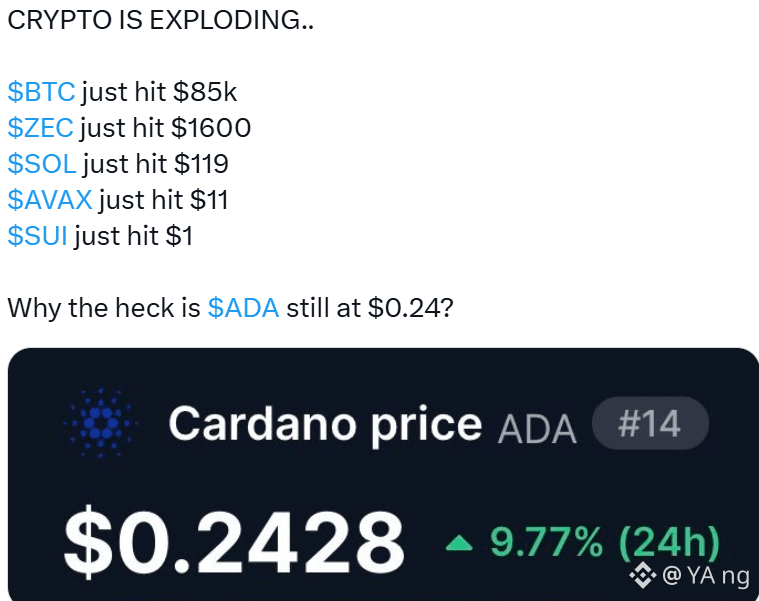
It seems like I'm not the only one who has this problem—does anyone have the answer?
It seems like I'm not the only one who has this problem—does anyone have the answer?
386
·
--
Cardano’s 12.29M #ADA Treasury Request Rejected
Cardano’s DReps declined Input Output’s funding request for Pogun, a Bitcoin $BTC DeFi project.
Key impacts
1 Impact on Cardano treasury and governance
Mostly positive: 12.29M ADA remains in the treasury and will not be converted into fiat, avoiding sell pressure. This demonstrates that decentralized governance is effective—even Input Output’s founding development company cannot automatically take community funds.
2 Potential impact on ADA demand, which may mean missing out on some BTC DeFi traffic.
Moderate to negative: The original proposal promised to return revenue to the treasury—first, 20% of profits after repaying principal, and then a permanent 5%; now that promise is gone.
3 Impact on the relationship between IO and Cardano
Going forward, IO will no longer assume Cardano is the top priority, but will deploy products on whichever blockchain is most suitable technically and commercially. This could lead to future IO new projects being spread across other chains $NIGHT
Possible next steps: At this point, there appear to be several options:
1 IO self-funding or private fundraising to continue development
In a broadcast on September 18, Hoskinson said Pogun still plans to launch in about 90 days, around mid-December; RealFi is expected to launch in October.
2 Multi-chain or non-exclusive deployment
Pogun would launch core functionality on Cardano first, while directing some traffic or variants to other chains to win support from other ecosystems.
3 Community or other funding sources
They could resubmit smaller-scale, more focused proposals, or seek joint funding from ecosystem funds, institutional investors, and partners.
4 Other avenues
On Cardano there are still other bridging, lending, or RWA-related projects in development; the broader Bitcoin ecosystem also has alternative options such as Stacks and Rootstock.
Cardano’s 12.29M #ADA Treasury Request Rejected
Cardano’s DReps declined Input Output’s funding request for Pogun, a Bitcoin $BTC DeFi project.
Key impacts
1 Impact on Cardano treasury and governance
Mostly positive: 12.29M ADA remains in the treasury and will not be converted into fiat, avoiding sell pressure. This demonstrates that decentralized governance is effective—even Input Output’s founding development company cannot automatically take community funds.
2 Potential impact on ADA demand, which may mean missing out on some BTC DeFi traffic.
Moderate to negative: The original proposal promised to return revenue to the treasury—first, 20% of profits after repaying principal, and then a permanent 5%; now that promise is gone.
3 Impact on the relationship between IO and Cardano
Going forward, IO will no longer assume Cardano is the top priority, but will deploy products on whichever blockchain is most suitable technically and commercially. This could lead to future IO new projects being spread across other chains $NIGHT
Possible next steps: At this point, there appear to be several options:
1 IO self-funding or private fundraising to continue development
In a broadcast on September 18, Hoskinson said Pogun still plans to launch in about 90 days, around mid-December; RealFi is expected to launch in October.
2 Multi-chain or non-exclusive deployment
Pogun would launch core functionality on Cardano first, while directing some traffic or variants to other chains to win support from other ecosystems.
3 Community or other funding sources
They could resubmit smaller-scale, more focused proposals, or seek joint funding from ecosystem funds, institutional investors, and partners.
4 Other avenues
On Cardano there are still other bridging, lending, or RWA-related projects in development; the broader Bitcoin ecosystem also has alternative options such as Stacks and Rootstock.
Cardano’s DReps declined Input Output’s funding request for Pogun, a Bitcoin $BTC DeFi project.
Key impacts
1 Impact on Cardano treasury and governance
Mostly positive: 12.29M ADA remains in the treasury and will not be converted into fiat, avoiding sell pressure. This demonstrates that decentralized governance is effective—even Input Output’s founding development company cannot automatically take community funds.
2 Potential impact on ADA demand, which may mean missing out on some BTC DeFi traffic.
Moderate to negative: The original proposal promised to return revenue to the treasury—first, 20% of profits after repaying principal, and then a permanent 5%; now that promise is gone.
3 Impact on the relationship between IO and Cardano
Going forward, IO will no longer assume Cardano is the top priority, but will deploy products on whichever blockchain is most suitable technically and commercially. This could lead to future IO new projects being spread across other chains $NIGHT
Possible next steps: At this point, there appear to be several options:
1 IO self-funding or private fundraising to continue development
In a broadcast on September 18, Hoskinson said Pogun still plans to launch in about 90 days, around mid-December; RealFi is expected to launch in October.
2 Multi-chain or non-exclusive deployment
Pogun would launch core functionality on Cardano first, while directing some traffic or variants to other chains to win support from other ecosystems.
3 Community or other funding sources
They could resubmit smaller-scale, more focused proposals, or seek joint funding from ecosystem funds, institutional investors, and partners.
4 Other avenues
On Cardano there are still other bridging, lending, or RWA-related projects in development; the broader Bitcoin ecosystem also has alternative options such as Stacks and Rootstock.
253
·
--
If each coin has its own narrative—for example, $ZEC with privacy and strengthened U.S. stock ETF support; and individuality, such as $SUI with high-efficiency L1, driven by its own ecosystem and trading needs.
$ADA still hasn’t reached the moment to truly showcase itself. When will we get to see it? You can only ask the whale. Besides, if big capital is unwilling to pull, it means it’s not taking a stance; you can’t attract more people’s attention. Nobody cares that the project’s funding revenue is limited. Insufficient capital means no one is willing to invest in breakthrough development. Without leading technology, you can only wait for the market to eliminate you.
Even if the founders have excellent vision and innovative ideas that are truly novel, if their votes are rejected, they can only watch other projects gradually catch up. This isn’t a question of whether they can become an industry leader anymore—it’s whether they can keep surviving in this industry, and whether the project can demonstrate its capabilities within this cycle.
If each coin has its own narrative—for example, $ZEC with privacy and strengthened U.S. stock ETF support; and individuality, such as $SUI with high-efficiency L1, driven by its own ecosystem and trading needs.
$ADA still hasn’t reached the moment to truly showcase itself. When will we get to see it? You can only ask the whale. Besides, if big capital is unwilling to pull, it means it’s not taking a stance; you can’t attract more people’s attention. Nobody cares that the project’s funding revenue is limited. Insufficient capital means no one is willing to invest in breakthrough development. Without leading technology, you can only wait for the market to eliminate you.
Even if the founders have excellent vision and innovative ideas that are truly novel, if their votes are rejected, they can only watch other projects gradually catch up. This isn’t a question of whether they can become an industry leader anymore—it’s whether they can keep surviving in this industry, and whether the project can demonstrate its capabilities within this cycle.
$ADA still hasn’t reached the moment to truly showcase itself. When will we get to see it? You can only ask the whale. Besides, if big capital is unwilling to pull, it means it’s not taking a stance; you can’t attract more people’s attention. Nobody cares that the project’s funding revenue is limited. Insufficient capital means no one is willing to invest in breakthrough development. Without leading technology, you can only wait for the market to eliminate you.
Even if the founders have excellent vision and innovative ideas that are truly novel, if their votes are rejected, they can only watch other projects gradually catch up. This isn’t a question of whether they can become an industry leader anymore—it’s whether they can keep surviving in this industry, and whether the project can demonstrate its capabilities within this cycle.
623
·
--
Verified
$ETH
This time, WMTX was mainly affected on the Ethereum side
The bridging direction is Ethereum ↔ Cardano
Issue type: the key/permission was stolen → resulting in illegal minting
As a result, a large amount of WMTX was minted on ETH, causing selling pressure
The core chain state on Cardano was not affected
Previously (NIGHT / Wanchain, around July 2026)
The main affected chain was $BNB (BSC)
The bridging direction was Cardano ↔ BNB Chain
Issue type: a signature verification vulnerability (no delimiter, allowing signatures to be reused)
As a result, about 515 million NIGHT was withdrawn from the bridge
The core chain state—Cardano / the Midnight protocol itself—was not affected
Commonality: both are risks from third-party cross-chain bridges, not a breakthrough of Cardano or any related L1’s consensus/protocol. The price crash mainly comes from the illegally newly minted or withdrawn tokens entering the market and creating selling pressure. It’s not an issue with Ada’s safety, but whoever gets hurt and bleeds is always $ADA —will you continue holding Ada?
$ETH
This time, WMTX was mainly affected on the Ethereum side
The bridging direction is Ethereum ↔ Cardano
Issue type: the key/permission was stolen → resulting in illegal minting
As a result, a large amount of WMTX was minted on ETH, causing selling pressure
The core chain state on Cardano was not affected
Previously (NIGHT / Wanchain, around July 2026)
The main affected chain was $BNB (BSC)
The bridging direction was Cardano ↔ BNB Chain
Issue type: a signature verification vulnerability (no delimiter, allowing signatures to be reused)
As a result, about 515 million NIGHT was withdrawn from the bridge
The core chain state—Cardano / the Midnight protocol itself—was not affected
Commonality: both are risks from third-party cross-chain bridges, not a breakthrough of Cardano or any related L1’s consensus/protocol. The price crash mainly comes from the illegally newly minted or withdrawn tokens entering the market and creating selling pressure. It’s not an issue with Ada’s safety, but whoever gets hurt and bleeds is always $ADA —will you continue holding Ada?
This time, WMTX was mainly affected on the Ethereum side
The bridging direction is Ethereum ↔ Cardano
Issue type: the key/permission was stolen → resulting in illegal minting
As a result, a large amount of WMTX was minted on ETH, causing selling pressure
The core chain state on Cardano was not affected
Previously (NIGHT / Wanchain, around July 2026)
The main affected chain was $BNB (BSC)
The bridging direction was Cardano ↔ BNB Chain
Issue type: a signature verification vulnerability (no delimiter, allowing signatures to be reused)
As a result, about 515 million NIGHT was withdrawn from the bridge
The core chain state—Cardano / the Midnight protocol itself—was not affected
Commonality: both are risks from third-party cross-chain bridges, not a breakthrough of Cardano or any related L1’s consensus/protocol. The price crash mainly comes from the illegally newly minted or withdrawn tokens entering the market and creating selling pressure. It’s not an issue with Ada’s safety, but whoever gets hurt and bleeds is always $ADA —will you continue holding Ada?
會,且加倉
61%
會,但不購買
15%
會,慢慢減倉
14%
這玩意兒只能待在象牙塔
10%
41 votes • Voting closed
3.7k
·
--
$ADA yesterday only in 比$SUI ,$DOGE and Ada which arrives at 250-day moving average first, the result today looks only Ada coin has not arrived yet. Currently have dot, wlfi which will arrive at the 250-day moving average first?
$ADA yesterday only in 比$SUI ,$DOGE and Ada which arrives at 250-day moving average first, the result today looks only Ada coin has not arrived yet. Currently have dot, wlfi which will arrive at the 250-day moving average first?
ADA
61%
DOT
25%
WLFI
14%
77 votes • Voting closed
5.1k
·
--
$ADA still has at least 40% upside potential. Let’s benchmark against Ethereum $ETH . Cardano hasn’t woken up yet; in the short term, if it doesn’t lag behind the pump, the price could reach 0.32–0.34. Let’s see how ADA shows itself.
No proof is also fine—after all, it’s already decided to go back and pick up $BNB (the original capital was originally BNB; later, sell BNB to buy ADA). Just watch Old Zach’s livestream from afar—no need to participate in person.
$ADA still has at least 40% upside potential. Let’s benchmark against Ethereum $ETH . Cardano hasn’t woken up yet; in the short term, if it doesn’t lag behind the pump, the price could reach 0.32–0.34. Let’s see how ADA shows itself.
No proof is also fine—after all, it’s already decided to go back and pick up $BNB (the original capital was originally BNB; later, sell BNB to buy ADA). Just watch Old Zach’s livestream from afar—no need to participate in person.
No proof is also fine—after all, it’s already decided to go back and pick up $BNB (the original capital was originally BNB; later, sell BNB to buy ADA). Just watch Old Zach’s livestream from afar—no need to participate in person.
329
·
--
massive growth coming to $BTC adoption, technology, and where trends are going quite optimistic. we'll see a billion new people and EWA $ETH of value enter the space before the end of 2030. The 4th generation is the unification of agents, privacy $NIGHT technology, smart compliance
massive growth coming to $BTC adoption, technology, and where trends are going quite optimistic. we'll see a billion new people and EWA $ETH of value enter the space before the end of 2030. The 4th generation is the unification of agents, privacy $NIGHT technology, smart compliance
112
Log in to explore more content
Join global crypto users on Binance Square
⚡️ Get latest and useful information about crypto.
💬 Trusted by the world’s largest crypto exchange.
👍 Discover real insights from verified creators.
Email / Phone number
Trending Topics
AIStocksWhatNext
910,367 views
6,721 Discussing
Share & Win Traffic Reward in our Trending Hashtag Campaign
✨Topic: What Other Investment Opportunities Remain as AI Stocks Keep Rising?
👉How to Join:
Publish a short post or article with hashtag #AIStocksWhatNext
Share whether you’re bullish or bearish, and post your AI stock holdings or trade — using the trade widget may improve your eligibility.
You can also strengthen your post by sharing data or charts, and avoiding AI-generated images.
✍️Create content based on the below angles:
- Nvidia says chip sales will double next year, and top AI companies keep hitting record revenue, the compute spend behind it is just as staggering. Is AI demand really taking off? And how long can it last? AI stocks are up across the board. Is this a real breakout, or just a short-term bounce?
- Industry leaders are calling to slow down AI development, while Trump plans to build an “AI Force”, claiming AI could account for 25% of U.S. GDP in the future. Whose side are you on? Will state-level backing be a long-term win for AI stocks?
- Are you buying AI stocks? Share your AI-related trade/holdings with our trade sharing widget.
⏰Campaign Period:
- 2026-09-22 7:00 - 2026-09-24 4:00 UTC
🎁Reward:
- Qualified posts that comply with the above guidelines and contain more than 100 words will be reviewed and may receive a random traffic boost of 500 to 3,000 views. You will receive a notification from your feed secretary if your post is selected.
- Get a chance to have your article featured on Binance Square Official
Need ideas for your post? Visit the topic page #AIStocksWhatNext or the Square Guide on How to Post for Better Reach.
Binance Square Official
·592 Likes
·1.7M views
BitcoinRejectedAt$87,300Twice
0 views
0 Discussing
BCHJumps28%OnCMEFuturesListing
13,907 views
566 Discussing