

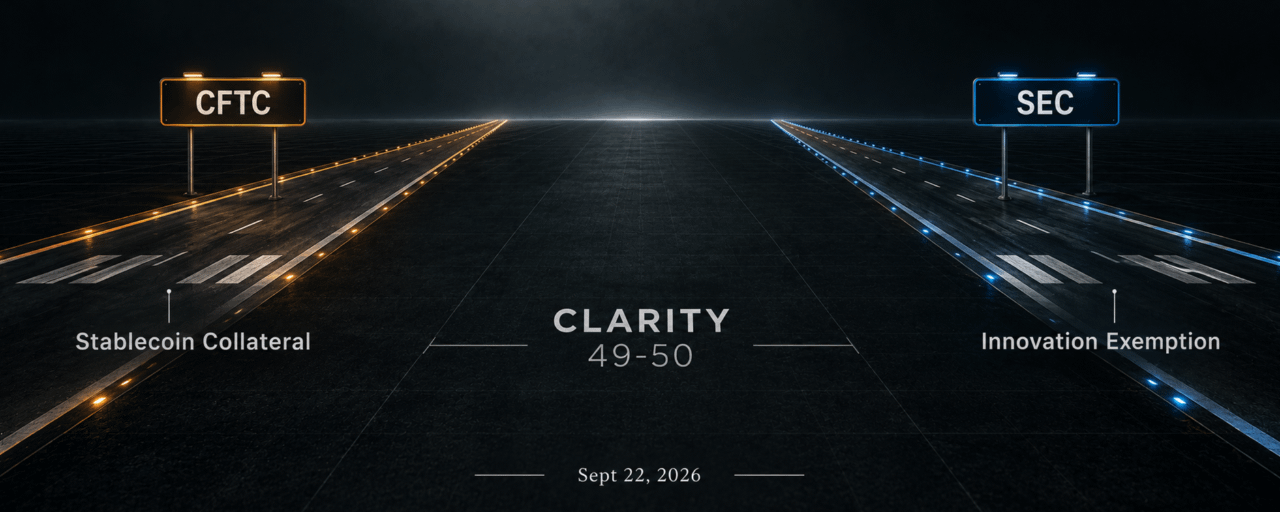

Two Regulators. Two Runways. No Congress.
Summary: CFTC Chairman calls for preparations for large-scale tokenization, while moving forward with the SEC separately; the CLARITY Act is shelved.
On September 22, CFTC Chairman Selig, in a public speech, said the U.S. needs to prepare markets for “large-scale tokenization,” adapt to new technologies such as blockchain and AI, and anticipate that changes to financial markets over the next decade will exceed the total of the past several decades.
The timing of this statement is worth noting. It has been a week since the Senate narrowly rejected the CLARITY Act with a procedural vote of 49 to 50. It has been five days since the SEC issued the “Innovation Exemptions” framework.
Two regulators, striking one after the other. Congress didn’t move.
What the CFTC has already done
Selig’s statements aren’t empty promises. This February, the CFTC already expanded the set of acceptable collateral to include stablecoins issued by national trust banks. That means that, in the CFTC-regulated derivatives markets, these stablecoins can be used as margin. It’s a specific technical arrangement, but it changes the real-world use of stablecoins in institutional trading.
Earlier on, the CFTC sought public input on 24-hour trading of energy derivatives. The “regulatory fit” Selig mentioned is, in this case, a concrete example: trading hours are no longer constrained by traditional trading days, because the underlying assets and trading technology have changed.
When regulators start using “public comment” to test new rules, they’re not waiting for legislation—they’re accumulating material for it.
Two lanes, progressing separately
Last week the SEC issued an “innovative exemption,” allowing tokenized NMS-listed stock to trade on compliant platforms, with a five-year pilot. On the CFTC side, stablecoin collateral has been put in place, 24-hour trading of energy derivatives is out for public comment, and Selig publicly called on the market to prepare for “large-scale tokenization.”
The differences between the two paths are clear: the SEC handles tokenization of securities-type assets, while the CFTC handles tokenization of derivatives and collateral. There is no formal coordination mechanism between them, but their direction is aligned.
What the CLARITY Act was originally supposed to do is to define a unified regulatory boundary for these two institutions. After the bill was shelved, each of them took one step forward within its own jurisdiction.
What’s next
The CFTC’s follow-up rule proposals. Selig’s remarks are directional; they require specific draft rules to be implemented. If the CFTC, on the basis of stablecoin collateral, further opens up derivatives trading for more tokenized assets, the width of this lane would increase significantly.
The first batch of TSV applications under the SEC’s innovation exemption. The timing of the operator notice determines how fast this lane starts. Next quarter’s data will be the first observation window.
Will the two lanes eventually converge? If tokenized stocks and tokenized derivatives involve the same underlying assets, a gray zone in the regulatory boundary will emerge. At that point, the CFTC and SEC will need to coordinate, or Congress will need to step in.
A bigger chessboard
Selig said the transformations of the next decade will exceed the total of the prior several decades. The emphasis isn’t on “a decade,” but on the “total”—meaning change won’t be linear.
After the CLARITY Act was shelved, the market initially believed that crypto regulation would enter a stall period. However, the actions by the SEC and CFTC show that progress at the executive level has not stopped. They build the infrastructure step by step within the existing legal framework, using exemptions, requests for public comment, and margin rules.
Congress’s legislation is framework-setting, while regulators’ rules are operational. When the framework isn’t in place, operational rules can run first—provided they don’t overstep their bounds.
Both lanes are moving forward now. Congress isn’t among them, but Congress’s absence itself is the background condition for this round of regulatory push.
#CFTC #SEC #tokenization #stablecoin #CLARITY Act