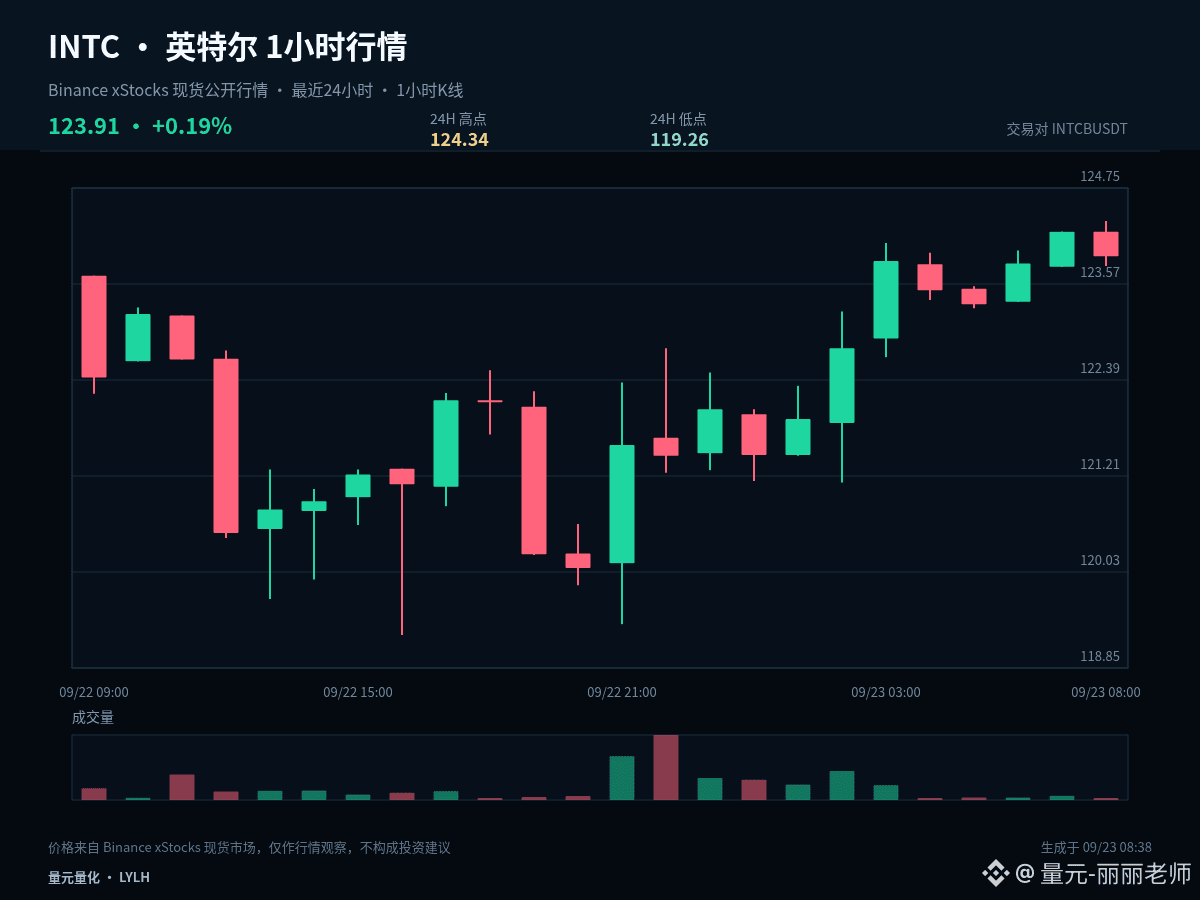
$INTCB #INTC It’s currently more suitable to first do a rebound confirmation rather than define a reversal in advance. Current price 123.91, 1 hour -0.24%, 24 hours +0.17%. Whether the two timeframes realign in the same direction is the key focus going forward.
The current price is near the upper bound of the past 24-hour volatility: 1 hour -0.24%, 24 hours +0.17%. The most important thing at the high is to confirm the market’s acceptance after a breakout. If the price can stay above the upper band, it indicates the market acknowledges a higher range; if it only briefly pierces through and quickly reclaims, you need to guard against a false breakout.
If the rebound can reclaim 121.8 and then further hold above 124.34, it suggests that buying pressure is starting to change the previous weakness. If price rises toward the midline and then falls again—especially if it drops back toward 119.26—that looks more like a failed repair, and you shouldn’t continue to rely on a bullish turnaround expectation.
Confirmation of a rebound failure also requires evidence. Don’t just chase a short because of one spike that turned into a pullback. A more reasonable sequence is to observe whether price is rejected at the resistance level, whether the lows shift downward again, and then decide your action based on whether subsequent pullbacks reclaim key levels.
Existing positions can be handled in segments around key levels to avoid making all judgments at once. If you are currently in cash, wait for confirmation of a breakout or for a pullback to stabilize. For U.S. equities/underlying assets, also watch for volatility caused by trading session transitions—your plan should be based on price conditions, not emotions.
The focus of short-term positioning isn’t to predict every single candlestick; it’s to make sure entry, trimming, and exit all have a basis. Do less until it’s confirmed; if key levels fail, redo the plan—control single-trade risk first, then talk about potential upside/downside space.
#BNBMarketCapPassesBNYMellon
The current price is near the upper bound of the past 24-hour volatility: 1 hour -0.24%, 24 hours +0.17%. The most important thing at the high is to confirm the market’s acceptance after a breakout. If the price can stay above the upper band, it indicates the market acknowledges a higher range; if it only briefly pierces through and quickly reclaims, you need to guard against a false breakout.
If the rebound can reclaim 121.8 and then further hold above 124.34, it suggests that buying pressure is starting to change the previous weakness. If price rises toward the midline and then falls again—especially if it drops back toward 119.26—that looks more like a failed repair, and you shouldn’t continue to rely on a bullish turnaround expectation.
Confirmation of a rebound failure also requires evidence. Don’t just chase a short because of one spike that turned into a pullback. A more reasonable sequence is to observe whether price is rejected at the resistance level, whether the lows shift downward again, and then decide your action based on whether subsequent pullbacks reclaim key levels.
Existing positions can be handled in segments around key levels to avoid making all judgments at once. If you are currently in cash, wait for confirmation of a breakout or for a pullback to stabilize. For U.S. equities/underlying assets, also watch for volatility caused by trading session transitions—your plan should be based on price conditions, not emotions.
The focus of short-term positioning isn’t to predict every single candlestick; it’s to make sure entry, trimming, and exit all have a basis. Do less until it’s confirmed; if key levels fail, redo the plan—control single-trade risk first, then talk about potential upside/downside space.
#BNBMarketCapPassesBNYMellon