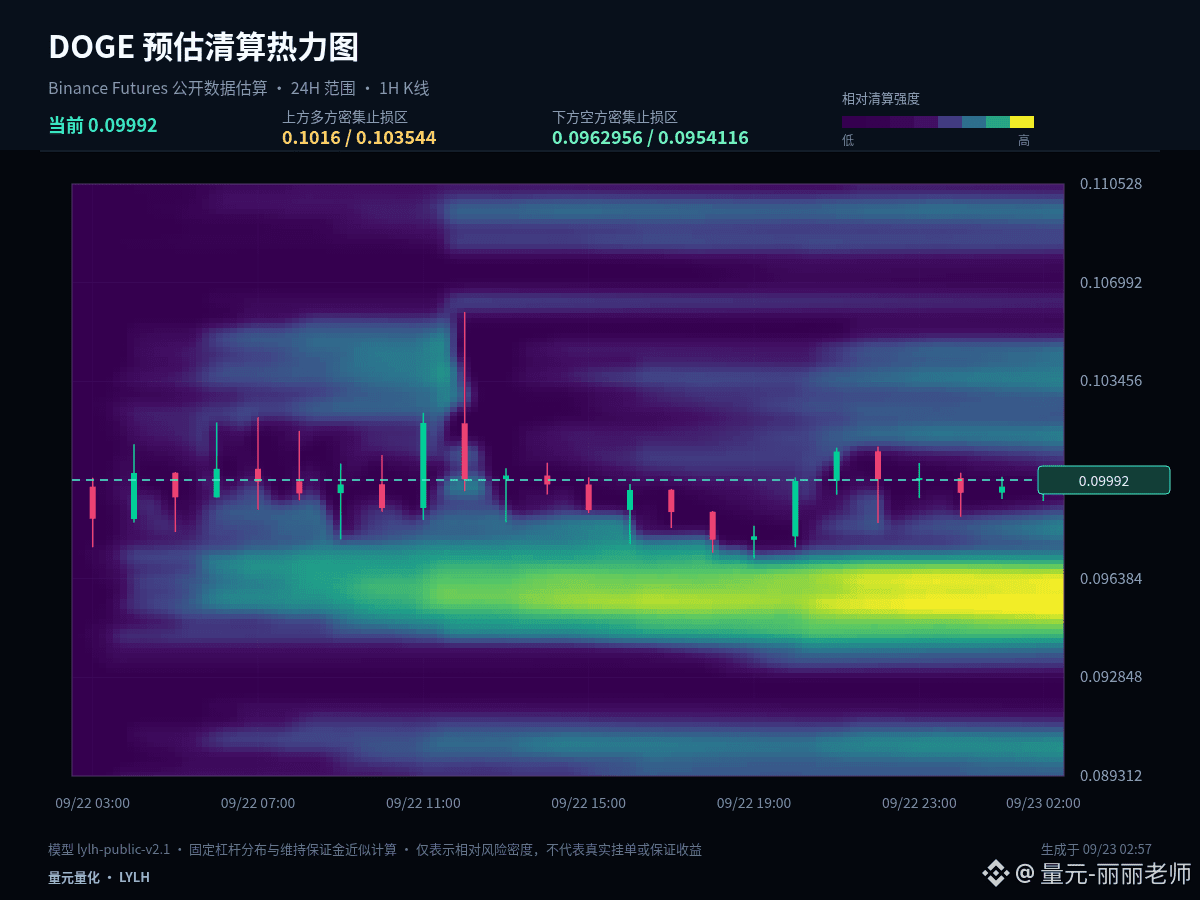
$DOGE #DOGE A clear one-way pattern has not yet formed; the 1-hour and 24-hour rhythms are still pulling against each other. In this phase, focus on the boundaries of the range, not the color of every individual candlestick.
Right now, the 1-hour is +0.24% and the 24-hour is +0.09%. The two cycles have not formed sufficiently clear directional alignment. In range-bound market conditions, the tolerance for chasing or killing the move is low. It’s more suitable to use confirmation at the upper boundary (direction) and confirmation at the lower boundary (support holding) as signals, while the midline is only used to judge relative strength/weakness.
I will take 0.101525 as the short-term long/short waterline: if it holds, it indicates the pullback is still within a controllable range, and later—if conditions allow—there may be another test of 0.10589. After a valid breakdown, don’t rush to enter; instead, wait for a new stable structure to appear near 0.09716.
There are three possible paths to handle next: if price effectively holds and stands above 0.10589, wait for a pullback that doesn’t break, then reassess whether the move can continue; if it breaks down effectively below 0.09716, prioritize controlling risk and wait for new support; if it continues to chop around 0.101525, treat it as range turnover and don’t repeatedly chase direction in the middle of the range.
For those who already have positions, the key is to manage based on whether support fails, not to be dragged around by every fluctuation. For those with no positions, prioritize waiting for a breakout and retest, or support confirmation. Spot can be scaled in batch by batch; for futures, shorten the decision chain—first determine the stop-loss level, then decide whether to participate.
Next, I will focus on tracking whether 0.101525 holds or fails. Do you lean more toward testing 0.10589 first, or returning to 0.09716 first? Feel free to share your judgment and reasoning.
#CardanoAddedToX402KitForADAPayments
Right now, the 1-hour is +0.24% and the 24-hour is +0.09%. The two cycles have not formed sufficiently clear directional alignment. In range-bound market conditions, the tolerance for chasing or killing the move is low. It’s more suitable to use confirmation at the upper boundary (direction) and confirmation at the lower boundary (support holding) as signals, while the midline is only used to judge relative strength/weakness.
I will take 0.101525 as the short-term long/short waterline: if it holds, it indicates the pullback is still within a controllable range, and later—if conditions allow—there may be another test of 0.10589. After a valid breakdown, don’t rush to enter; instead, wait for a new stable structure to appear near 0.09716.
There are three possible paths to handle next: if price effectively holds and stands above 0.10589, wait for a pullback that doesn’t break, then reassess whether the move can continue; if it breaks down effectively below 0.09716, prioritize controlling risk and wait for new support; if it continues to chop around 0.101525, treat it as range turnover and don’t repeatedly chase direction in the middle of the range.
For those who already have positions, the key is to manage based on whether support fails, not to be dragged around by every fluctuation. For those with no positions, prioritize waiting for a breakout and retest, or support confirmation. Spot can be scaled in batch by batch; for futures, shorten the decision chain—first determine the stop-loss level, then decide whether to participate.
Next, I will focus on tracking whether 0.101525 holds or fails. Do you lean more toward testing 0.10589 first, or returning to 0.09716 first? Feel free to share your judgment and reasoning.
#CardanoAddedToX402KitForADAPayments