
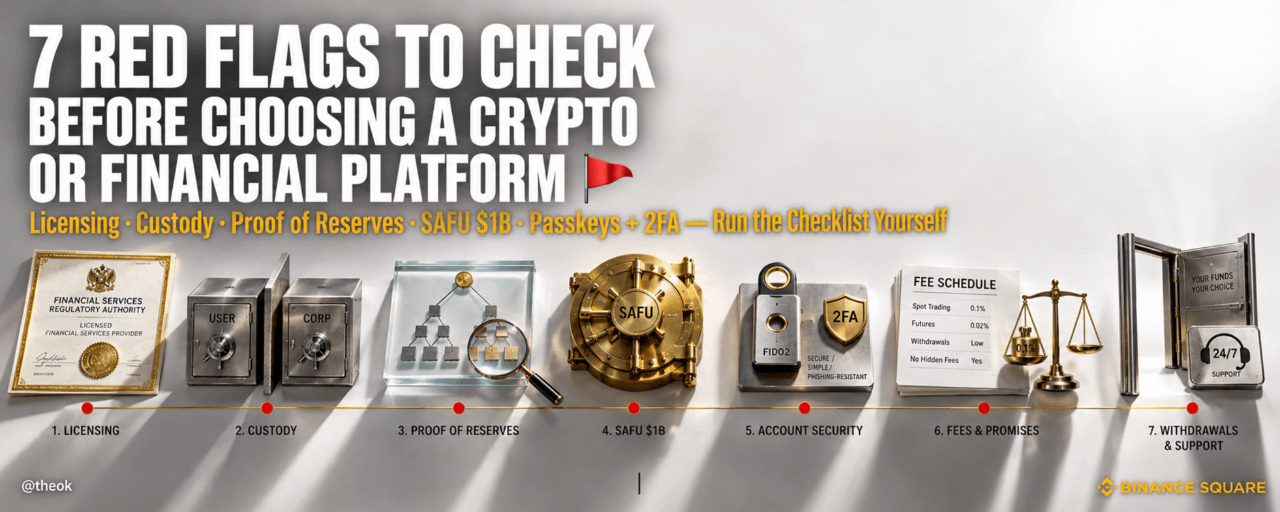

Before choosing a crypto or financial platform, check its regulatory status, security protections, custody arrangements, fee structure and withdrawal policies. Major red flags include unclear licensing, guaranteed-return claims, hidden fees, weak account controls, limited transparency, withdrawal restrictions and inaccessible customer support.
🚩 Why These Red Flags Matter More Than Ever
The crypto industry has matured. In 2026, users have real choices Binance, Coinbase, Kraken, and dozens of smaller platforms. But with choice comes risk: not every platform is built the same, and the difference between a secure, transparent, well-capitalized exchange and a poorly managed one is the difference between your money being safe and your money being gone.
The problem is that most users especially new users in emerging markets do not know what to check before depositing funds. They look at the interface, the token list, and maybe a referral bonus. They do not look at the things that actually determine whether their money is safe.
This article fixes that. Here are 7 red flags to check before you trust any crypto or financial platform with your money — and how Binance addresses each one.
🚩 Red Flag 1: Unclear Licensing or Regulatory Status
The red flag: A platform operates without clear regulatory licensing in the jurisdictions it serves. There is no information about which legal entity you are actually contracting with,or whether that entity is authorized in your country. The "About Us" page is vague. The terms of service reference a shell company in an obscure jurisdiction.
Why this matters: Without regulatory oversight, there is no accountability. If the platform mismanages funds, freezes accounts unjustly, or collapses entirely, users have no regulatory body to turn to. No license means no recourse.
What to check:
Which legal entity actually serves your account? (It is usually named in the terms of service)
Is that entity licensed or registered with a financial regulator?
Are the licenses verifiable on the regulator's official website?
Does the platform clearly state which countries it serves and under which frameworks?
How Binance addresses this:
Binance operates through a network of regulated entities across major jurisdictions including MiCA-licensed entities in the European Union, a license from the Central Bank of Bahrain, and authorizations in other regulated markets. Each entity is subject to oversight by its local regulator.
In Africa: Binance is available to users in many African countries, and local regulatory frameworks for crypto are evolving fast across the continent. Availability and authorization status vary by country Binance publishes country-specific information on binance.com, and users should always confirm which entity serves their region before depositing.
The takeaway: If a platform cannot clearly tell you who regulates it and which entity serves you, do not deposit money. A regulated platform states its licenses openly. An unclear platform hides them.
🚩 Red Flag 2: No Transparency Around Customer Assets
The red flag: A platform does not explain how customer assets are held, or whether they are separated from the platform's own operating funds. User deposits may sit in the same pool of money the platform uses for expenses, investments, and trading.
Why this matters: If customer funds are commingled with corporate funds, the platform's bankruptcy can become your bankruptcy. Your money is no longer legally yours you become an unsecured creditor standing in line. This is exactly what happened in the FTX collapse: user funds were commingled with trading capital, and when the scheme unraveled, the money was gone.
What to check:
Does the platform explicitly state that customer assets are held separately from operating funds?- Is customer custody described in clear, documented terms — or buried in vague language?
Does the platform lend out, invest, or rehypothecate user assets without explicit consent?
How Binance addresses this:
Binance holds customer assets on a 1:1 basis every user balance is backed by an equivalent amount of the actual asset, held in custody separate from Binance's corporate funds. Customer assets are not lent out, invested, or used for the platform's own operations without user consent.
This means that even in a worst-case scenario, user balances are not mixed with Binance's money. Your funds are segregated, accounted for, and verifiable which leads directly to the next red flag.
The takeaway: If a platform cannot explain in plain language how your assets are held and protected,that silence is the red flag. Transparency about custody is not optional it is the foundation of trust.
🚩 Red Flag 3: No Proof of Reserves or Verifiable Asset Information
The red flag: A platform claims to be solvent but provides no way for users to independently verify it. A press release is not proof. A screenshot is not proof. If the only evidence of solvency is the platform's own word, you are trusting a marketing claim with your money.
Why this matters: Every major exchange failure in crypto history Mt. Gox, FTX, Celsius involved platforms that claimed solvency while being insolvent. Real transparency requires cryptographic proof, not assurances.
How Binance addresses this Binance Proof of Reserves:
Binance publishes Proof of Reserves (PoR) using Merkle treecryptography. Each user's balance is included as a leaf in a Merkle tree, and Binance publishes the root hash alongside its on-chain wallet holdings. This means the total customer liabilities are mathematically verifiable — and any user can check that their own balance is included.
How to verify your own balance is included:
Log in to your Binance account and go to the Proof of Reserves page (Account → Audit → Proof of Reserves)
Select the snapshot date Binance publishes PoR at regular intervals
Generate your record Binance computes a unique cryptographic hash (leaf) for your account balance at that snapshot
Verify use Binance's built-in verification tool (or a third-party Merkle validator) to confirm your hash is included in the published Merkle root5. Done if your leaf is in the tree, your balance was counted in the reserves. The math either adds up or it does not and you checked it yourself.
The takeaway: Proof of Reserves turns "trust us" into "verify yourself." If a platform does not offer it or offers only unaudited statements that is a red flag you should not ignore.
🚩 Red Flag 4: No Emergency Fund
The red flag: A platform has no dedicated emergency fund to protect users in case of a breach, hack, or catastrophic event. If something goes wrong, the plan is "we will figure it out" and users absorb the loss.
Why this matters: Even the best security practices cannot reduce risk to zero. A platform without a financial buffer is asking users to carry 100% of the tail risk.
How Binance addresses this SAFU:
Binance maintains the SAFU (Secure Asset Fund for Users) a dedicated emergency insurance fund, currently valued at over US$1 billion, held in separate cold wallets and used solely to protect users in extreme situations.
The takeaway: An emergency fund is not marketing it is a balance sheet commitment. Ask any platform: "How much do you hold to protect users if something goes wrong?" If there is no clear answer, that is your answer.
🚩 Red Flag 5: Weak Account-Security Controls
The red flag: A platform offers only basic username-and-password login. No 2FA options, no phishing protection, no withdrawal controls. The security model is "pick a strong password and hope."
Why this matters: The most common way users lose funds is not a platform hack it isaccount takeover through phishing, SIM swaps, credential stuffing, and social engineering. Strong account controls make these attacks ineffective.
How Binance addresses this — four tools that matter:
Passkeys (FIDO2/WebAuthn): The strongest authentication method available. Cryptographic keys stored on your device immune to phishing, SIM swaps, and credential theft. Your authentication never leaves your device.
Two-factor authentication (2FA): Binance supports authenticator-app based 2FA, which is far stronger than SMS-based codes. Certain sensitive actions (withdrawals, API key creation) require it.
Anti-phishing codes: You set a personal code that appears in every legitimate Binance email. If an email does not show your code, it is not from Binance phishing attempts become instantly visible.
Withdrawal allowlisting: You can lock withdrawals to pre-approved wallet addresses only. Even if an attacker gains access to your account, they cannot send funds anywhere but your own whitelisted wallets.
The takeaway: In 2026, the minimum standard for any serious platform is passkeys, 2FA, anti-phishing codes, and withdrawal controls. If a platform does not offer all four, your account is one phishing email away from being drained.
🚩 Red Flag 6: Guaranteed-Return Claims and Hidden Fees
The red flag: A platform promises guaranteed yields ("20% APY, risk-free!") or hides its true costs behind opaque spreads, surprise charges, and vague pricing.
Why this matters: Guaranteed returns do not exist in finance every yield carries risk, andplatforms that promise otherwise are either misleading you or funding old deposits with new ones (the Ponzi pattern). Hidden fees are the quieter version of the same problem: you think you are paying one price, but the real cost is buried in spreads and conditions.
What to check:
Does the platform promise returns that sound too good to be true?
Is the fee schedule published, complete, and easy to find?
Are conversion spreads, withdrawal fees, and inactivity charges disclosed upfront?
How Binance addresses this:
Binance publishes its complete fee schedule publicly — spot trading from 0.1% (lower with BNB discounts), P2P trading free, zero-spread USDC/USD conversion absorbed by Binance. And critically: Binance does not promise guaranteed returns. Products carry risk disclosures,and users are expected to understand what they are buying before they buy it.
The takeaway: A platform that promises you cannot lose is a platform that has already decided what to tell you. Transparency about fees — and honesty about risk — are non-negotiable.
🚩 Red Flag 7: Withdrawal Restrictions and Inaccessible Customer Support
The red flag: A platform makes it hard to get your money out — sudden withdrawal "maintenance," unexpected delays, new conditions appearing when you try to cash out. And when you contact support, nobody answers.
Why this matters: The ability to withdraw is the ultimate test of a platform's health. Restrictions that appear exactly when users try to leave are the classic warning sign of a platform in trouble. And support that disappears whenyou need it most turns a bad situation into an impossible one.
What to check:
Are withdrawal policies clear, published, and consistent?
Are there restrictions that only appear when you attempt a withdrawal?
Is customer support reachable 24/7 — and does it actually resolve issues?
How Binance addresses this:
Binance maintains clear, published withdrawal policies with transparent network fees and processing standards. Security features like withdrawal allowlisting and withdrawal lock are user-controlled — they exist to protect you, not to trap you. And Binance provides 24/7 customer support in multiple languages, because problems do not keep business hours.
The takeaway: Test the exit before you need it. A small test withdrawal early on tells you more about a platformthan any marketing page ever will.
✅ The 7-Point Checklist Evaluate Any Platform in 5 Minutes
Licensing Is the legal entity and its regulator clearly identified? If no → red flag.
Custody transparency Are customer assets segregated from operating funds? If unclear → red flag.
Proof of Reserves Can you cryptographically verify your own balance? If no → red flag.
Emergency fund Is there a dedicated fund protecting users? If no → red flag.
Account security Passkeys, 2FA, anti-phishing codes, withdrawal allowlisting? If missing → red flag.
Fees and promises Published fees, no guaranteed returns? If opaque → red flag.
Withdrawals and support Clear exit policies, reachable support? If restricted → red flag.
If a platformfails even one check, ask why. If it fails two or more, do not deposit money.
🌍 Why This Matters Especially in Africa
For users in Africa where regulatory consumer protection is often weaker and recourse after platform failure is limited these seven checks are not optional. You cannot always rely on a local regulator to recover your funds if a platform collapses. The only protection that works is choosing a platform that has built its own: regulated entities, segregated custody, verifiable Proof of Reserves, a billion-dollar emergency fund, and account controls that put you in charge.
Binance passes all seven checks. That is not marketing it is a checklist you can run yourself, right now.
Relevant FAQs
Is Binance regulated in Africa?
Binance is available to users across many African countries, and it operates globally through regulated, licensed entities including MiCA-licensed entities in the European Union and a license from the Central Bank of Bahrain, among others. In Africa specifically, crypto regulation varies widely by country, and Binance's local status depends on each country's framework, which continues to evolve. The right step is to check binance.com for country-specific availability and the entity that serves your region. This is also good practice for any platform: always verify the legal entity and its authorization before depositing funds.
How do I know if Binance is Safe?
Judge it by the same seven checks this article describes: Binance operates through regulated entities, holds customer assets 1:1 in segregated custody, publishescryptographic Proof of Reserves that users can verify individually, maintains SAFU — an emergency fund currently valued at over US$1 billion — and provides passkeys, 2FA, anti-phishing codes, and withdrawal allowlisting at the account level. Safety is not a promise; it is a set of verifiable practices. Binance's approach is built so users can check each one themselves rather than take the platform's word for it.
How does Binance protect customer assets?
Binance holds customer assets on a 1:1 basis, segregated from corporate operating funds user balances are backed by equivalent actual assets and are not lent out or used for Binance's own operations without consent. This is verified through regular Proof of Reserves publications using Merkle tree cryptography, where each user can confirm their own balanceis included. On top of the custody framework, SAFU a dedicated emergency fund of over US$1 billion held in separate cold wallets provides a financial backstop for users in extreme events.
What is Binance Proof of Reserves?
Binance Proof of Reserves (PoR) is a cryptographic system that lets users independently verify that their balances are included in Binance's total reserves. Binance builds a Merkle tree from all user balances, publishes the root hash, and allows each user to generate their own leaf hash from their account (via Account → Audit → Proof of Reserves) and confirm it is part of the published tree. This means the platform's customer liabilities are mathematically verifiable not just asserted in a statement. It transforms solvency from a matter of trust into a matter ofmath.
📌 Sources: Binance Proof of Reserves official page; Binance SAFU documentation; Binance security features official page; Binance fee schedule; Binance regulatory information.
⚠️ Educational content only. Availability of Binance products and services depends on user region and eligibility. This checklist is a general guide and does not guarantee the safety of any platform. Always do your own research. Does not constitute financial advice.