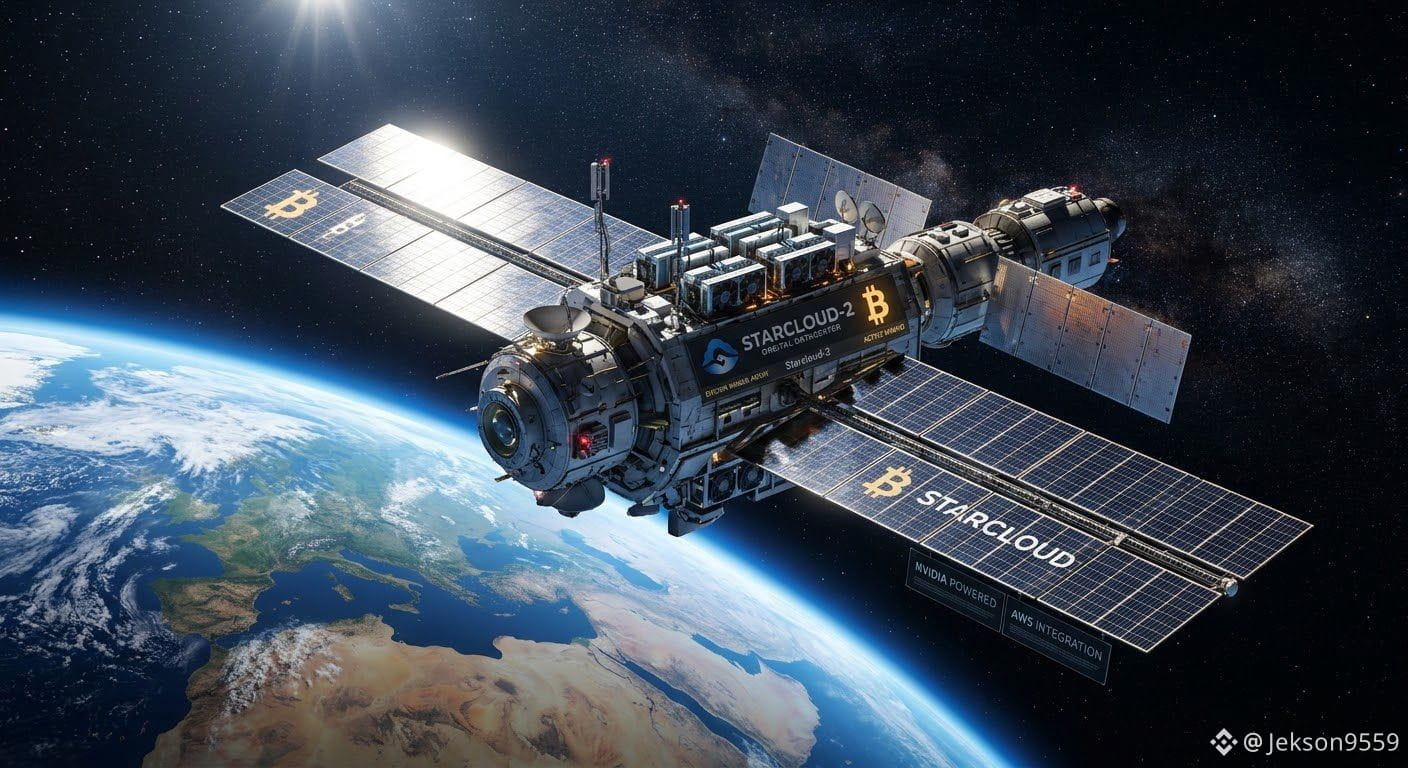
Startup Starcloud (with the support of Nvidia and Cisco) is preparing for the first-ever Bitcoin mining in open space using the Starcloud-2 satellite.
Why space?
Infinite energy: In a Sun-synchronous orbit, solar panels receive light 24/7 — without night, clouds, or atmospheric losses.
Ecology and resources: Mining consumes ~20 GW on Earth. Moving computing to orbit will relieve the power grids.
Cheap proving ground: ASIC chips cost about $1,000 per kW (significantly cheaper than AI chips), making BTC an ideal test for the first space data centers.
The main challenge — cooling
In a vacuum, there is no air, so fans or liquid systems don’t work. All heat from the hot chips will be dissipated solely through giant infrared radiators.
If successful, Starcloud plans to deploy a 5 GW orbital constellation for mining and artificial intelligence computing.#btc $NVDAB
Why space?
Infinite energy: In a Sun-synchronous orbit, solar panels receive light 24/7 — without night, clouds, or atmospheric losses.
Ecology and resources: Mining consumes ~20 GW on Earth. Moving computing to orbit will relieve the power grids.
Cheap proving ground: ASIC chips cost about $1,000 per kW (significantly cheaper than AI chips), making BTC an ideal test for the first space data centers.
The main challenge — cooling
In a vacuum, there is no air, so fans or liquid systems don’t work. All heat from the hot chips will be dissipated solely through giant infrared radiators.
If successful, Starcloud plans to deploy a 5 GW orbital constellation for mining and artificial intelligence computing.#btc $NVDAB