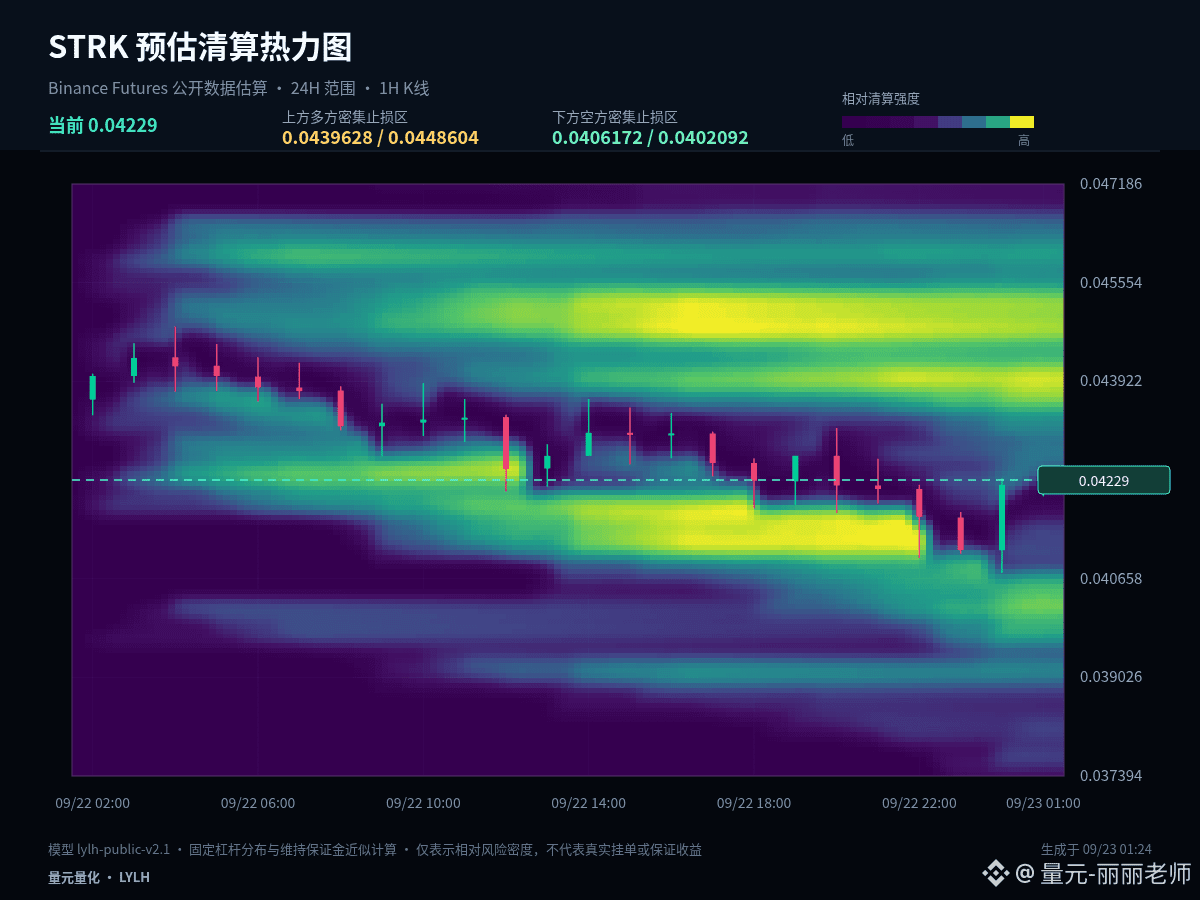
$STRK #STRK A clear one-sided trend has not yet formed; the 1-hour and 24-hour rhythms are still tugging at each other. In this phase, focus on the boundaries of the range rather than the color of every single candlestick.
Currently, the 1-hour is +0.12% and the 24-hour is -3.23%. The two cycles have not yet established sufficiently clear alignment in the same direction. In range-bound markets, the tolerance for chasing and killing is lower. It’s more suitable to use confirmation at the upper boundary for direction, confirmation at the lower boundary for support/absorption, while treating the midline as only a line dividing strength and weakness.
For key price levels: 0.04284 is the current structural midline and the first standard for judging whether a pullback is healthy. As long as price can remain stably above it, the bulls still retain initiative. Above that, first look toward 0.04481. If price falls back below the midline, attention should shift to the second support/absorption at 0.04087.
Execution requires clear conditions. After a breakout above 0.04481, you need confirmation—don’t chase just because of a momentary surge. After dipping to 0.04087, you need to see whether price can quickly reclaim—don’t buy just because you see the drop. If the middle zone doesn’t offer sufficient odds, waiting itself is also part of the strategy.
Position sizing should distinguish between spot and contracts. Existing spot holdings can be managed in segments around key levels, without frequently flipping bias due to one 1-hour candlestick. Staying in cash and waiting for confirmation, then entering in batches, is more comfortable.
Contracts place greater emphasis on the entry location and invalidation conditions. When volatility expands, proactively reduce position size to avoid turning short-term judgment into passive holding.
The key focus with contracts is not to predict every single candlestick. Instead, ensure there is a basis for entry, trimming, and exit. Do less without confirmation; if a key level fails, redo the plan. First control single-trade risk, then talk about upside space.
#CardanoAddedToX402KitForADAPayments
Currently, the 1-hour is +0.12% and the 24-hour is -3.23%. The two cycles have not yet established sufficiently clear alignment in the same direction. In range-bound markets, the tolerance for chasing and killing is lower. It’s more suitable to use confirmation at the upper boundary for direction, confirmation at the lower boundary for support/absorption, while treating the midline as only a line dividing strength and weakness.
For key price levels: 0.04284 is the current structural midline and the first standard for judging whether a pullback is healthy. As long as price can remain stably above it, the bulls still retain initiative. Above that, first look toward 0.04481. If price falls back below the midline, attention should shift to the second support/absorption at 0.04087.
Execution requires clear conditions. After a breakout above 0.04481, you need confirmation—don’t chase just because of a momentary surge. After dipping to 0.04087, you need to see whether price can quickly reclaim—don’t buy just because you see the drop. If the middle zone doesn’t offer sufficient odds, waiting itself is also part of the strategy.
Position sizing should distinguish between spot and contracts. Existing spot holdings can be managed in segments around key levels, without frequently flipping bias due to one 1-hour candlestick. Staying in cash and waiting for confirmation, then entering in batches, is more comfortable.
Contracts place greater emphasis on the entry location and invalidation conditions. When volatility expands, proactively reduce position size to avoid turning short-term judgment into passive holding.
The key focus with contracts is not to predict every single candlestick. Instead, ensure there is a basis for entry, trimming, and exit. Do less without confirmation; if a key level fails, redo the plan. First control single-trade risk, then talk about upside space.
#CardanoAddedToX402KitForADAPayments