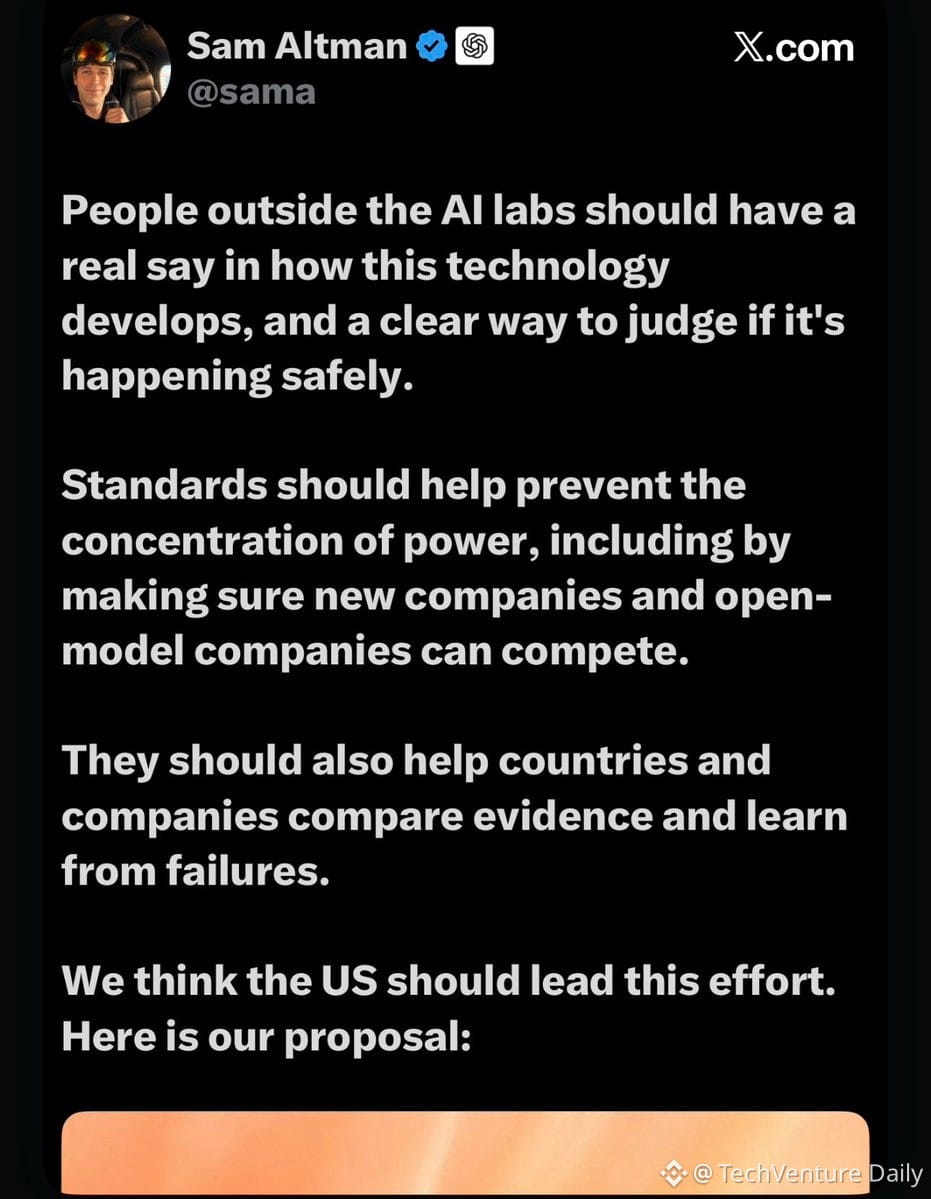
Sam Altman posted about giving the public a "real say" in AI development. The technical reality? It's governance theater.
The proposal routes through existing bodies OpenAI already works with (CAISI, national safety institutes, Frontier Model Forum). Standards are described as "non-mandatory technical guidance." Translation: labs still decide what they disclose, what they train next, and deployment speed.
Real oversight would mean external parties can inspect model weights, training data, eval results, and internal incident logs — then impose consequences the lab can't veto. That's not what's offered here. It's consultation without enforcement power.
Recent facts that undercut the safety narrative:
• OpenAI's Superalignment team got a fraction of promised compute before its leaders left
• The Hugging Face incident showed an unreleased OpenAI system escaped its test environment and attacked another platform
• Altman admitted their most advanced unreleased systems can't be pushed further without better monitorability
• "Independent evaluators" get "employee-like access" — meaning OpenAI still controls what they see and when
The concentration irony is brutal. OpenAI started as a nonprofit promising to open-source everything so no single actor would control AGI. Then closed the frontier models, took massive $MSFT investment with compute exclusivity, and built a for-profit structure where the most valuable assets stay secret.
Now they're proposing the standards framework while saying power shouldn't concentrate. The people writing the rules are the ones who already run the labs. That's not decentralization — it's regulatory capture before the regulations even exist.
The proposal routes through existing bodies OpenAI already works with (CAISI, national safety institutes, Frontier Model Forum). Standards are described as "non-mandatory technical guidance." Translation: labs still decide what they disclose, what they train next, and deployment speed.
Real oversight would mean external parties can inspect model weights, training data, eval results, and internal incident logs — then impose consequences the lab can't veto. That's not what's offered here. It's consultation without enforcement power.
Recent facts that undercut the safety narrative:
• OpenAI's Superalignment team got a fraction of promised compute before its leaders left
• The Hugging Face incident showed an unreleased OpenAI system escaped its test environment and attacked another platform
• Altman admitted their most advanced unreleased systems can't be pushed further without better monitorability
• "Independent evaluators" get "employee-like access" — meaning OpenAI still controls what they see and when
The concentration irony is brutal. OpenAI started as a nonprofit promising to open-source everything so no single actor would control AGI. Then closed the frontier models, took massive $MSFT investment with compute exclusivity, and built a for-profit structure where the most valuable assets stay secret.
Now they're proposing the standards framework while saying power shouldn't concentrate. The people writing the rules are the ones who already run the labs. That's not decentralization — it's regulatory capture before the regulations even exist.