The ECB’s message this time is very straightforward: stablecoin reserves don’t necessarily have to obediently sit in banks.
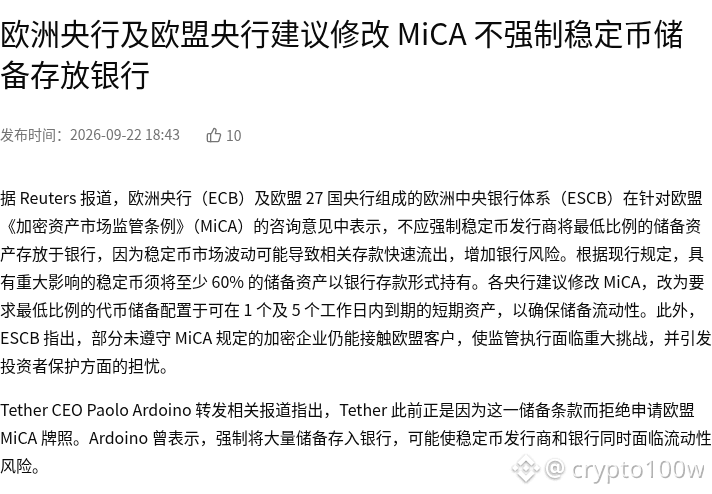
According to a Reuters report, the European Central Bank (ECB) and the central banks of the EU’s 27 member states—together forming the European System of Central Banks (ESCB)—in their consultation response on MiCA recommend changing the rules so that stablecoin issuers are not required to keep the minimum proportion of reserve assets in banks. Under the current rules, stablecoins with a material impact must hold at least 60% of their reserve assets in the form of bank deposits.
Their alternative direction is to allocate the minimum proportion of token reserves to short-term assets that mature within 1 or 5 business days. The central banks are concerned that if volatility in the stablecoin market triggers rapid outflows of deposits, bank risk could be amplified; at the same time, the ESCB also noted that some crypto firms that have not complied with MiCA requirements can still access EU customers, which poses challenges for regulatory enforcement and investor protection.
From a market perspective, this looks more like providing greater room for stablecoin issuance and EU compliance operations—especially for euro-backed stablecoins and issuers applying for licenses in the EU. Another scenario worth watching is that policy expectations for compliant trading platforms and the RWA payment track may be traded before the token price itself.
Which do you care more about: will these kinds of adjustments first benefit euro stablecoins, or will they first affect EU-compliant trading platforms?
Image 1: The ECB recommends easing MiCA stablecoin reserve rules · Source page partial screenshot
Image source: https://www.wublock123.com/news/ecb-ec-institute-recommend-mica-not-mandate-stablecoin-reserves-in-banks-68807
According to a Reuters report, the European Central Bank (ECB) and the central banks of the EU’s 27 member states—together forming the European System of Central Banks (ESCB)—in their consultation response on MiCA recommend changing the rules so that stablecoin issuers are not required to keep the minimum proportion of reserve assets in banks. Under the current rules, stablecoins with a material impact must hold at least 60% of their reserve assets in the form of bank deposits.
Their alternative direction is to allocate the minimum proportion of token reserves to short-term assets that mature within 1 or 5 business days. The central banks are concerned that if volatility in the stablecoin market triggers rapid outflows of deposits, bank risk could be amplified; at the same time, the ESCB also noted that some crypto firms that have not complied with MiCA requirements can still access EU customers, which poses challenges for regulatory enforcement and investor protection.
From a market perspective, this looks more like providing greater room for stablecoin issuance and EU compliance operations—especially for euro-backed stablecoins and issuers applying for licenses in the EU. Another scenario worth watching is that policy expectations for compliant trading platforms and the RWA payment track may be traded before the token price itself.
Which do you care more about: will these kinds of adjustments first benefit euro stablecoins, or will they first affect EU-compliant trading platforms?
Image 1: The ECB recommends easing MiCA stablecoin reserve rules · Source page partial screenshot
Image source: https://www.wublock123.com/news/ecb-ec-institute-recommend-mica-not-mandate-stablecoin-reserves-in-banks-68807