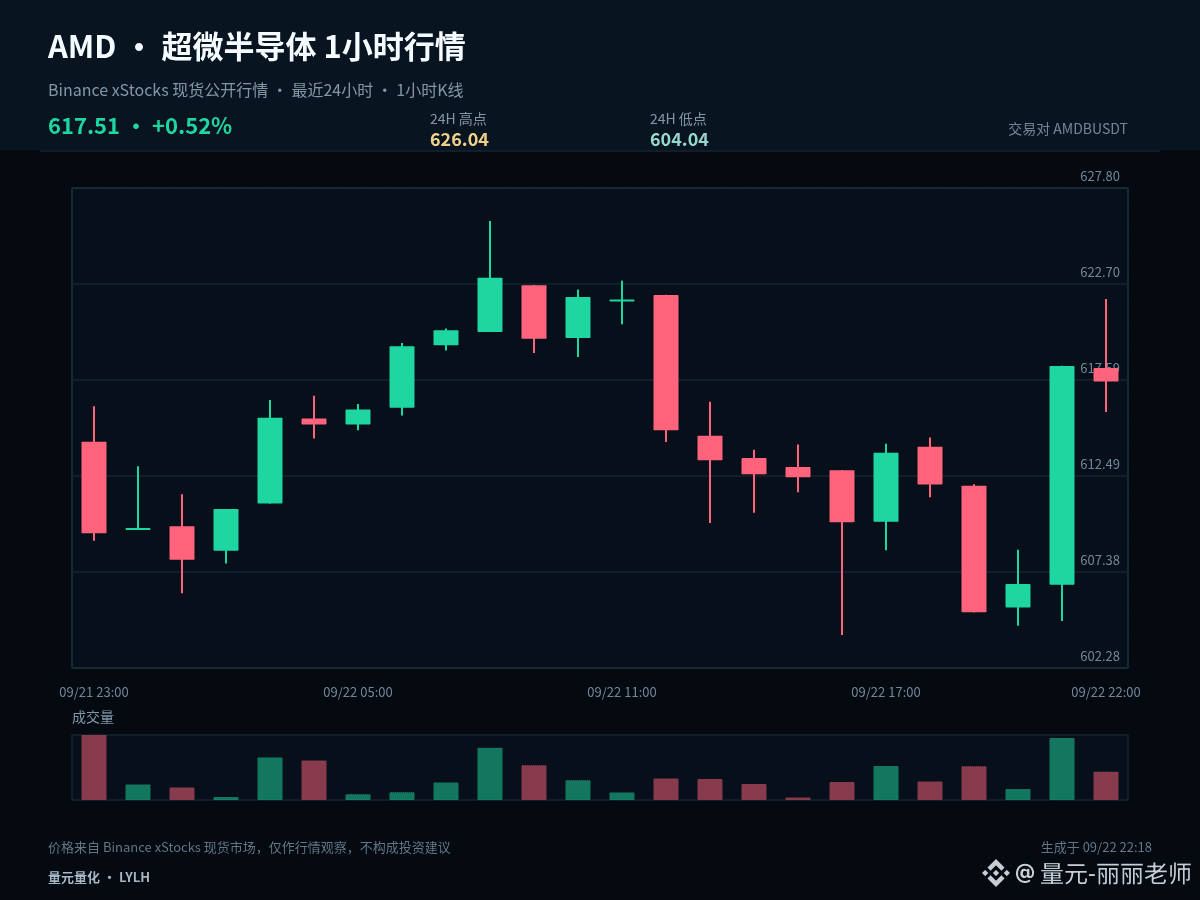
$AMDB #AMD Market snapshot record: current price 617.51, 1 hour -0.13%, 24 hours +1.14%, and the amplitude over the past 24 hours is about 3.6%. First, write down the data and your judgment at this moment; later we’ll validate it with the price action.
$AMDB #AMD has not formed a clear one-way trend yet; the rhythm of the 1-hour and 24-hour charts is still in conflict. In this phase, focus on the boundaries of the range rather than the color of each individual candlestick.
For key price levels: 615.04 is the mid-axis that must be reclaimed for a weak recovery to be considered meaningful. If price cannot stand back above it, the rebound should be treated as a technical correction. Below, 604.04 still has a possibility of being tested again; only after reclaiming the mid-axis do we have the right to further observe 626.04.
There are three ways forward: if price effectively holds above 626.04, wait for a pullback that doesn’t break and then reassess whether the move can continue; if it breaks down below 604.04, prioritize risk control and wait for new support; if it continues to range around 615.04, treat it as a range rotation—don’t chase a direction repeatedly in the middle of the range.
When reviewing afterward, I will check three things: how price reacts when it first approaches the key level, whether the 1-hour close completes the confirmation, and whether adjustments are made according to the plan after the judgment is invalidated. Compared with merely recording outcomes, these three points reveal execution issues more effectively.
A trading plan must include invalidation conditions. Even when a judgment is correct, it can be realized in segments; when it’s wrong, you must allow yourself to exit—don’t use averaging-in to cover the fact that the original logic has changed. The market will update, and your viewpoint should adjust in line with price evidence.
#CardanoAddedToX402KitForADAPayments
$AMDB #AMD has not formed a clear one-way trend yet; the rhythm of the 1-hour and 24-hour charts is still in conflict. In this phase, focus on the boundaries of the range rather than the color of each individual candlestick.
For key price levels: 615.04 is the mid-axis that must be reclaimed for a weak recovery to be considered meaningful. If price cannot stand back above it, the rebound should be treated as a technical correction. Below, 604.04 still has a possibility of being tested again; only after reclaiming the mid-axis do we have the right to further observe 626.04.
There are three ways forward: if price effectively holds above 626.04, wait for a pullback that doesn’t break and then reassess whether the move can continue; if it breaks down below 604.04, prioritize risk control and wait for new support; if it continues to range around 615.04, treat it as a range rotation—don’t chase a direction repeatedly in the middle of the range.
When reviewing afterward, I will check three things: how price reacts when it first approaches the key level, whether the 1-hour close completes the confirmation, and whether adjustments are made according to the plan after the judgment is invalidated. Compared with merely recording outcomes, these three points reveal execution issues more effectively.
A trading plan must include invalidation conditions. Even when a judgment is correct, it can be realized in segments; when it’s wrong, you must allow yourself to exit—don’t use averaging-in to cover the fact that the original logic has changed. The market will update, and your viewpoint should adjust in line with price evidence.
#CardanoAddedToX402KitForADAPayments