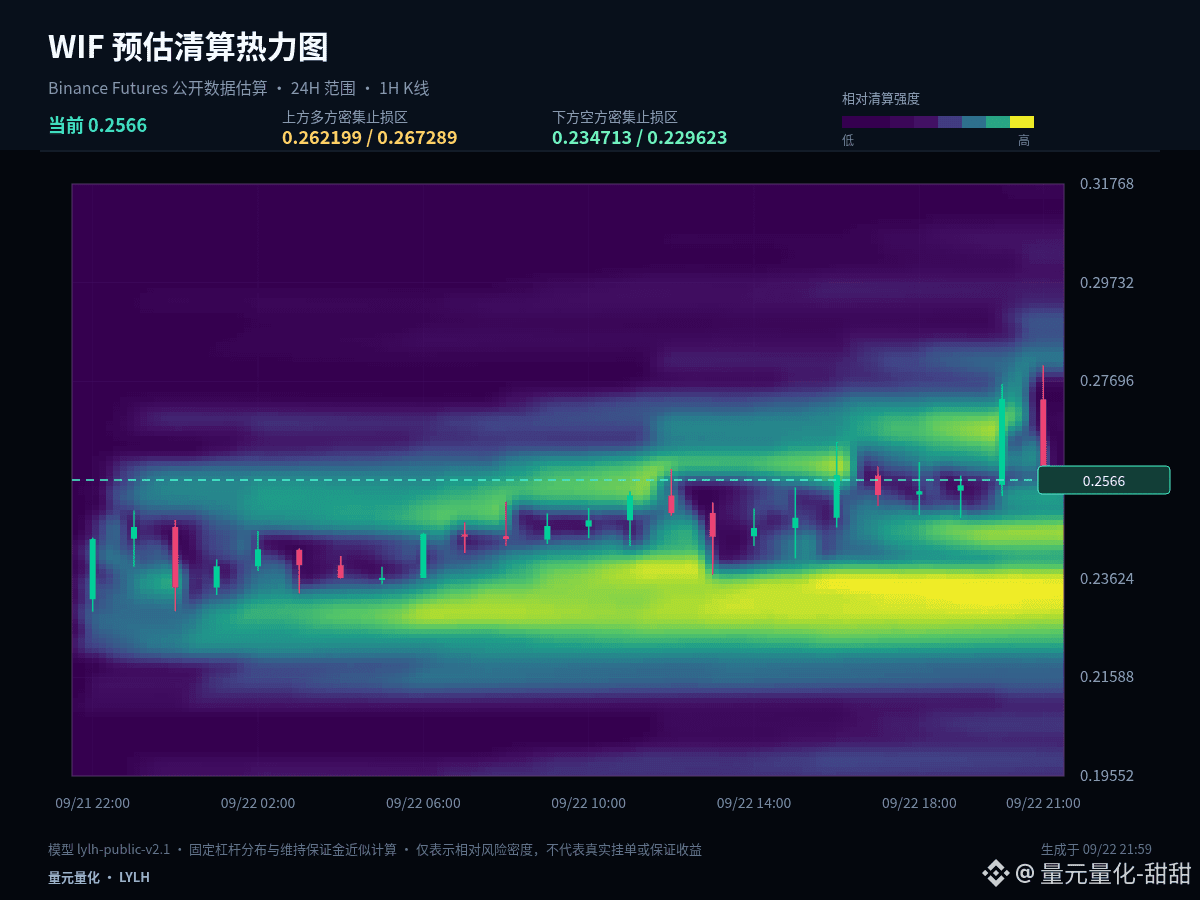
$WIF #WIF Record an intraday viewpoint: current price 0.257, 1-hour -5.96%, 24-hour +10.8%, and the high-low swing over the past 24 hours is about 19.6%.
In terms of cycle relationships, the 1-hour -5.96% is weaker than the 24-hour +10.8%, meaning short-term risk is concentrating in and releasing. To judge whether selling pressure is truly bottoming out, you can’t just look at a single rebound candlestick—you need to watch whether the lows stop making lower lows, whether the rebound can reclaim the midline, and whether sell pressure further amplifies when price revisits support.
The three price levels we should monitor together are: the midline at 0.2549, the confirmation level above at 0.2801, and the defensive support level below at 0.2297. The midline determines short-term initiative, while the upper and lower boundaries determine whether the market has truly exited the prior volatility range.
My scenario analysis isn’t a single-direction bet. If price breaks above 0.2801 and can hold, it means upside room has been reopened; if it breaks below 0.2297 and fails to rebound, it means the structure is weakening further; if it ranges between the two, then continue observing closes on either side of the 0.2549 midline.
For those with existing positions, the key is managing based on whether support has invalidated—not getting dragged along by every fluctuation. For those currently in cash, prioritize waiting for a breakout-and-retest or a confirmation of support. Spot positions can be scaled in batches; for futures, you should shorten the decision chain: first set the stop-loss location, then decide whether to participate.
Risk control still comes before the conclusion: execute only when conditions appear, and re-evaluate promptly if the price action proves invalid. The greater the volatility, the more you should restrain the size of each position. The above is an intraday projection based on the current 1-hour and 24-hour data, and it does not constitute any promise of returns.
Next, I will focus on tracking whether 0.2549 holds or fails. Do you lean more toward testing 0.2801 first, or returning to 0.2297 first? Feel free to share your view and reasoning.
#MuseOvertakesChatGPTAsTopFreeIOSApp
In terms of cycle relationships, the 1-hour -5.96% is weaker than the 24-hour +10.8%, meaning short-term risk is concentrating in and releasing. To judge whether selling pressure is truly bottoming out, you can’t just look at a single rebound candlestick—you need to watch whether the lows stop making lower lows, whether the rebound can reclaim the midline, and whether sell pressure further amplifies when price revisits support.
The three price levels we should monitor together are: the midline at 0.2549, the confirmation level above at 0.2801, and the defensive support level below at 0.2297. The midline determines short-term initiative, while the upper and lower boundaries determine whether the market has truly exited the prior volatility range.
My scenario analysis isn’t a single-direction bet. If price breaks above 0.2801 and can hold, it means upside room has been reopened; if it breaks below 0.2297 and fails to rebound, it means the structure is weakening further; if it ranges between the two, then continue observing closes on either side of the 0.2549 midline.
For those with existing positions, the key is managing based on whether support has invalidated—not getting dragged along by every fluctuation. For those currently in cash, prioritize waiting for a breakout-and-retest or a confirmation of support. Spot positions can be scaled in batches; for futures, you should shorten the decision chain: first set the stop-loss location, then decide whether to participate.
Risk control still comes before the conclusion: execute only when conditions appear, and re-evaluate promptly if the price action proves invalid. The greater the volatility, the more you should restrain the size of each position. The above is an intraday projection based on the current 1-hour and 24-hour data, and it does not constitute any promise of returns.
Next, I will focus on tracking whether 0.2549 holds or fails. Do you lean more toward testing 0.2801 first, or returning to 0.2297 first? Feel free to share your view and reasoning.
#MuseOvertakesChatGPTAsTopFreeIOSApp