Retail revolution: harvesting dog chasers—if you don't make big money, you blame me, Episode 3
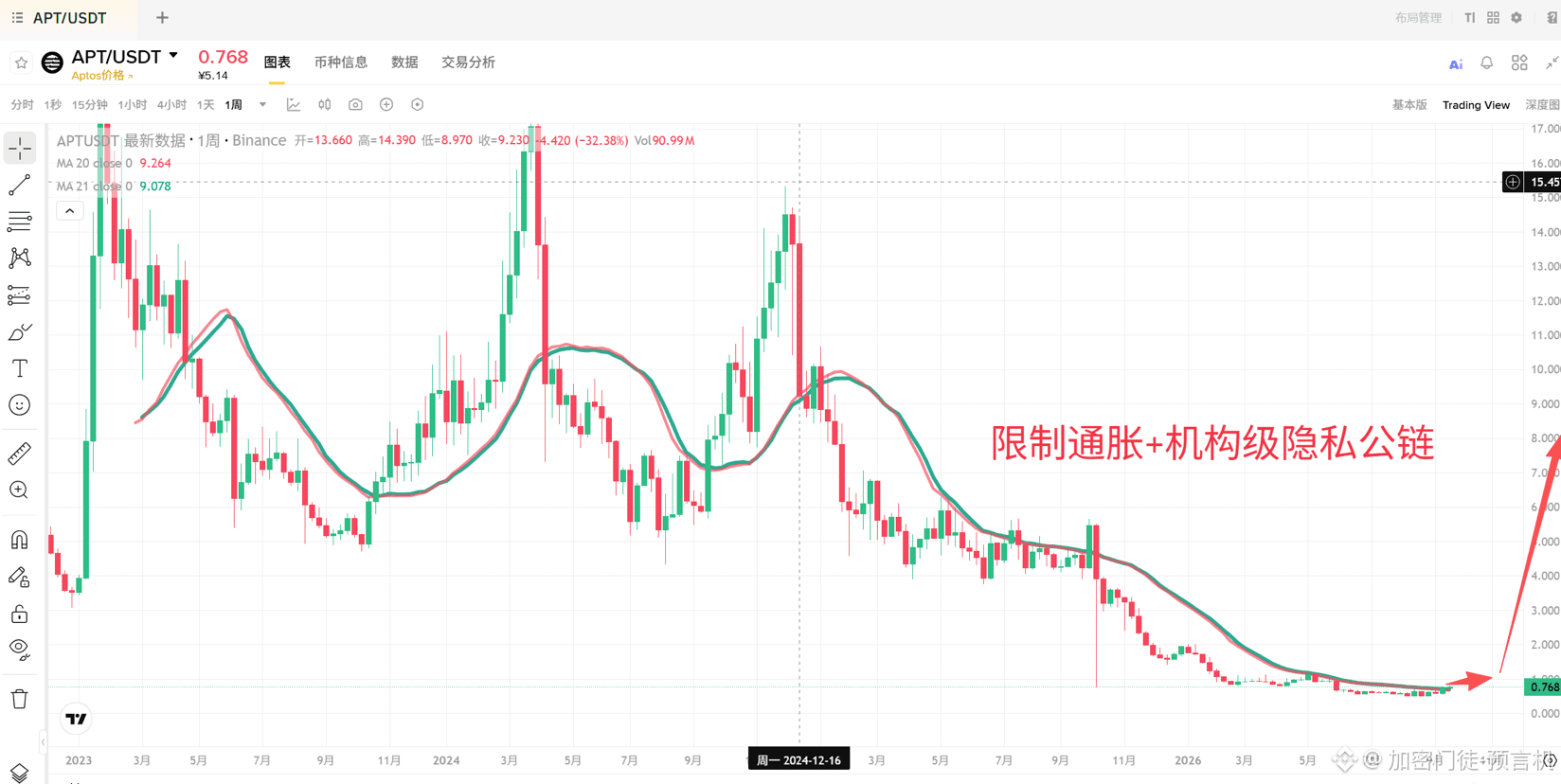
$APT has long-term line potential for a breakout.
The core isn’t just a simple lagged pump in privacy coins; it’s that the fundamentals are clearly changing: inflation is being constrained + increased burning + a hard supply cap + moving toward institutional-grade compliant privacy.
After privacy assets like ZEC have already surged significantly, the market may start looking for the next batch of privacy + financial infrastructure targets.
1. A new transformation: APT begins shifting to an institutional-grade privacy chain
First is the token economic model. APT is moving away from its former high-emission pattern toward:
Reducing new issuance + increasing Gas burn + enforcing a hard supply cap.
It reduces future additional APT while improving the long-term supply structure by increasing burning through on-chain usage.
2. APT begins to solve the privacy problem for institutional onboarding.
One of the biggest issues with traditional public chains is excessive transparency. In the future, banks, funds, and market makers moving large amounts of assets on-chain won’t be willing to disclose balances, trade amounts, and the movement of funds in full.
APT’s Confidential APT focuses on: hiding sensitive financial information while preserving selective disclosure and auditing capability. This is also its biggest difference from ZEC:
ZEC does “privacy money”—protecting who sends money to whom, and how much is transferred.
APT does “privacy financial infrastructure”—protecting business confidentiality while serving stablecoins, DEXs, RWA, and institutional finance.
In the future, when traditional assets move on-chain at scale, what may be needed won’t be absolute transparency, and not absolute anonymity either, but:
Transparency + privacy + audibility.
So APT isn’t trying to become the second ZEC; it’s competing for a bigger market: becoming the privacy layer for future institutional on-chain finance.
3. The capital lineup behind it:
A16z, Jump Crypto, Binance Labs (now YZi Labs), Multicoin, Coinbase Ventures, Circle Ventures, Franklin Templeton, Apollo, Dragonfly, Tiger Global, ParaFi, Hashed, Paxos, and more.
So what’s truly worth researching about APT now isn’t simply an oversold rebound at the bottom; it’s: an established L1 that the market has overlooked, while simultaneously rebuilding its token economic model and its institutional privacy narrative.
The same-type backers were hyping SUI last year, and this year and next year they’re hyping APT.
Is there no one to lift my ambition to the clouds? I’ll climb to the mountaintop myself, stepping through the snow.
#aptos #比特币突破5月高点逼近8.6万美元 $BTC $SUI
$APT has long-term line potential for a breakout.
The core isn’t just a simple lagged pump in privacy coins; it’s that the fundamentals are clearly changing: inflation is being constrained + increased burning + a hard supply cap + moving toward institutional-grade compliant privacy.
After privacy assets like ZEC have already surged significantly, the market may start looking for the next batch of privacy + financial infrastructure targets.
1. A new transformation: APT begins shifting to an institutional-grade privacy chain
First is the token economic model. APT is moving away from its former high-emission pattern toward:
Reducing new issuance + increasing Gas burn + enforcing a hard supply cap.
It reduces future additional APT while improving the long-term supply structure by increasing burning through on-chain usage.
2. APT begins to solve the privacy problem for institutional onboarding.
One of the biggest issues with traditional public chains is excessive transparency. In the future, banks, funds, and market makers moving large amounts of assets on-chain won’t be willing to disclose balances, trade amounts, and the movement of funds in full.
APT’s Confidential APT focuses on: hiding sensitive financial information while preserving selective disclosure and auditing capability. This is also its biggest difference from ZEC:
ZEC does “privacy money”—protecting who sends money to whom, and how much is transferred.
APT does “privacy financial infrastructure”—protecting business confidentiality while serving stablecoins, DEXs, RWA, and institutional finance.
In the future, when traditional assets move on-chain at scale, what may be needed won’t be absolute transparency, and not absolute anonymity either, but:
Transparency + privacy + audibility.
So APT isn’t trying to become the second ZEC; it’s competing for a bigger market: becoming the privacy layer for future institutional on-chain finance.
3. The capital lineup behind it:
A16z, Jump Crypto, Binance Labs (now YZi Labs), Multicoin, Coinbase Ventures, Circle Ventures, Franklin Templeton, Apollo, Dragonfly, Tiger Global, ParaFi, Hashed, Paxos, and more.
So what’s truly worth researching about APT now isn’t simply an oversold rebound at the bottom; it’s: an established L1 that the market has overlooked, while simultaneously rebuilding its token economic model and its institutional privacy narrative.
The same-type backers were hyping SUI last year, and this year and next year they’re hyping APT.
Is there no one to lift my ambition to the clouds? I’ll climb to the mountaintop myself, stepping through the snow.
#aptos #比特币突破5月高点逼近8.6万美元 $BTC $SUI